

🪨 Lead-in
Have you ever seen or heard of runes?
Some people may already feel close to them and have been using them for a long time.
Others may have only encountered the word in passing — or perhaps not at all.
I came across runes while exploring symbols from different cultures, drawn by the way meaning can be carried not only through words, but through shapes and signs.
It happened around the same time I encountered oracle cards, and out of curiosity, I began reading, learning, and quietly experimenting with them on my own.
Historically, runes were carved into stone, wood, and objects.
In rune stones and other inscriptions, we often find names, brief messages, or markings intended to preserve memory and meaning — traces of a person, a relationship, or an important moment in life.
Because of this background, working with runes can feel quite different from oracle or tarot cards.
They are not always gentle or encouraging in tone.
Some runes clearly point to pause, resistance, or stagnation, which makes the way a question is asked especially important.
Rather than using them only for readings, I keep a few runes I feel drawn to displayed among my spiritual tools.
Just as some people find comfort and grounding in holding stones or crystals, runes can be touched, seen, and lived with — allowing a quiet relationship to form over time.
Like many symbolic tools, their depth unfolds naturally.
By using them for purposes that feel right to you — protection, focus, intention, or reflection — a personal connection often begins to grow on its own.

🔮 A Brief History of Runes
Runes are among the earliest known writing systems of Northern Europe,
used across parts of the Germanic world from the first centuries CE.
Unlike later alphabets designed for long texts, runic inscriptions were often brief.
They were carved into stone monuments, wood, tools, weapons, and personal objects — materials meant to endure daily life or the passage of time.
Archaeological findings and surviving rune stones show that runes were used to record names, relationships, and short messages, as well as to mark moments intended to be remembered.
Some inscriptions appear commemorative, others practical, and some seem to carry ritual or symbolic meaning, reflecting a worldview where language, memory, and intention were closely intertwined.
Because carving runes required effort and time, the act itself held significance.
To inscribe a rune was not simply to write, but to leave a trace — of presence, memory, or meaning — fixed into physical form.
As writing systems evolved and cultural shifts took place, runes gradually fell out of everyday use.
Yet their symbolic power remained, preserved in artifacts, folklore, and later interpretations that continue to inspire interest today.
🌟 Runes as Symbols: Meaning Beyond Language
Runes are not only letters or historical artifacts.
Each rune also carries a symbolic quality — a direction rather than a definition.
Instead of expressing complex ideas through sentences, runes work through essence.
A single shape may point to movement, protection, disruption, growth, delay, or flow.
Because of this, their meanings are often felt as much as they are understood.
Unlike modern systems that aim for clarity and reassurance, runes can be direct and uncompromising.
Some symbols speak of resistance, pause, or limitation, reminding us that not all guidance is meant to comfort — some is meant to clarify.
This is why intention and question-setting are especially important when working with runes.
Rather than asking for simple encouragement or prediction, they respond best to open, reflective questions — ones that invite awareness instead of certainty.
Over time, many people find that certain runes begin to feel familiar.
A symbol may repeatedly draw attention, evoke emotion, or resonate without clear reason.
These moments are often the beginning of a personal relationship with the rune, where meaning deepens through experience rather than explanation.
In this way, runes function less as answers and more as mirrors —
reflecting states of energy, inner movement, and the quiet truths that words sometimes miss.
🌟 Examples of Rune Meanings
While interpretations can vary by tradition and personal experience,
certain runes are commonly associated with particular qualities or states.
Here are a few well-known examples, shown simply as reference points.
✧ Runes Often Associated with Support or Movement
ᚠ Fehu
Often linked to resources, flow, and nourishment — not only material wealth, but energy that moves and circulates.
It can suggest beginnings, exchange, or something that wants to grow when cared for properly.
ᚱ Raidho
Commonly associated with movement, journeys, and alignment.
It may point to progress, travel, or finding the right rhythm rather than rushing forward.
✧ Runes That Point to Pause or Stagnation
ᚾ Nauthiz
Frequently interpreted as necessity, constraint, or friction.
Rather than punishment, it often highlights areas where patience, adjustment, or inner work is required.
ᛁ Isa
Associated with ice, stillness, and suspension.
It can indicate a temporary freeze — a time when action is limited and waiting becomes part of the process.
✧ A Gentle Reminder
These meanings are not fixed rules.
Runes do not describe good or bad outcomes in simple terms —
they reflect conditions, movements, and underlying energies.
A rune associated with pause may be offering protection through stillness,
while one linked to movement may ask for responsibility as well as courage.
Over time, meanings deepen through use, reflection, and personal connection.
🧿 Runes as Talismans
Runes have long been associated not only with reading or interpretation,
but also with being carried, placed, or lived with as symbols of intention.
Creating a rune talisman does not require special tools or elaborate rituals.
What matters most is clarity of purpose and a quiet sense of respect.
You might begin by choosing one or two runes that resonate with the intention you wish to support —
protection, focus, transition, grounding, or inner strength.
Rather than seeking the “best” rune, it is often more meaningful to notice which symbol draws your attention naturally.
A talisman can be made in many simple ways:
- drawn on paper or cloth
- carved or written on a small piece of wood
- placed beside a stone, crystal, or natural object
- kept on an altar or among personal spiritual tools
Once created, the talisman does not need constant activation or repetition.
Simply keeping it nearby — seen, touched, or remembered — allows the intention to stay present.
Some people choose to revisit their talisman from time to time,
adjusting or releasing it when the purpose has been fulfilled.
Others keep the same rune for years, allowing its meaning to shift as life changes.
In this way, a rune talisman becomes less about control
and more about companionship — a quiet reminder of what you are choosing to hold and honor.
🌠Bind Runes and Traditional Talismans
Beyond single runes, some traditions describe the use of bind runes —
symbols created by combining two or more runes into a single form.
In a reference book I read, Hajimete no Rune Uranai (A Beginner’s Guide to Rune Reading はじめてのルーン占い), bind runes are introduced as talismanic symbols rather than tools for prediction.
They are described as ways of layering intention, often used for protection, focus, or support in daily life.
The same book also introduces runes that were traditionally treated as protective signs or charms, used as talismans rather than written messages.
These symbols were drawn, carved, or carried with care,
not to force outcomes, but to hold intention and meaning close.
In addition to books, similar interpretations can be found across many online sources.
While details and explanations vary, the shared understanding is that these symbols were meant to be lived with —
as visual reminders, companions, or markers of intention.
For this reason, when working with bind runes or talismanic symbols today,
it is often enough to choose one or two runes that clearly resonate,
allowing simplicity and clarity to guide the design.
🧿 Making Your Own Rune Talisman
✧ Trying It Yourself: A Simple Bind Rune Example
After seeing traditional examples, I tried drawing a simple bind rune myself,
using existing rune symbols described in reference books.
This example combines runes commonly associated with
“gift” and “words,” and is often interpreted as a symbol for inviting good fortune.

Another example combines runes associated with
“human” and “words,” which is commonly linked to wisdom or understanding.

Once created, a rune talisman does not need to be used in a fixed way.
It can be kept in a wallet, slipped into a planner or notebook,
placed on a desk or shelf, or simply displayed in a space where it feels right.
What matters is not where it is kept,
but whether it remains a gentle reminder of intention
in the flow of daily life.
✧ Using Runes as Wearable Talismans
Some people choose to carry rune symbols as wearable talismans,
such as pendants or charms.
Whether hand-made or crafted by others,
these objects serve as quiet reminders of intention,
rather than tools meant to create specific outcomes.
While writing this section, I also came across a few visual examples of rune symbols
used as talismans.
They are shared here simply as references — not as instructions —
to show how rune symbols are sometimes expressed in physical form.

A rune formula carved on black stone,
often introduced as a talisman associated with good fortune and abundance.

Vegvísir, often described as a runic compass.
In some reference books, it is introduced as a protective talisman
meant to help one find the way.
🕊 Kaha’s Note
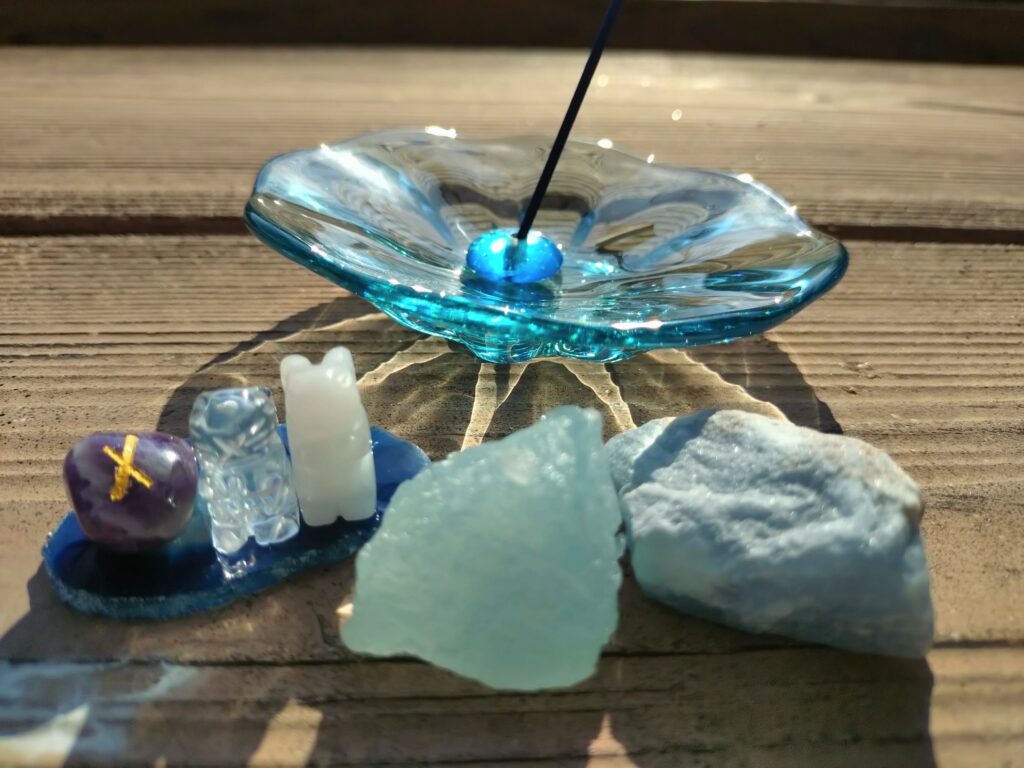
The two rabbit-shaped crystals, purchased in Izumo and associated with purification and inspiration, are displayed alongside the other stones.
I don’t see runes — or any spiritual tools — as something that can be used lightly or without care.
They feel deep, layered, and personal.
At the same time, I believe they are meant to be explored gently, through reading, trying, and experiencing them in ways that feel natural to each person.
Over time, through use and reflection, these tools begin to feel like one’s own.
Connection grows through experience rather than rules.
During the new moon oracle reading for the 20th,
I placed an amethyst rune associated with “gift” beside the cards,
with the intention that the message itself might reach everyone as a gift.
I quietly asked for support and clarity so that this intention could be held throughout the reading.
I currently work mainly with two kinds of rune stones: amethyst and lapis lazuli,
and I use them differently depending on the moment.
For me, amethyst feels closely connected to inspiration, intuition, and inner insight.
Lapis lazuli, on the other hand, feels grounding and protective,
and I often carry it as a talisman when traveling.
Rather than fixing their roles permanently,
I let my intention guide how I work with them.
By choosing what feels right in each situation,
a relationship with the runes gradually forms.
Soon after I received both stones,
I visited a sacred place and gently purified them with shrine water.
At that time, I asked that they might become tools
for connecting with my higher self and supportive higher energies.
In the end, I feel that what matters most is not correctness, but sincerity —
approaching these symbols with respect, curiosity,
and trust in one’s own experience.
🌿 Explore More
If you’d like to explore more reflections on symbols, nature, and spiritual journeys,
you’re always welcome to return home.

コメント