

✨ Lead-in
The Mandala has long been a symbol of balance, wholeness, and spiritual clarity.
Rooted in Eastern traditions, it invites us inward—to reflect, realign, and rediscover our path.
The Mandala Chart draws inspiration from this sacred form.
Born in Japan, it brings the essence of the mandala into daily life—offering a simple yet profound structure to help us turn quiet intention into meaningful action.
Before we manifest, there is a meeting.
Between our dreams and our hands.
Between what we sense, and what we choose.
The Mandala Chart invites that meeting.
It begins with a simple square.
Nine boxes, placed with quiet intent.
But within them—movement, vision, direction.
The Mandala Chart was first developed in Japan in the 1980s by Yasuo Matsumura, a business consultant who sought to help people clarify their goals and navigate complexity with calm focus.
It was shaped by a culture that listens inwardly—
where simplicity holds depth, and form reveals intention.
One of the most well‑known examples comes from Shohei Ohtani, a Japanese baseball player now thriving in the U.S.
As a high school student, he used a Mandala Chart to map out his dream:
to be drafted as a top pick by eight professional teams.
This piece isn’t about performance.
It’s about vision.
And about choosing to make space
for what truly matters—within you.
The Mandala Chart is not a method.
It is a mirror.
And perhaps, a doorway.
🌐A Deeper Order: Inspired by the Kongokai Mandala
The traditional Mandala Chart sequence—from A to H—is not arbitrary.
It reflects the sacred spatial arrangement found in the Kongokai Mandala (Diamond Realm Mandala), one of the two central mandalas in esoteric Buddhism.
At the heart of this mandala is Dainichi Nyorai (Vairocana Buddha), representing the cosmic center—the source of all wisdom, presence, and clarity.
From this still center, radiating in all directions, are manifestations of enlightened qualities and actions.
This same structure is mirrored in the Mandala Chart:
the center square holds your core theme, much like Dainichi Nyorai sits at the center of the Kongokai.
Surrounding it are eight supporting aspects—each aligned with and emanating from the center.
The layout order—A (bottom), B (left), C (top), D (right), and then E–H in diagonals—follows this sacred geometry, inviting your reflections to unfold in harmony with a deeper wisdom.
While you’re free to explore your chart intuitively,
honoring this sequence offers not just clarity—but alignment with a centuries-old contemplative tradition.
The Mandala Chart is more than a planning tool.
It is a subtle echo of sacred structure—a quiet map of intention and awakening.
⭐What is the Mandala Chart?
🚩A Japanese Method for Vision and Structure
The Mandala Chart is a simple framework for vision and structure.
Nine squares. One in the center, surrounded by eight.
That’s all it needs to begin.
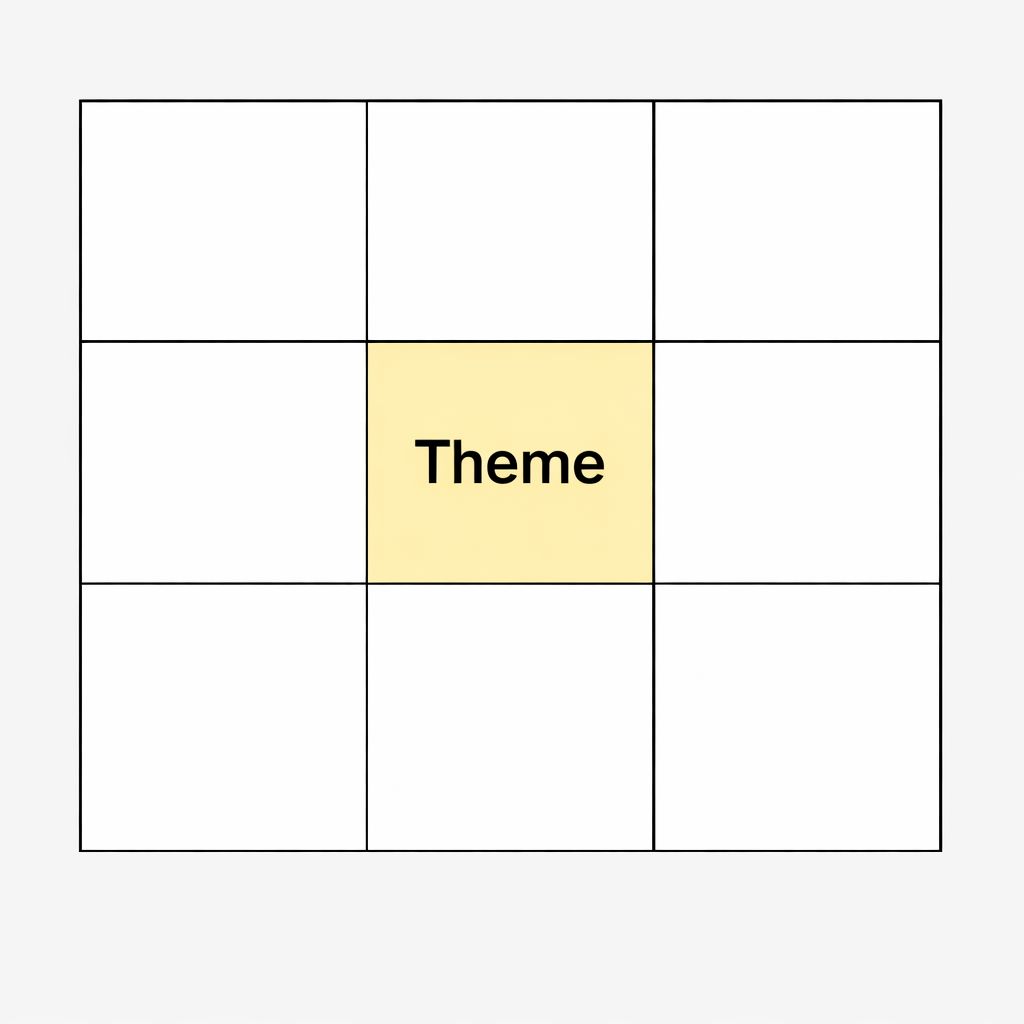
In the center, you write your core theme—your intention, dream, or goal.
Around it, you add eight related elements.
They might be qualities, actions, resources, or reminders.
Each supports the center. Each reveals a part of the path.
Though it looks like a simple diagram, the Mandala Chart carries the spirit of the mandala—a symbol of wholeness, balance, and harmony.
It reflects a way of seeing the world from the inside out.
This method has since been used not only in professional settings,
but also in personal reflection, creative work, and spiritual practice.
His central theme—“Top draft pick by 8 teams”—sat in the middle.
Around it, he placed essential areas like strength training, control, communication, mental clarity, and gratitude.
Each area was then expanded with clear, practical steps.
From bodywork to picking up trash,
his chart blended ambition with humility, clarity with character.
His example is featured in the Japanese book
“Yume o Kanaeru Mandala Chart: Kyoi no 9-Masu Shikouhou” (The Mandala Chart That Makes Dreams Come True: The Remarkable 9-Box Thinking Method),
published by Takarajimasha.
This isn’t just a planning tool.
It’s a way of meeting your dream with care.
One square at a time.
🌞How to Use the Mandala Chart
Start with a quiet moment.
A breath. A pause. A space to begin.
Take a blank Mandala Chart.
Nine squares. The center is your beginning.
In that center box, write your core theme.
This could be a goal, a question, a feeling, or a dream.
It doesn’t have to be perfect. Just true.
Once you’ve named your theme,
look at the eight surrounding boxes.
Ask yourself:
What supports this?
What do I need to develop it?
What qualities, actions, or conditions will help it grow?
There are no wrong answers.
These outer boxes can be as grounded as “daily routine” or as abstract as “trust.”
Some people include values like “discipline” or “curiosity.”
Others might list concrete actions like “write every morning” or “reach out to a mentor.”
You are mapping what your theme is made of—what holds it, nourishes it, and brings it closer.
You can stop here—and already have a clear, visual representation of your dream.
But if you want to go deeper, you can expand each of the outer boxes into their own Mandala Charts.
This creates a larger structure of clarity and action—
not just a picture of what you want, but a pathway for how to move toward it.
🌿 Your First Chart: A Simple Example to Try
Here is a sample Mandala Chart based on a real exercise from a Japanese book on this method.
The central theme is “Clarify My Future Vision”—a question many of us hold quietly within.
Each surrounding box invites reflection from a different angle.
You don’t need to fill it all at once.
Just sitting with one or two questions can begin to open something.
📋 Mandala Chart Example: Clarify My Future Vision
| F Who benefits from your presence, and how? | C What is your personal or professional catchphrase? | G What helps you stay connected to your vision? |
| B How are you contributing to the world? | 🎯Theme: Clarify My Future Vision | D What is your core guiding word or keyword? |
| E What values do you and your team share? | A Who do you want to be in 10 years? | H What legacy will you leave in 100 years? |
🖼️ (You can also draw this by hand or print it out as a journaling template.)
✨ This example is adapted from a page in a Japanese book I found deeply inspiring.
The book offers many possible themes—not just long-term visions like this one,
but also short-term goals such as “lose 10kg,” “pass an exam,”
“run more meaningful meetings,” or “grow a successful business.”
It can be used for personal growth, creative goals, or even within teams and organizations.
Whether your intention is internal or external, short-term or lifelong,
the structure helps bring it into form.
👉 If you’d like to try this practice yourself, you’re warmly invited to create your own Mandala Chart.
Let it be gentle, intuitive, and yours.
In traditional Mandala Chart structure, each of the surrounding boxes is labeled from A to H and filled out in a specific sequence.
This reflects the flow of energy in Buddhist mandalas—from the center outward, following a sacred order.
But this is your chart.
You may begin wherever inspiration strikes.
If one question calls to you more strongly than the others, start there.
Let the structure guide you—but not confine you.
🌟What a Mandala Chart looks like
⚾ Shohei Ohtani’s Mandala Chart (High School Version) — English Breakdown
Below is an English interpretation of Shohei Ohtani’s high school Mandala Chart.
At the center is his core dream — being selected as the #1 pick by eight teams.
Each surrounding block (A–H) represents a key area of development, with supporting elements that defined how he approached that part of his growth.
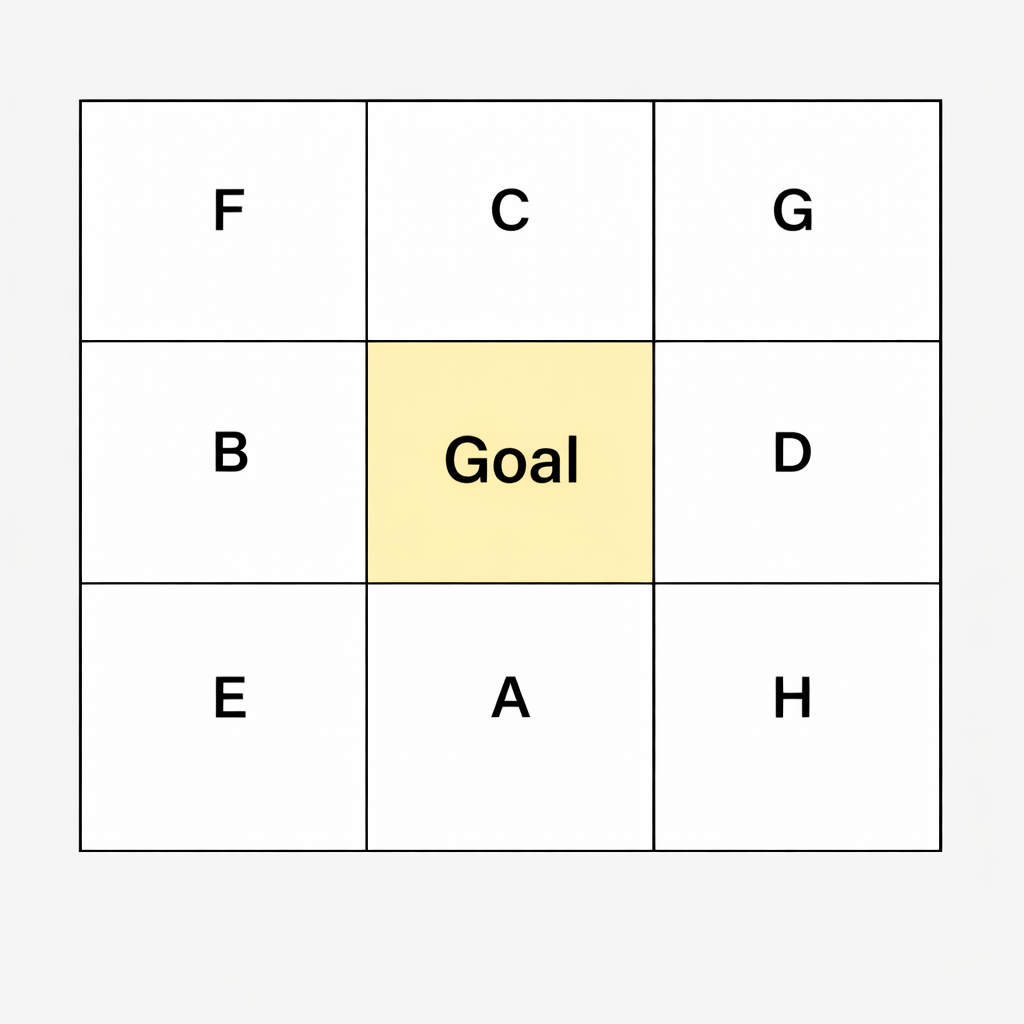
🎯 Goal (Center)
Be drafted as the #1 pick by 8 teams
🅰 — Luck / Support (運)
People and attitudes that bring support and good fortune:
- Become someone people want to support
- Take good care of equipment
- Pick up trash
- Respect umpires
- Think positively
- Greet others
- Clean your room
- Read books
🅱 — Mental (メンタル)
Inner strength and calm under pressure:
- Be strong in big moments
- Stay mentally calm
- Don’t be swayed by atmosphere
- Keep your head cool, heart warm
- Mental practice
- Stay committed
- Keep confidence
- Stay focused
🅲 — Control (コントロール)
Technical pitching control:
- Control release point
- Hit target both strike & ball
- Accurate command
- Practice rhythm
- Adjust to conditions
- Consistent form
- Visualize control
- Refine mechanics
🅳 — Speed (スピード)
Velocity and physical power:
- Pitch at 160 km/h
- Develop fastball power
- Strengthen lower body
- Enhance overall strength
- Sprint / power drills
- Shoulder strength
- Body increase
- Balance and posture
🅴 — Character / Relationships (人間性)
Personal values and how you are seen:
- Be loved by others
- Kindness
- Thoughtfulness
- Gratitude
- Use tools respectfully
- Clean environment
- Trustworthiness
- Humanity
🅵 — Physical Training (体づくり)
Conditioning and training focus:
- Front squat 90kg (FSQ)
- Rear squat 130kg (RSQ)
- Improve flexibility
- Whole body training
- Supplements
- Recovery
- Consistent conditioning
- Body support routines
🅶 — Sharpness / Skill (キレ)
Sharpness of pitch and tactical skill:
- Strong snap
- Power into ball
- Wrist control
- Release consistency
- Grip refinement
- Pitch variation sense
- Timing
- Ball movement awareness
🅷 — Break Balls / Variations (変化球)
Pitch types and variation mastery:
- Forkball
- Curveball
- Changeup
- Pitch type expansion
- Count strategy
- Increase pitching options
- Matchup planning
- Visualize breaking pitches
The center is Ohtani’s big dream:
to be drafted number one by eight professional teams.
Around the center are eight focus areas (A–H), each with eight supporting elements that define how he approached that part of his growth.
This is a great example of how a Mandala Chart turns a big vision into concrete habits, behaviors, and qualities — not just goals.
✍️ Try It Yourself: Your Mandala Chart for This Year
Let this be your moment to reflect.
Take a pen, a notebook, or a blank page—and draw 9 squares.
In the center, write your core theme for the year.
Something you want to invite, experience, or grow in 2026.
Need a little help to get started?
Here are 8 gentle prompts to guide your outer boxes (A–H):
🅰 — Who do you want to be/ accomplish by the end of this year?
🅱 — How do you want to contribute to the world or people around you?
🅲 — What personal or professional phrase represents your energy?
🅳 — What core value or word will guide your choices?
🅴 — What qualities or practices will support your growth?
🅵 — Who benefits from your actions, and how?
🅶 — What keeps you connected to your vision when things get tough?
🅷 — If you imagine yourself 10 years from now, what legacy do you hope to begin creating now?
Take a few quiet minutes to answer each one.
You don’t need perfect words—just honest ones.
Then fill in your chart, placing your answers around your theme.
Let your Mandala Chart be a small compass for this year.
Return to it when you feel unsure, and let it remind you of your own path.
✨ The future doesn’t need to be predicted. It needs to be met—with presence.
And if you’re curious about the full 81-square Mandala Chart—like the one Shohei Ohtani used—there are books and resources available to explore.
It’s a powerful way to bring even greater clarity and momentum to your dreams. Feel free to give it a try.
🌸 Kaha’s Note
What makes Shohei Ohtani’s chart so powerful is not just the ambition of his goal—
but the clarity he carried with him, even as a teenager.
He kept his vision in front of him, and step by step, he walked toward it.
And that’s what this tool invites us to do, too.
Seen from another angle, this is not just a method for elite athletes.
It’s a way for any of us to give form to what matters.
In Japan, this chart has even been introduced in moral education classes,
where students are encouraged to chart their own dreams, inspired by Ohtani.
But the power of the Mandala Chart isn’t in strict planning.
It’s in reflection — the process of turning inward, clarifying what you care about,
and making your thoughts and goals visible, so that you can move toward them with intention.
If it speaks to you, explore it for yourself.
There are Mandala Chart notebooks and English versions available online.
Whether you start with a big dream or a small one, perfect or messy —
✨ May this be a year where you move toward your goals, one square at a time.
🔗 Explore More
If you’d like to explore more reflections, spiritual tools, and quiet visioning practices, you’re warmly invited to visit:
👉 8rainbow.work
Discover new insights, tools, and quiet inspiration to support your inner journey.


コメント