
🍀 Lead-in
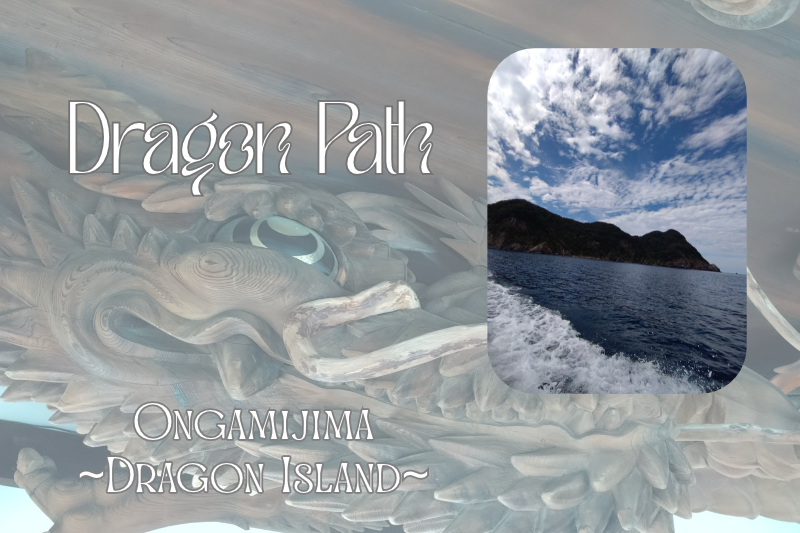
Late this summer, I set out by boat across the blue waters of Wakasa Bay, heading toward a small island off the Tsunekami Peninsula in Fukui Prefecture.
My destination was Ongamijima (御神島), an uninhabited island surrounded by the Sea of Japan.
As we approached, the island rose dramatically from the water, its rocky slopes covered in dense summer greenery. What fascinated me most was how its appearance changed as the boat moved. From one angle, it resembled a steep, triangular mountain; from another, its long silhouette reminded me of a dragon resting upon the sea.
I had come to explore this mysterious island, but the journey itself was already becoming part of the experience.
Beyond its striking natural beauty, Ongamijima also holds stories of gods and ancient beliefs that have been passed down through the generations.
Let’s travel across the water and discover the island, its legends, and the unexpected connections that make it part of my Dragon Path journey.
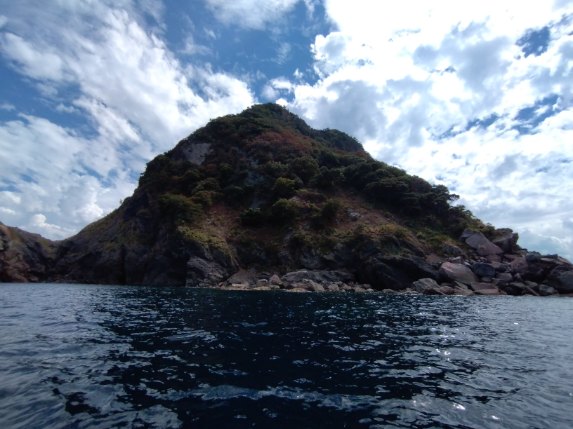
Ongamijima rising from the waters of Wakasa Bay, its rocky slopes framed by a dramatic summer sky.
🐲 Dragon Presence
One of the most fascinating things about Ongamijima is how dramatically its silhouette changes depending on where you view it.
From one side, the island rises like a steep, triangular mountain, with rugged rocks and green vegetation covering its slopes.
But as our boat continued around the island, its outline gradually transformed. The long, uneven ridge began to resemble the body of a dragon lying peacefully across the sea.
It was remarkable to see such different shapes emerge from the very same island.
Perhaps this is part of what makes Ongamijima so captivating. The rocks and ridges remain unchanged, yet a shift in perspective reveals an entirely different character.
To my eyes, it was as though a sleeping dragon had become visible among the waves.
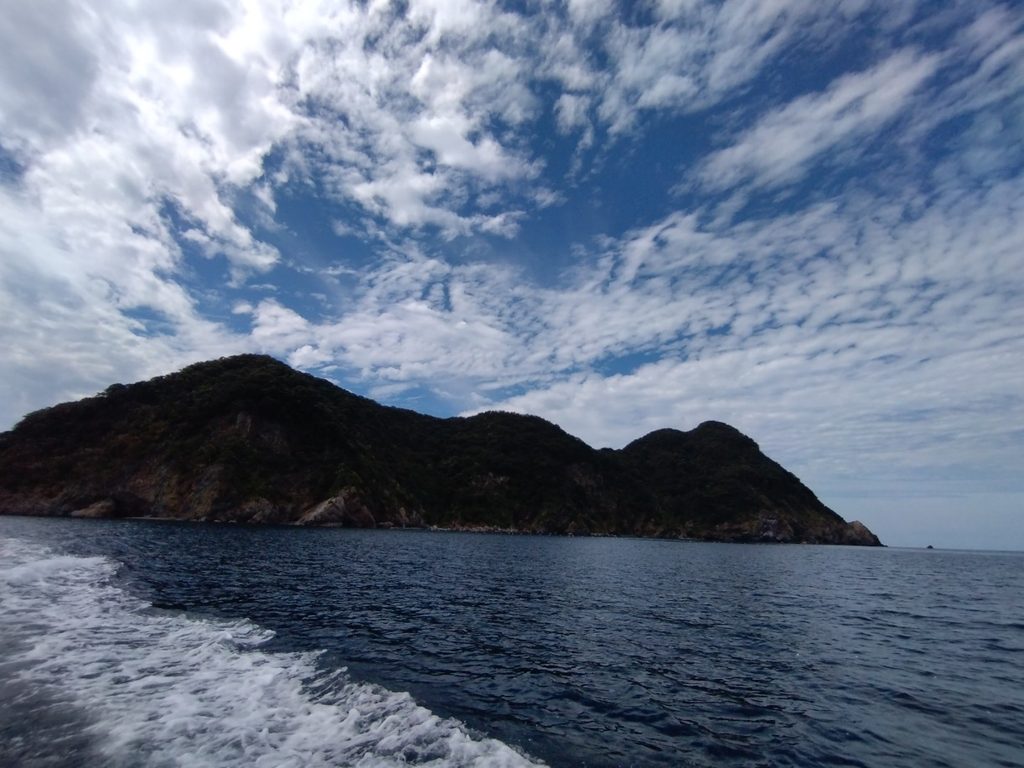
Ongamijima resting like a dragon upon the sea, beneath a sky filled with delicate summer clouds.
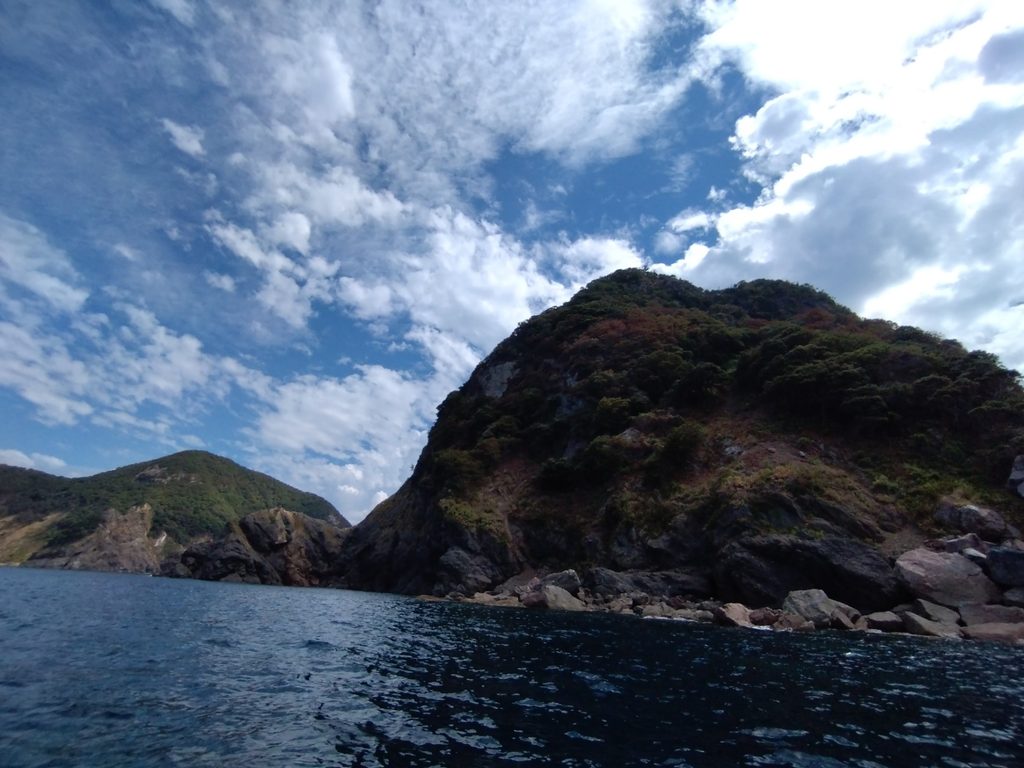
A closer view of Ongamijima’s rugged cliffs and green slopes, seen from the surrounding sea.
🎥 Watch Ongamijima from the Sea
Photographs capture only a single moment, but the view changes continuously as the boat moves around the island.
Watch Ongamijima from the water and discover its shifting silhouette, the summer sky, and the surrounding sea.
▶️ YouTube — Approaching Ongamijima
📷 Instagram — Ongamijima from the Sea 👉@8rainbowawakening.jp
📜 Local Lore
Long before Ongamijima became a destination for visitors exploring the coast of Wakasa, it held a special place in local religious traditions.
According to an old tradition, the island was once home to Tsunekami Shrine (常神社), which now stands on the nearby Tsunekami Peninsula. The shrine is listed among the ancient shrines recorded in the Engishiki, a collection of laws and regulations compiled in the tenth century.
Another story connects Ongamijima with Empress Jingū (神功皇后), a legendary figure in Japan’s early imperial history.
According to local legend, the empress sought shelter near the island when rough seas interrupted her voyage. Tsunekami Shrine continues to enshrine Empress Jingū among its deities today.
⛩️ Visiting Tsunekami Shrine
After exploring Ongamijima, I also visited Tsunekami Shrine on the nearby peninsula.
A wooden torii gate stands beneath tall trees, with stone steps leading deeper into the wooded shrine grounds.
The peaceful setting offered a different perspective on the island’s traditions. Having seen Ongamijima from the sea, I was now visiting the shrine whose history is said to be connected with it.
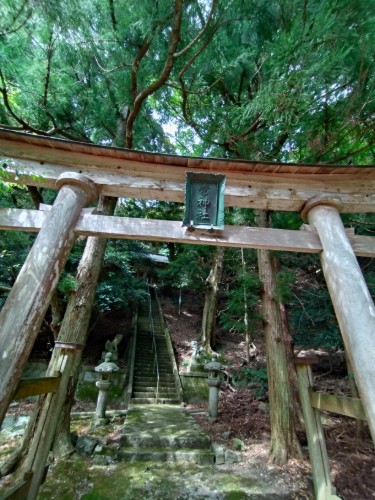
The wooden torii gate and stone steps of Tsunekami Shrine, nestled among the trees of the Tsunekami Peninsula.
Although the sky was clear that day, a brief, delicate drizzle unexpectedly fell while I was at the shrine. It lasted only a moment, and I also spotted a black butterfly among the trees.
These small, unexpected encounters made my visit especially memorable.
Whether viewed from the sea or approached through the quiet forest, Ongamijima and Tsunekami Shrine remain connected through the stories and traditions of the Wakasa coast.
✨ Sacred Highlights
🌿 Landing on Ongamijima
After approaching the island by boat, I finally had the opportunity to step ashore.
Up close, Ongamijima revealed a quieter, more intimate side of its landscape. Rugged rocks, dense summer greenery, and the surrounding sea created a sense of seclusion.
Standing on the island itself was a different experience from admiring its silhouette across the water.
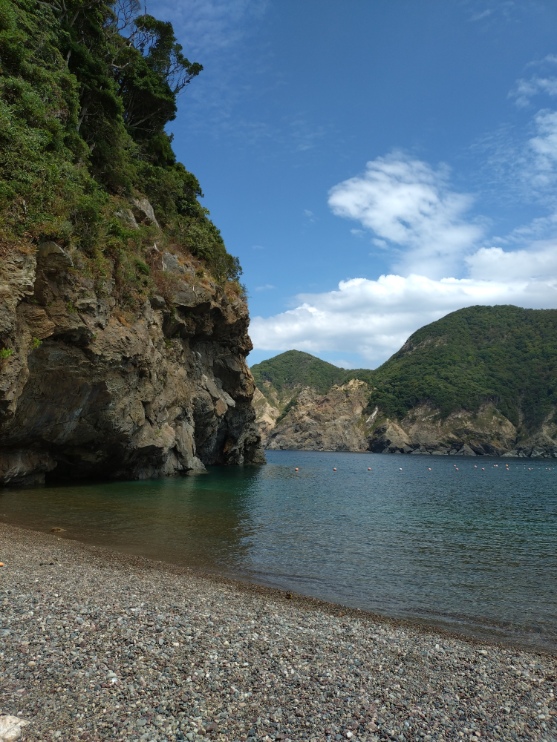
A quiet pebble beach on Ongamijima, surrounded by rocky cliffs and the calm waters of Wakasa Bay.
🪨 Exploring the Rocky Coast
As our boat continued along the coastline, we passed steep cliffs and unusual rock formations rising directly from the sea.
The closer we came, the more details emerged — weathered surfaces, layers of stone, and patches of greenery clinging to the rocky slopes.
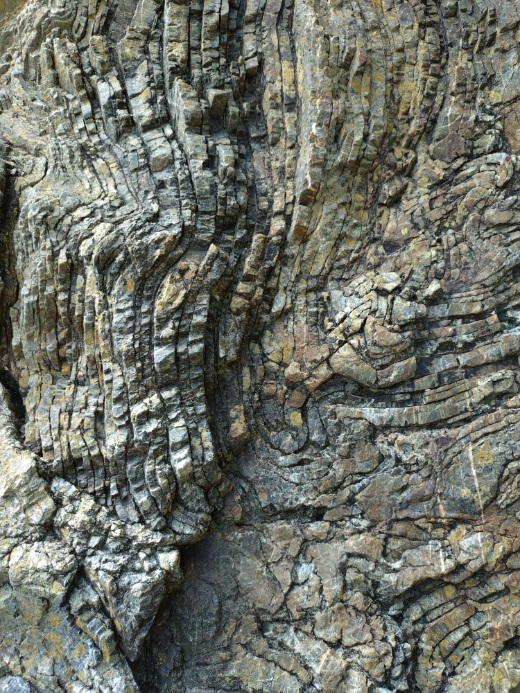
Intricate folds and patterns in the rock, revealing the remarkable textures of Ongamijima’s coastline.
🌊 A Glimpse Inside a Sea Cave
One of the most memorable moments was approaching a cave along the coast.
Our boat ventured briefly inside, offering a glimpse of the rocky interior before returning to the open water.
The contrast between the enclosed space of the cave and the bright summer sea outside made this short encounter especially striking.
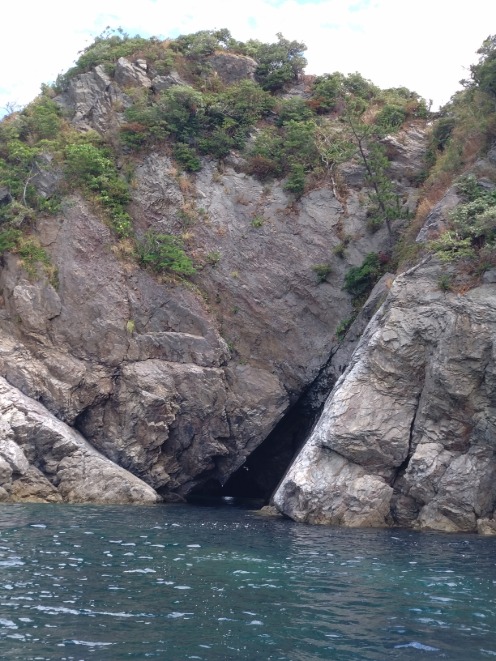
🎥 Watch on YouTube — A Glimpse into a Sea Cave
Join me for a brief glimpse into a sea cave along Ongamijima’s rugged coastline, where our boat slips into the shadows before returning to the open sea.
☁️ Beneath the Summer Sky
Above the island, delicate patterns of clouds stretched across the blue sky.
At one point, I also spotted a large bird soaring overhead.
Together with the rugged coastline and the surrounding sea, these fleeting moments made the journey feel like a series of discoveries, each revealing another aspect of Ongamijima.
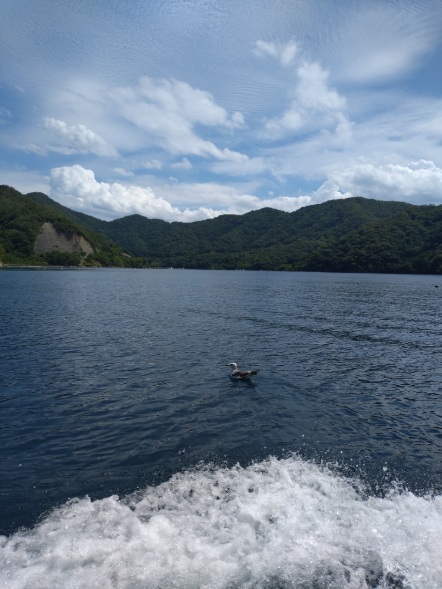
An open sky, gentle sea waves, and a lone seabird floating on the water.
🧵 Hidden Threads
One of the most intriguing connections surrounding Ongamijima leads far beyond the shores of Wakasa Bay — southward through Kyoto and Nara.
I learned of an intriguing theory suggesting that a sacred alignment, sometimes described as a ley line, may connect Niu Kawakami Shrine Shimosha (丹生川上神社下社) in Nara with Ongamijima in Fukui.
🐉 A Sacred Alignment Across Japan
🐉 御神島(おんがみ島)
↓
⛩️ 貴船神社 奥宮
↓
🏯 平安京
↓
🏯 平城京
↓
🏯 藤原京
↓
⛩️ 丹生川上神社 下社
An illustrative north-to-south sequence of places associated with the proposed sacred alignment, rather than a geographically verified straight line.
💧Sacred Places, Ancient Capitals, and Water Deities
The proposed alignment brings together sacred sites and three historic imperial capitals, each with its own significance in Japan’s history and spiritual traditions.
Following the sequence from north to south:
- 🐉 Ongamijima (御神島) — Fukui: An uninhabited island in Wakasa Bay, forming the northern endpoint of the proposed alignment.
- ⛩️ Kifune Shrine Okumiya (貴船神社奥宮) — Kyoto: A sacred site associated with water worship. Kifune Shrine enshrines Takaokami-no-Kami (高龗神), a deity of water and rainfall.
- 🏯 Heian-kyō (平安京) — Kyoto: Established in 794, this imperial capital became the center of Japanese court culture for centuries.
- 🏯 Heijō-kyō (平城京) — Nara: Established in 710, this ancient capital played a central role in the development of Buddhism and Japan’s early state.
- 🏯 Fujiwara-kyō (藤原京) — Nara: The imperial capital from 694 to 710, known for its early planned urban layout.
- ⛩️ Niu Kawakami Shrine Shimosha (丹生川上神社下社) — Nara: An ancient shrine dedicated to Kuraokami-no-Kami (闇龗神), a dragon deity associated with water and rainfall.
The proposed ley line is a spiritual interpretation rather than historical proof that these places were deliberately arranged along a single straight line.
Having already visited Niu Kawakami Shrine Shimosha, I found it fascinating to discover this proposed connection with Ongamijima.
From the mountain valleys of Nara to an island in the Sea of Japan, water and the ancient imagery of dragons seemed to weave another thread through the landscape.
💚 Kaha’s Whisper
What began as a journey to a small island became an opportunity to discover so much more about the Wakasa region.
Before this trip, I had little idea how many fascinating stories and places were waiting to be explored along this part of Japan’s coastline.
I discovered the local legend of Yaobikuni, a woman said to have lived for 800 years after eating the flesh of a mermaid. I also visited Jingūji Temple, where the ancient Omizu-okuri ritual connects the sacred waters of Wakasa with Tōdai-ji Temple in Nara.
The beautiful landscapes of the Mikata Five Lakes revealed yet another side of this fascinating region.
Even the sea held surprises. I spotted dozens of tiny, brilliant blue fish swimming around the rocks. We wondered how such tropical-looking fish could be living in the Sea of Japan. Later, I learned that warm ocean currents can bring southern fish into Wakasa Bay.
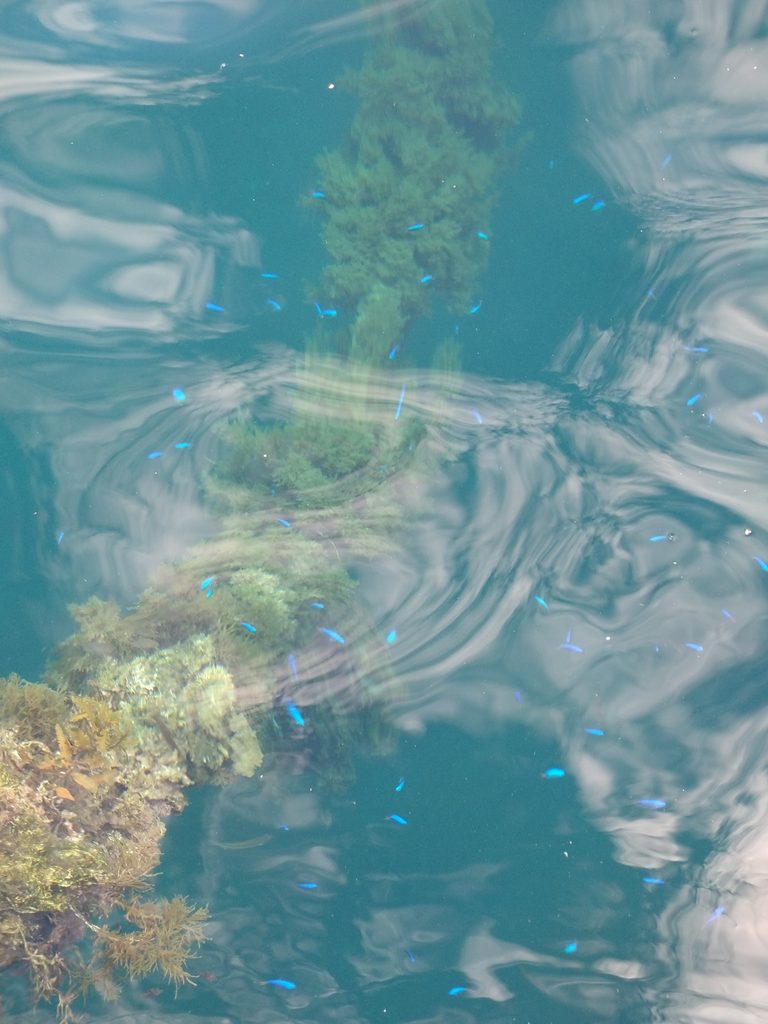
Brilliant blue fish swimming among the rocks in the clear waters of Wakasa Bay.
On Ongamijima, I also brought three special stones that I had collected during my visits to the three Niu Kawakami Shrines in Nara. Each shrine offers a different stone, and I had purchased one at each location:
- Water (水) — Niu Kawakami Shrine Kamisha (Upper Shrine)
- Spirit (神) — Niu Kawakami Shrine Nakasha (Middle Shrine)
- Power (力) — Niu Kawakami Shrine Shimosha (Lower Shrine)
I gently washed all three stones in the clear seawater, bringing together memories of the sacred mountain waters of Nara and the sea surrounding Ongamijima.
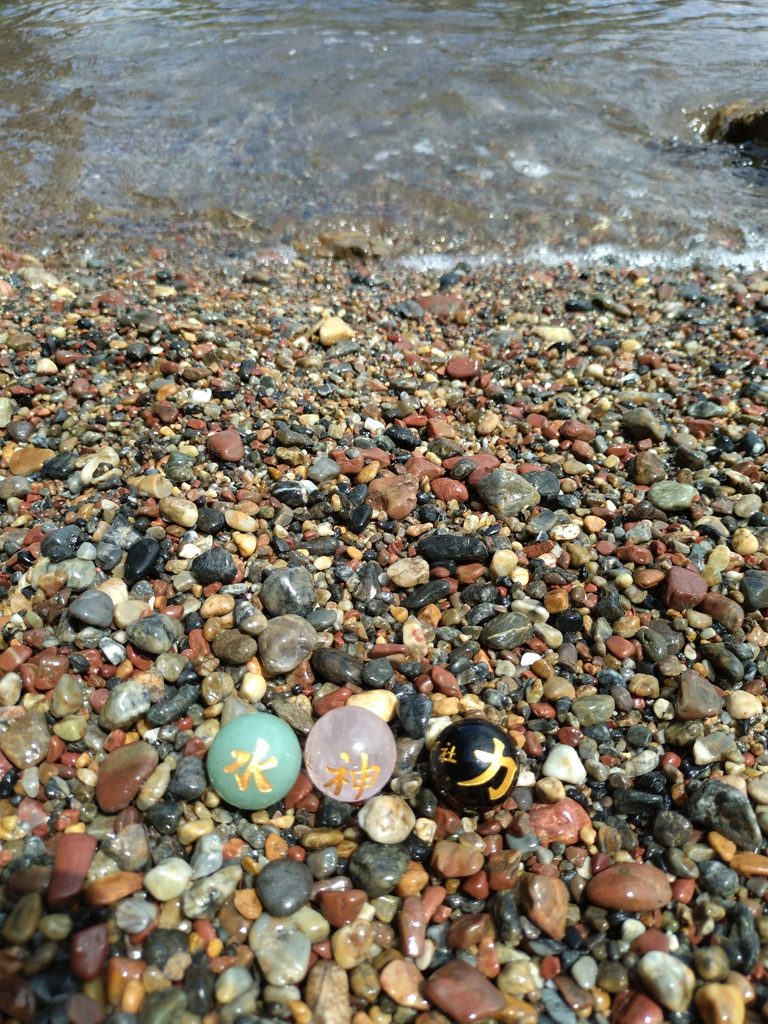
Three stones from the Niu Kawakami Shrines — Water, Spirit, and Power — resting on the pebble shore of Ongamijima.
Looking back, I realize that this journey was about much more than reaching one destination.
It opened the door to new legends, sacred traditions, and unexpected discoveries — each one leading naturally to another.
Perhaps that is what I love most about following the Dragon Path. A single destination can become the beginning of an entirely new journey.
🌈 Follow the Woven Threads
The journey to Ongamijima opened the door to more discoveries across Wakasa — and revealed an unexpected connection with the dragon and water deities of Nara.
🌿 Explore the Mikata Five Lakes
Discover the changing colors and landscapes of the five lakes in Fukui Prefecture.
Earth Whispers — Mikata Five Lakes
🐎 Dragon Path #2-1 — Niu Kawakami Shrine Shimosha
Begin at the shrine associated with the proposed sacred alignment, where dragon worship and the tradition of sacred horses continue.

⛰️ Dragon Path #2-2 — Niu Kawakami Shrine Kamisha
Travel into the mountains of Nara to discover the shrine of Takaokami-no-Kami and its sacred waters.

🐉 Dragon Path #2-3 — Niu Kawakami Shrine Nakasha
Complete the journey through the three shrines at Nakasha, where the water goddess Mizuhanome-no-Kami, ancient cedars, and dragon traditions await.
Thank you for joining this journey across the waters of Wakasa. May it inspire you to discover more of the stories hidden within Japan’s sacred landscapes.

コメント