

A journey through sacred places, living legends, and the hidden threads of Ryūjin
⛰️ Lead-in
Hidden in the mountains of Dorogawa (洞川) in Tenkawa Village, Nara Prefecture, Ryūsenji Temple (龍泉寺) serves as the guardian temple of Ōminesan-ji Temple (大峯山寺) and stands at the gateway to Mount Ōmine (大峯山).
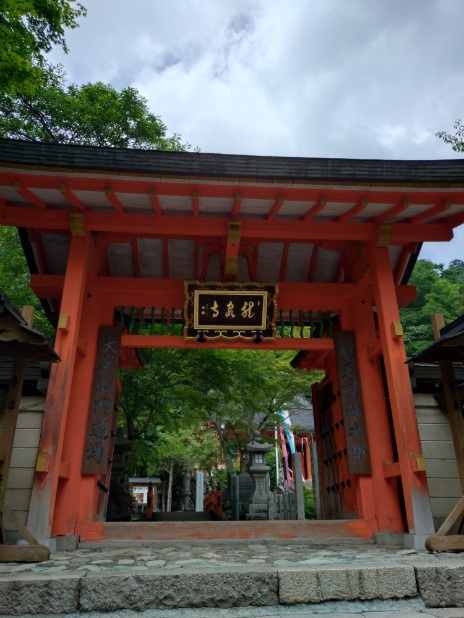
The vermilion gate of Ryūsenji Temple in Dorogawa.
The temple belongs to the Daigo School of Shingon Buddhism (真言宗醍醐派), whose head temple is Daigoji Temple in Kyoto. Ryūsenji is recognized as part of Japan Heritage and serves as the guardian temple of Ōminesan-ji Temple (大峯山寺), a UNESCO World Heritage Site. It is also one of the En no Gyōja Sacred Sites (役行者霊蹟札所) and the Kinki Thirty-six Fudō Pilgrimage (近畿三十六不動尊霊場).
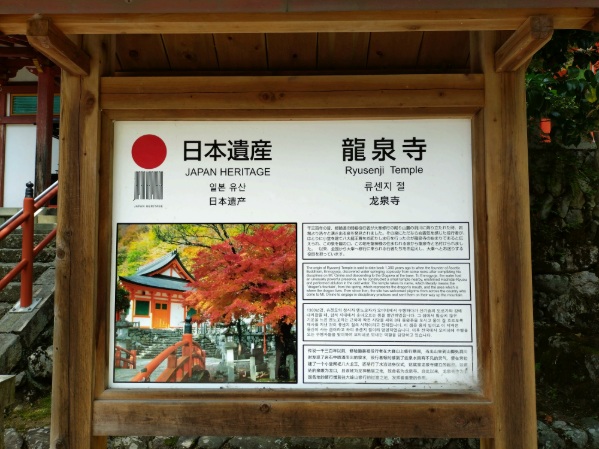
A Japan Heritage information board introducing Ryūsenji Temple.
According to the temple’s tradition, during the Hakuhō period (白鳳時代), En no Gyōja (役行者) discovered a spring flowing from the rocks while training on Mount Ōmine. He enshrined the Eight Great Dragon Kings (八大龍王) beside the spring and prayed for peace in the area and the safety of practitioners.
Today, visitors can see Ryūō-no-Taki (龍王の瀧), Tatsu-no-Kuchi (龍之口), and Daiichi Suigyōba (第一水行場), where they can touch the sacred spring water.
This is where the Dragon Path begins.
🐉 Dragon Presence
Throughout Ryūsenji Temple, the presence of the Dragon Kings can be found in many forms.
At the heart of the temple stands Hachidai Ryūō-dō (八大龍王堂), the hall dedicated to the Eight Great Dragon Kings, the guardian deities of Ryūsenji Temple. According to the temple’s tradition, En no Gyōja experienced the presence of the Dragon Kings at this sacred spring and enshrined them here.
Remarkably, Hachidai Ryūō-dō was the only temple building to survive the great fire that swept through Dorogawa in 1946. It was carefully restored and rededicated in 2001. Inside, visitors are welcomed by a magnificent dragon painting spanning nearly six metres across the ceiling, watching over all who enter with both gentle compassion and quiet dignity.
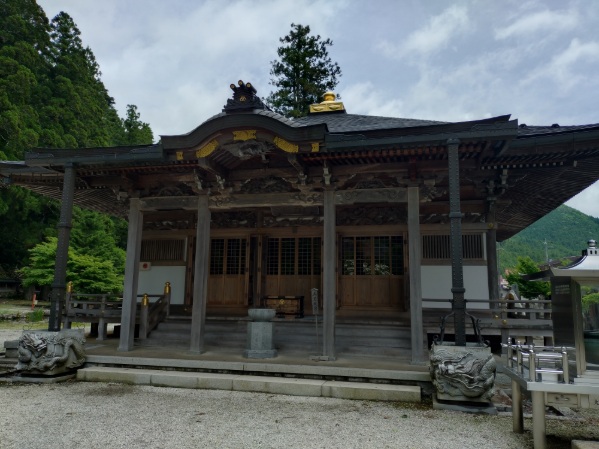
Hachidai Ryūō-dō (八大龍王堂), dedicated to the Eight Great Dragon Kings.
🐉 The Eight Great Dragon Kings
Ryūsenji Temple introduces the Eight Great Dragon Kings as:
- Nanda Ryūō (難陀龍王 / なんだりゅうおう)
- Bananda Ryūō (跋難陀龍王 / ばなんだりゅうおう)
- Washukitsu Ryūō (和修吉龍王 / わしゅきつりゅうおう)
- Tokushaka Ryūō (德叉迦龍王 / とくしゃかりゅうおう)
- Anabatatta Ryūō (阿那婆達多龍王 / あなばたったりゅうおう)
- Manashi Ryūō (麻那斯龍王 / まなしりゅうおう)
- Ubara Ryūō (優鉢羅龍王 / うばらりゅうおう)
- Kurikara Ryūō (鳩利迦龍王 / くりかりゅうおう)
The brief descriptions below are based on traditional Buddhist interpretations of the Eight Great Dragon Kings and are provided as general background. Some names and traditions vary between Buddhist texts and temples.
Nanda Ryūō (難陀龍王)
Traditionally associated with joy and blessings. Together with his younger brother Bananda, he is said to have celebrated the Buddha’s birth by showering him with heavenly water, a tradition remembered during Hanamatsuri (the Flower Festival).
Bananda Ryūō (跋難陀龍王)
The younger brother of Nanda. According to Buddhist tradition, he protected the Buddha throughout his life and vowed to safeguard the Dharma after the Buddha’s passing.
Washukitsu Ryūō (和修吉龍王)
Known in Sanskrit as Vāsuki, he later became closely associated in Japan with the Nine-Headed Dragon (Kuzuryū) tradition and is often revered as a powerful dragon deity.
Tokushaka Ryūō (德叉迦龍王)
Known as a dragon whose gaze could bring death to those who incurred his wrath, symbolizing formidable power. In Japanese tradition, he is also associated with the legend of Shichimen Tennyo.
Anabatatta Ryūō (阿那婆達多龍王)
Guardian of the legendary Lake Anavatapta, the sacred lake from which the four great rivers of the world are believed to flow. He is revered as a symbol of purity and cooling compassion.
Manashi Ryūō (麻那斯龍王)
Renowned for his immense strength. Tradition tells that he pushed back the sea to protect the world when the Asuras caused the waters to surge.
Ubara Ryūō (優鉢羅龍王)
Associated with the blue lotus (utpala), a symbol of purity, wisdom, and spiritual beauty in Buddhist tradition.
Kurikara Ryūō (鳩利迦龍王)
In Japanese Esoteric Buddhism, Kurikara Ryūō is closely associated with Fudō Myōō (Acala) and symbolizes the wisdom that overcomes ignorance and obstacles.
📖 Goshuinchō of the Eight Dragon Kings
Ryūsenji Temple also offers four beautifully illustrated goshuinchō (御朱印帳). Each book features two Dragon Kings, and together the four volumes depict all eight guardians.
In addition, the temple’s monthly goshuin (御朱印) features a different Dragon King each month, allowing visitors to encounter each of the Eight Great Dragon Kings throughout the year.
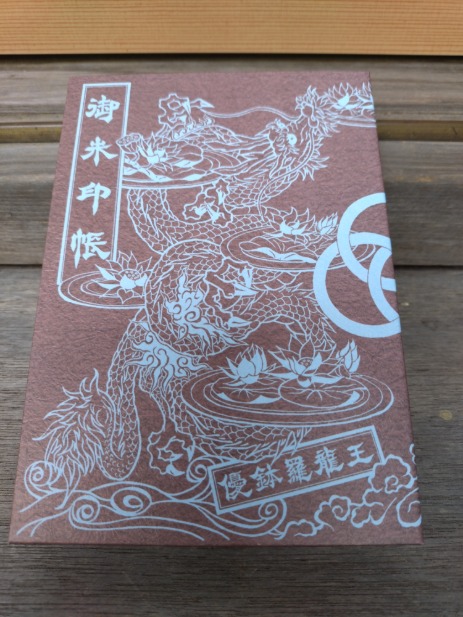
One of the four goshuinchō featuring the Eight Great Dragon Kings.

A monthly goshuin featuring one of the Dragon Kings.
When I first learned about the Eight Great Dragon Kings, I found myself especially drawn to Ubara Ryūō, the Dragon King associated with the blue lotus.
Since then, blue lotuses have continued to appear through a series of meaningful encounters in my own journey. Whether these moments are simply coincidences or something more, they have made me wonder if each of us is quietly given our own small signs along the way.
Perhaps each of us has our own quiet signs waiting to be noticed. Is there one Dragon King that especially speaks to you?
📜 Local Lore — The Legend of the White Serpent
Long ago, a married couple working at Ryūsenji Temple were blessed with a baby boy.
One day, however, it became known that the wife was the incarnation of a white serpent.
She gave one of her eyes in place of her milk and disappeared.
When that eye was gone, she appeared once again from Tatsu-no-Kuchi (Dragon Spring) and gave her other eye.
Before disappearing once more, she said:
“When the temple bell rings six times in the morning and seven times at dusk, it will be my signal to come and nurse my child.”
This legend has been passed down at Ryūsenji Temple for generations and remains one of the temple’s best-known local stories.
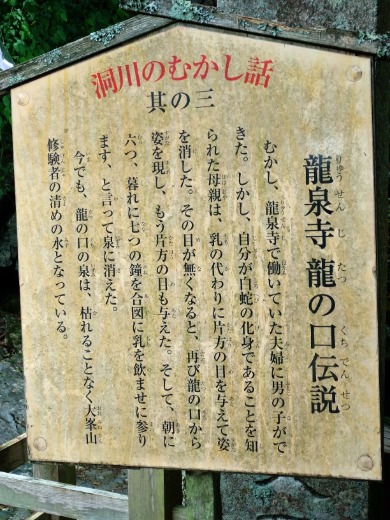
The information board telling the local legend of Ryūsenji Temple.
Like many legends found in Japan’s sacred places, this story gently weaves together dragons, serpents, motherhood, and the life-giving power of sacred water.
In Japanese tradition, dragons and serpents are often closely connected, while white serpents are regarded as sacred beings associated with deities, water, and good fortune. I have also heard of the famous Legend of the White Snake in China. Although each tradition tells a different story, I cannot help feeling that these sacred beings share something in common, quietly connecting cultures across time and place. Perhaps these sacred stories are different expressions of the same timeless thread.
✨ Sacred Highlights
💧 Daiichi Suigyōba (第一水行場)

Daiichi Suigyōba (The First Water Purification Site).
Daiichi Suigyōba is one of the sacred places where practitioners of Shugendō perform water purification before entering the mountains. Traditionally, it has served as the first purification site for practitioners before ascending Mount Ōmine. Even today, visitors may touch the clear spring water that has long been regarded as a source of spiritual purification.
🎥 Watch on YouTube
Sacred Water Purification Site (Daiichi Suigyōba)
https://youtube.com/shorts/JAUEfoGxszo
🐉 Tatsu-no-Kuchi (龍之口)

Tatsu-no-Kuchi (Dragon Spring).
The sacred spring associated with both the Eight Great Dragon Kings and the legend of the White Serpent. According to the temple’s tradition, Ryūsenji (“Temple of the Dragon Spring”) takes its name from this sacred spring.
🎥 Watch on YouTube
Dragon Spring (Tatsu-no-Kuchi) – Part 1
https://youtube.com/shorts/9E05Fv_ljy4
Dragon Spring (Tatsu-no-Kuchi) – Part 2
https://youtube.com/shorts/E3aEHlF4YXc
💦 Ryūō-no-Taki (龍王の瀧)
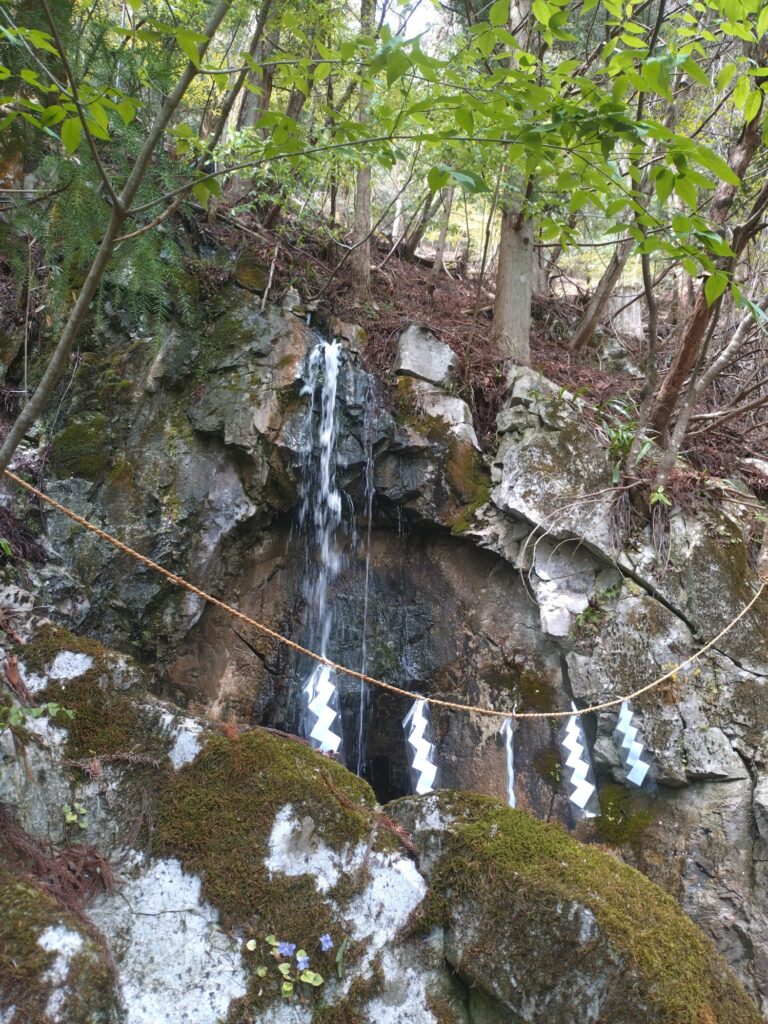
Ryūō-no-Taki (Dragon King’s Waterfall).
A sacred waterfall used for Shugendō purification rituals.
🎥 Watch on YouTube
Dragon Waterfall (Ryūō-no-Taki)
https://youtube.com/shorts/k9MLL77OtjM
🧵 Hidden Threads — Tōrō no Iwaya (A Sacred Cave of Shugendō)
Ryūsenji Temple revealed many hidden threads to me—Shugendō, Shingon Buddhism, Fudō Myōō, bodhisattvas, and the ancient traditions woven through this sacred mountain landscape.
One place that especially captured my attention was Tōrō no Iwaya (蟷螂の窟, “The Mantis Cave”), which I finally visited again this spring. Although I had been to the area before, I had somehow overlooked it.
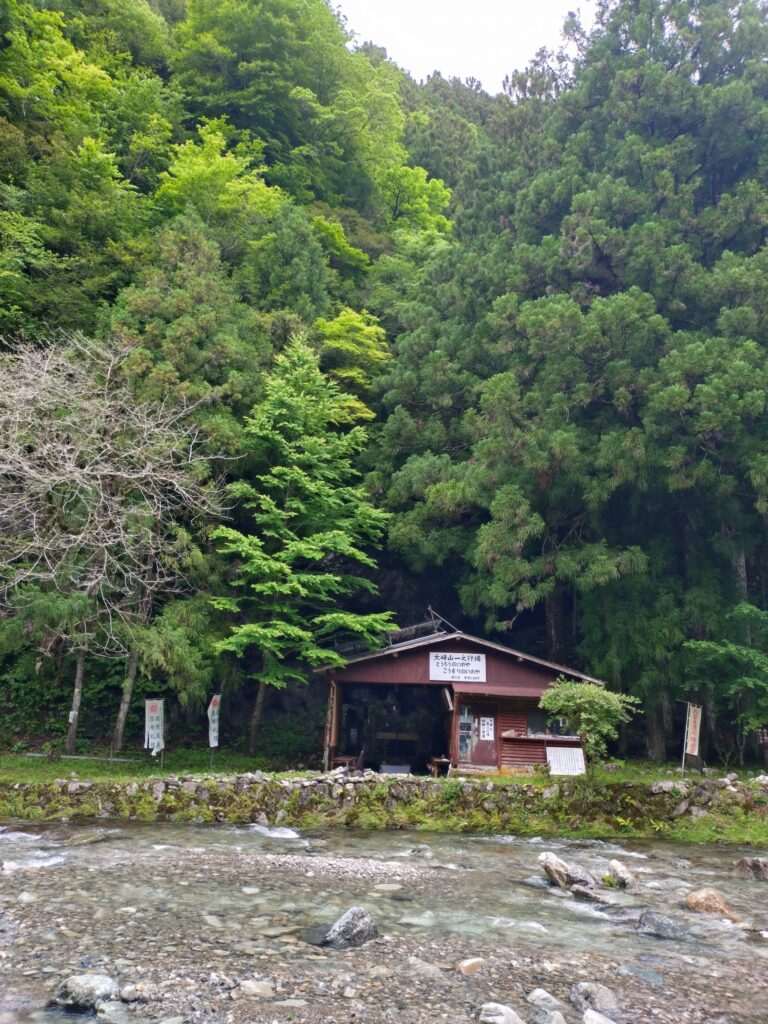
Across the clear waters of Dorogawa stands Tōrō no Iwaya, a sacred Shugendō training site hidden within the mountains.
Simply standing before the rocky cave, I could sense an extraordinary spiritual presence. It is one of the most mysterious places I have encountered on this journey.
Visitors may enter only when the caretaker is present, and so far I have never happened to visit while the cave was open. Perhaps, when the right moment comes, I may one day be able to step inside.
The information on the sign by the road says that Tōrō no Iwaya has long been regarded as one of the most important training caves of Shugendō. Mountain ascetics entered the cave to deepen their spiritual practice, and those who completed their training there were believed to be spiritually reborn. Among the many training sites on Mount Ōmine, it has long been one of the most highly revered.
According to local tradition, the cave became a place of Shugendō training through the practice of En no Gyōja. Its name is believed to come from the posture required to enter the narrow passage, where practitioners bend low and raise their hands above their heads, resembling a praying mantis. The posture also symbolizes humility.
Several legends are associated with this sacred cave.
One tradition says that a male and female giant serpent began terrorizing the region, causing local people and even Shugendō practitioners to avoid the area. As a result, Ryūsenji Temple gradually fell into decline. When Shōbō Rigen Daishi (聖宝理源大師) returned under an imperial order to restore the sacred mountain, he used the power of Buddhist teachings to subdue the serpents. Ryūsenji Temple is said to have flourished once again after the serpents were subdued.
Another version of the legend says that a male and female giant serpent were living in the caves around Dorogawa and harming local people. When Shōbō Rigen Daishi came to revive the sacred training grounds of Mount Ōmine, he entered the cave (蟷螂の窟) while chanting Buddhist sutras and subdued the male serpent. The female serpent fled into another cave, whose entrance was sealed. That cave became known as Hebi no Kura (蛇の倉, “The Serpent’s Storehouse”).
Today, visitors can still stand before Tōrō no Iwaya and quietly reflect on these legends, which continue to shape the spiritual landscape of Dorogawa.

An information board introducing a local tradition associated with Tōrō no Iwaya and Shōbō (Rigen Daishi).
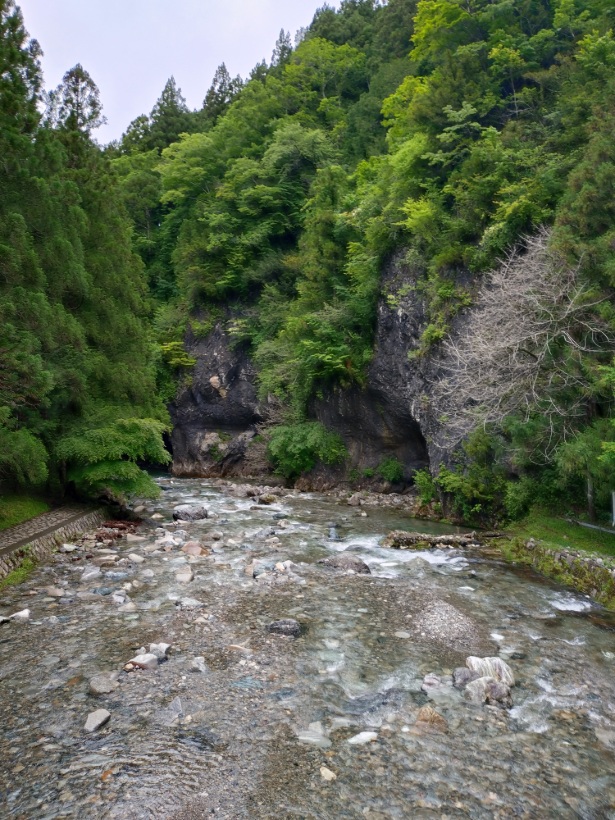
The clear stream flowing beside the cave, where Shugendō practitioners have passed for centuries.

An information board explaining the origins of Tōrō no Iwaya and its connection with Shugendō.

The rocky landscape surrounding Tōrō no Iwaya (The Mantis Cave).
I hope that one day I will be able to enter Tōrō no Iwaya. I sometimes wonder whether that quiet place might help me reconnect with a deeper part of myself, just as so many sacred places quietly have along this journey. Perhaps another hidden thread is quietly waiting to be discovered.
🌿 Kaha’s Whisper
Many years ago, I first became consciously aware of the presence of Ryūjin. Looking back, however, I sometimes wonder if they had been quietly guiding my path long before I recognized them.
Dragons are said to dwell throughout nature—in mountains, forests, rivers, waterfalls, and springs.
In Japanese tradition, Ryūjin are regarded as powerful guardians of the natural world. Many believe they encourage people to grow, overcome challenges, and move toward a higher way of living.
Over the years, as I visited Ryūsenji and other sacred places connected with dragons, I gradually felt my connection with Ryūjin deepen. Whenever I visit places connected with dragons, I often find myself experiencing unexpected moments—a sudden breeze, rain arriving beneath a clear sky, clouds opening after a storm, or flashes of lightning that seem to mark the beginning of another mysterious experience. I don’t claim to understand these moments, but they have encouraged me to pay closer attention to the quiet ways nature sometimes speaks.
Whether these experiences are simply coincidences or something more, they have inspired me to continue exploring Japan’s dragon traditions with an open heart and a sense of wonder.
As our world continues to change, I hope we can learn once again to live in harmony with nature rather than apart from it.
Tenkawa Village is one of those rare places where I feel the presence of nature most deeply.
May everyone who visits this sacred place with respect for the mountains, the rivers, and all living beings find a sense of peace within.
🌈Follow the Woven Threads
More stories continue to unfold through Dragon Path, Divine Thread, and Japan: Life & Spirit—each revealing another thread in Japan’s sacred landscape.
🐉 Explore Ryūjin — Japan’s Dragon Spirits
Discover how Ryūjin are connected with water, nature, transformation, and spiritual growth in Japanese tradition.
🔗 Ryūjin — Japan’s Dragon Spirit Power
💧 Meet the Water Goddess of Tenkawa
Journey deeper into Tenkawa Village and discover Benzaiten—the goddess associated with sacred water, music, wisdom, and artistic expression.
🔗 Benzaiten — Another Face of Saraswati
🦋 A Sacred Moment at Ryusenji Temple
A butterfly appeared before Hachidai Ryūō-dō—a quiet and beautiful encounter in the sacred landscape of Tenkawa Village.

コメント