

🗿Lead-in
Time travels here — from ancient times to the present —
carrying the sacred energy of the land.
In Asuka, stones are more than matter.
They are memory.
They hold the weight of rituals, myths, and human presence —
etched with silence, shaped by centuries.
This history of this area goes way back over fourteen centuries.
Each stone tells a story,
not through words,
but through the space it occupies —
and the stillness it invites.
This journey moves through five stones,
each one a trace of something greater:
a tomb, a guardian, a curse, a prayer.
They remain as the earth breathes around them —woven into time itself.
🎥 A short video is now live alongside this post.
Get a quick glimpse of their presence in this 54-second short video:
👉 Click here to watch
🦊Ishibutai Kofun — The Stage of Stone
Beneath the open sky in the village of Asuka lies a structure so massive, so precisely formed, that it almost feels unreal — yet there it stands: Ishibutai Kofun (石舞台古墳).
Believed to be the tomb of Soga no Umako (蘇我馬子), a powerful statesman of the 6th century, this stone chamber was once covered by an earthen mound. That mound has long since eroded, revealing a chamber of over thirty large granite boulders, arranged with stunning precision.
The tomb measures approximately 7.7 meters in length, 3.5 meters in width, and 4.7 meters in height.
The two ceiling stones alone weigh an estimated 64 tons (north) and 77 tons (south), with the total structure reaching a weight of over 2,300 tons.
You cannot touch the stones. You cannot climb them— it is a resting place, and a sacred one.
Step inside, and the air shifts.
Light falls through the open ceiling, casting sharp lines across the chamber floor.
You feel like you’re standing in a place where something lingers — power, spirit, time.
As for the name “Ishibutai,” or “Stone Stage,”
two legends explain it:
One speaks of a fox spirit who transformed into a woman and performed a beautiful dance atop the stones, entrancing all who saw.
Another tells of traveling performers who arrived in the village without a stage, and so used the giant stones instead — turning a tomb into a space of art, if only for a moment.
Today, the performance has long ended.
But the presence remains.

The entrance to Ishibutai Kofun. The burial chamber once lay beneath an earthen mound, now open to the sky.

Offerings placed at the base of the stone — a reminder that this is still, in many ways, a sacred resting place.
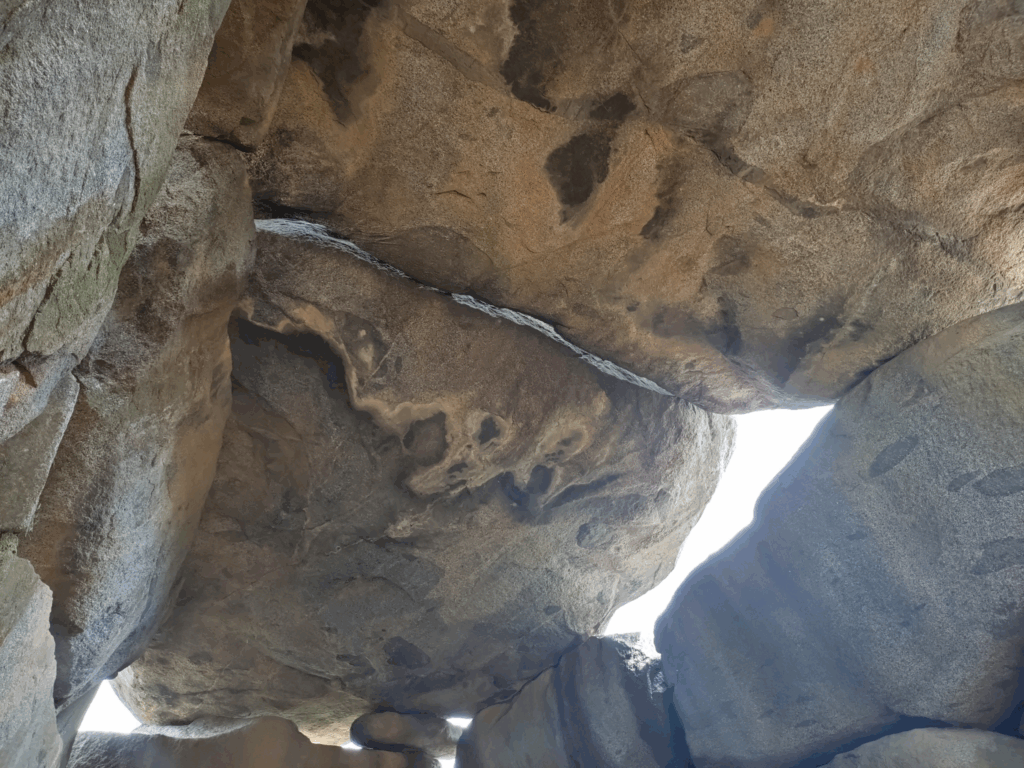
Looking up from inside the chamber — the weight, the texture, the impossible balance.

A lone bird rests atop the Ishibutai Kofun — as if listening to the ancient whispers of stone.
🗿Saruishi — Four Figures, Still Watching
Near a quiet burial mound in Asuka, four granite figures sit — silent, unmoving, and still surrounded by questions.
They are known as Saruishi, the “Monkey Stones.”
But whether they truly depict monkeys is unclear.
Their features are bold and stylized: large eyes, broad faces, and bodies shaped with human-like familiarity, yet not quite human.
They were unearthed in the early 18th century from a nearby rice field,
and today they rest on the west side of a round tomb identified by the Imperial Household Agency as that of Princess Kibihimenomiko,
mother of Empress Kōgyoku and Emperor Kōtoku.
Even so, their connection to the tomb is uncertain.
Some suggest the stones originally belonged to the Kitagawa Remains, located to the south of the Kinmei Imperial Mausoleum.
Their age, purpose, and original placement remain unknown.
Scholars have proposed various interpretations —
from ancient masked dancers of gigaku, to protective figures, to ritual statues carved for spiritual reasons or even amusement.
The Japanese word “saru” means “monkey,”
but it also carries the meaning of “to leave” or “to go away.”
This duality has led some to believe the stones may have served as symbols meant to drive away misfortune or unwanted spirits — not through force, but through quiet departure.
We may never know who carved them, or why.
But standing before them, it’s hard not to wonder —
what were they meant to see?

Two of the Saruishi statues — their forms worn by time, their meaning still uncertain. Are they smiling? Watching? Waiting?

Set quietly beneath the trees, the four Saruishi stand with presence but no explanation — a mystery carved into stone.
🐢Kameishi — The Turtle That Watches the Land
Set low in a quiet corner of Asuka, nestled between homes and fields,
sits a single stone shaped unmistakably like a turtle.
It’s called Kameishi, or the Turtle Stone — a figure both endearing and mysterious.
Its origins remain uncertain.
Some believe it may be related to an indigenous cult that predates the arrival of Buddhism in Japan —
a time when natural forms were revered as spiritual beings.
Others point to its possible connection to the “Four Guardians” of ancient cosmology, where each direction held a sacred beast —
the turtle being protector of the north.
But one legend speaks from the heart.
Long ago, a quarrel between villages on either side of a lake led to many turtles perishing in the chaos.
Moved by this, the people carved this stone as an act of memorial, a way to honor those silent witnesses of nature.
The stone faces south and is said to never be allowed to turn west — for if it does, the entire Asuka basin will flood.
And so, it stays.
Still. Grounded. And strangely comforting.

A stone plaque retells an old story — of lost turtles, village quarrels, and a carving made in their memory.

With rounded eyes and a faint smile, the Turtle Stone gazes south. Is it watching? Waiting? Or simply being?

Just steps from the stone, rice fields sway with the wind — life carrying on beside stillness.
🌿 Kaha’s Note
Asuka continues to feel like a land touched by something unseen —
where stones don’t just sit on the earth, but seem to hold memory, stories, and presence.
Recently, Japan officially recommended Asuka for UNESCO World Heritage status,
and international interest is quietly rising.
With that, the area is gradually becoming more equipped to welcome visitors —
facilities are being improved, and the region is embracing its role as a cultural destination.
Still, it remains rich in nature.
Cycling and hiking are popular ways to explore the hills and fields,
and the air feels clearer here — not just physically, but emotionally.
Many ancient stones remain hidden across the landscape,
each with its own role in history or legend.
And many of them are tied to powerful women — empresses and priestesses,
whose stories ripple beneath the surface of the land.
In future visits, I hope to continue this quiet journey through time —
and to share more of Asuka’s sacred energy and silent beauty.
🌈 Explore More
If this post moved something in you,
you may enjoy an earlier piece that dives into the roots of Japan’s spiritual history —
including the life and influence of a remarkable woman who helped shape its first Buddhist era:
👉 Divine Thread #7 — Exploring Ancient Asuka: Where Empress Suiko Shaped Japan’s First Buddhist Era


コメント