

🌿 Lead-in
For many people in Japan, Ise is a familiar sacred name —
a place often described as one that should be visited at least once in a lifetime.
Yet this was not always a journey freely open to everyone.
For a long time, travel required permission, time, and money — things that many ordinary people did not have.
Still, the wish to pray at Ise lived quietly in the hearts of the people.
As times changed, the pilgrimage gradually became a shared journey.
Travelers helped one another along the road, offering food, shelter, and guidance.
Even those who arrived with little were supported by unseen kindness.
Because people believed they reached Ise thanks to this collective grace,
the journey came to be known as Okage-mairi —
a pilgrimage made possible “by grace.”
From this culture of trust and mutual care, a gentle and remarkable figure emerged:
Okageinu —
a dog said to have walked the sacred road to Ise on behalf of someone who could not.
Today, this custom no longer remains as a living practice.
Yet the stories have been quietly passed down through generations.
Along the road leading to Geku (外宮), one can still find a small statue that recalls this gentle tradition.
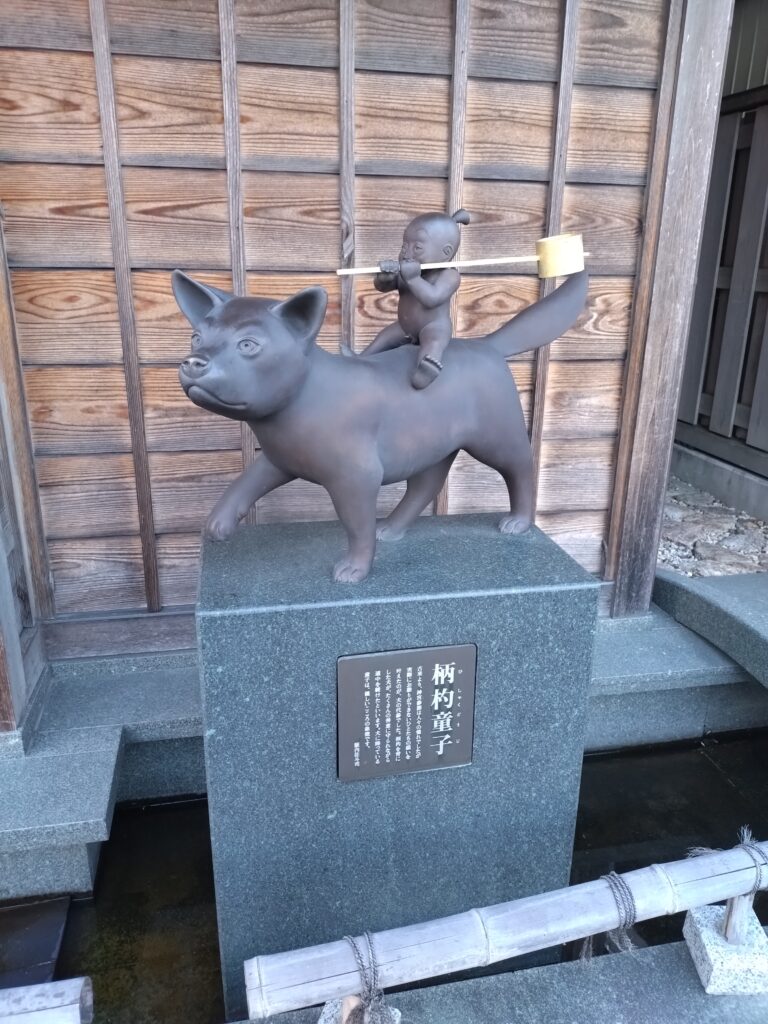
The statue is known as Hishaku-dōji —a name that reflects the ladle once carried by Okageinu, symbolizing trust and the kindness of strangers along the journey.
In this article, I would like to share the story of Okageinu —
a dog whose journey reflects a time when trust, kindness, and unseen support guided the way to Ise.
🐾 What is Okageinu?
Okageinu refers to dogs that were said to have traveled to Ise on behalf of their owners during the Edo period.
When illness, age, or circumstance made the journey impossible, people entrusted their wishes to a dog — asking it to walk the sacred road in their place.
To make this clear to others, the dog was sent out wearing a note and travel funds tied around its neck, often with a small ladle.
This ladle signaled that the dog was on a pilgrimage and invited kindness along the way — water, food, rest, and guidance from strangers who understood its purpose.
Travel to Ise Grand Shrine was not an easy task in those days.
Yet stories tell of dogs reaching Ise safely, supported by the quiet generosity of people they met along the road.
Whether every detail can be proven or not, Okageinu remains a symbol of something deeply rooted in Japanese culture:
a shared belief that trust, compassion, and unseen support could carry even the smallest traveler forward.
📖 A Well-Known Okageinu Story
One of the most well-known Okageinu stories comes from Sukagawa, in present-day Fukushima Prefecture.
According to historical records and local accounts, a white Akita dog named Shiro lived with the Ichihara family, a long-established household in the area.
Shiro was known for his intelligence and was said to understand human words, often running errands for his owner.
For generations, the family had made a pilgrimage to Ise Grand Shrine each spring.
However, during the Edo period, the head of the household fell ill and could no longer make the journey.
In his place, Shiro was entrusted with the pilgrimage.
The dog was sent off wearing a pouch around his neck containing travel money, a hand-drawn map, and a written message asking those along the road to guide him safely to Ise.
The family prayed daily for Shiro’s safe return.
After nearly two months, Shiro came back home —
still carrying the sacred talisman from Ise, the receipt for offerings, records of expenses along the way, and the remaining travel funds.
The story spread quickly through the region, and Shiro came to be honored as a faithful and remarkable dog.
When he later passed away, he was buried at the family temple, where his memorial still remains today.
Today, this practice no longer exists in the same form.
Yet stories like Shiro’s continue to be passed down.
In Ise, traces of Okageinu can still be found in statues, souvenirs, and gentle motifs seen throughout the town.

With permission from the hotel front desk,
I photographed this Okageinu doll.
Stories like Shiro’s are no longer lived in the same way today,
yet in Ise, they continue to be remembered —
gently carried forward in small, familiar forms like this.
💖Kaha’s Note
To me, the story of Okageinu deeply moves the heart.
It seems to reflect the trust, honesty, and warmth of the people who lived in that time,
as well as the quiet beauty of the Japanese spirit —
a culture shaped by sincerity, care, and mutual support.
It also speaks gently of the bond between humans and dogs,
and of a trust that allowed one to carry another’s wish across a long and uncertain road.
One morning, as I walked near Geku,
a brilliant light appeared along the forest path.
When I later looked at the photograph, a soft, beautiful glow had been captured.
Near the lower part of the image,
I noticed a shape — something like a dog, or perhaps a fox.
What caught my attention was what looked like a collar around its neck,
and for a moment, the stories of Okageinu came quietly to mind.
Perhaps it was only my imagination.
Perhaps I had been thinking about Okageinu the day before,
and my thoughts simply found their way into the light.
Even so, it felt gentle —
as if something was softly saying, “I am here.”
Whether it was real or only a feeling,
Okageinu remains, to me, a symbol of trust, honesty, and care —
qualities that continue to be needed in our society today.
Some stories do not ask to be proven.
They simply remind us of what has been quietly carried through time.

Captured in the morning light near Geku.
In the glow, I noticed a gentle shape —
undefined, quiet, and open to interpretation.
🌿 Explore more
If this story resonated with you,
you may find other gentle reflections on Japanese life, spirit, and quiet journeys here.
Return HOME
👉 https://8rainbow.work
Stories of sacred places, everyday moments, and threads of trust and light —
shared slowly, one step at a time.


コメント