

🏮 Lead-in
Have you ever wondered what all those beautiful items at Japanese temples and shrines are for? From omamori and ofuda to ema and goshuin books, each one has its own meaning and tradition.
In this article, we’ll explore the basic differences between these sacred items and help you enjoy your next visit to a Japanese temple or shrine even more.
🧿 Omamori (Protective Charms)
Omamori are probably the most familiar sacred items found at Japanese temples and shrines. Each charm is associated with a specific blessing, such as good health, success in studies, safe travel, finding love, or protection from misfortune.

Most temples and shrines have a counter where visitors can receive omamori and other sacred items.
Most omamori are made of beautiful fabric and are designed to be carried in a bag or attached to personal belongings. They are not meant to be opened, as the blessing is believed to remain safely inside.
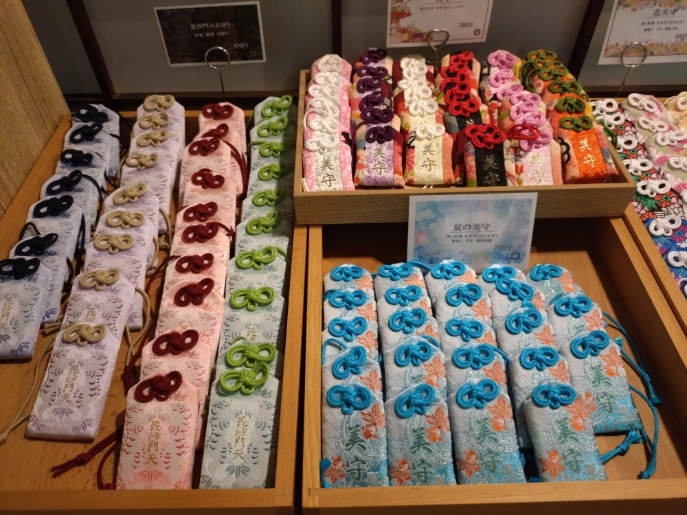
These omamori from Shōrin-ji Temple are dedicated to Bishamonten, the guardian deity of protection, and Kisshōten, the goddess of beauty, happiness, and prosperity. Because Kisshōten is especially associated with beauty, the temple offers a wonderful variety of beauty charms in different colors and designs.
Today, many temples and shrines also create their own unique omamori inspired by their history and local traditions. For example, Ryosenji temple is famous for its roses, so its transparent acrylic omamori features delicate rose, cherry blossom, and traditional Japanese patterns. When the light catches it, it shimmers with rainbow colors, and visitors can even choose the color of the decorative cord, tied in a beautiful knot inspired by mizuhiki, the traditional Japanese art of decorative cord tying.

Before being offered to visitors, omamori are blessed through a prayer ceremony by the temple or shrine. They are not simply souvenirs, but sacred items believed to carry prayers and blessings.
🏠 Ofuda (Sacred Talismans)
Unlike omamori, which are carried with you, ofuda are sacred talismans that are meant to protect your home rather than an individual. Both Shinto shrines and Buddhist temples offer ofuda, although their appearance and traditions may differ.
At Shinto shrines, ofuda are often placed in a kamidana (household Shinto altar). If there is no kamidana, many people choose a clean, high place where the ofuda can be treated with respect.
Temple ofuda are also kept respectfully in the home. Depending on the temple’s tradition, they may be displayed on a shelf, near the entrance, or in another appropriate place. If you are unsure, the temple staff will be happy to explain the recommended way to care for it.
If you receive an ofuda during your travels, don’t worry too much about following every tradition perfectly. Customs may vary depending on the temple, shrine, family, or region. The most important thing is to treat it with respect and gratitude.

Different types of ofuda (sacred talismans) offered at Ryusenji Temple for protection, safety, and various blessings.
✍️ Ema (Wooden Prayer Plaques)
Ema are wooden prayer plaques on which visitors write their wishes before hanging them at a temple or shrine.
The word ema literally means “picture horse.” Long ago, people offered real horses to shrines as sacred gifts. As this became impractical, wooden plaques painted with horses were offered instead. Over time, the designs evolved beyond horses, and today ema come in a wide variety of shapes and motifs unique to each temple or shrine.
After writing a wish, visitors usually write their name as well before hanging the ema on a designated rack, leaving their prayers at the sacred site.

Torii-shaped ema hanging at Fushimi Inari Taisha, where visitors leave their wishes and prayers.
Today, ema come in many different shapes and designs depending on the temple or shrine. Some feature zodiac animals, while others are inspired by local deities, legends, or the unique traditions of each sacred place.
For example, at Ganriki Inari Shrine within Yanagidani Kannon Temple, visitors can find ema featuring the Japanese character 「め」 (me, meaning “eye”), reflecting prayers for healthy eyesight and clear vision.
While many people write both their wish and their name on the ema, some shrines offer privacy stickers for those who prefer to keep their wishes private. Sarutahiko Shrine in Ise is one such example.

Unique ema at Ganriki Inari Shrine, featuring designs symbolizing good eyesight, clear vision, eye protection, foxes, and local traditions.
🎲 Omikuji (Fortunes)
Omikuji are traditional fortune slips found at many Japanese temples and shrines. They offer guidance on different aspects of life, such as health, love, studies, business, travel, and relationships.
The basic process is similar at most temples and shrines. After drawing a numbered stick, you either receive the matching fortune from a staff member or collect it yourself.

Drawing an omikuji at Tenkawa Daibenzaiten Shrine. After drawing a numbered stick, visitors receive the corresponding fortune.
At some shrines, the process is slightly different. For example, at Kashihara Jingu Shrine, visitors simply choose one sealed omikuji from a box instead of drawing a numbered stick.

At Kashihara Jingu Shrine, visitors choose a sealed omikuji directly from the box.
The result may range from Great Blessing (Daikichi) to Great Curse (Daikyō), depending on the temple or shrine.
Many people keep a lucky fortune in their wallet or at home as a reminder of the positive message. Others choose to tie their fortune to a designated rack or tree, symbolically leaving behind bad luck and entrusting their prayers to the sacred place.
At some shrines, different trees are used for tying omikuji. For example, a lucky fortune may be tied to a pine tree (matsu), while an unlucky one may be tied to a cedar tree (sugi), reflecting a traditional Japanese play on words: matsu also means “to wait,” symbolizing the hope that good fortune will stay with you, while sugiru means “to pass,” expressing the wish that bad luck will soon pass away.

An omikuji showing a message of good fortune.
Today, many temples and shrines also offer creative variations of omikuji.
One popular example is mizumikuji (“water fortunes”). Visitors receive a seemingly blank fortune slip and place it in water, where the hidden message gradually appears.


A mizumikuji revealing its hidden message after being placed in water.
Some omikuji include a small lucky charm inside, allowing visitors to take home both the fortune and a keepsake.

A Daikichi (Great Blessing) omikuji containing a small lucky charm.
Many temples and shrines also create their own original omikuji inspired by local traditions.
At Nomi Shrine in Osaka, visitors choose their favorite sumo wrestler figure. Inside is a traditional fortune slip, while the small ceramic wrestler can be taken home and displayed as a keepsake.

A sumo wrestler omikuji from Nomi Shrine, combining a traditional fortune with a collectible keepsake.
🌿 A Unique Tradition at Ise Jingu
One interesting exception is Ise Jingu, where omikuji are not offered.
According to local guides, this tradition dates back to a time when visiting Ise was a long and difficult pilgrimage that only a limited number of people could make. Simply arriving safely at Japan’s most sacred shrine was considered a great blessing in itself, so there was no need to seek additional fortune through an omikuji.
📖 Goshuin & Goshuin Books
A goshuin is a beautiful handwritten calligraphy and red seal received at a temple or shrine as a record of your visit and worship. Today, many visitors collect goshuin as meaningful memories of their journeys, but they are considered much more than souvenirs—they represent your prayer and respect for a sacred place.
Originally, at Buddhist temples, worshippers copied sutras by hand and offered them to the temple as an act of devotion. In return, they received the temple’s official seal as proof that the sutra had been dedicated. This is why goshuin are also known as nōkyō (“sutra dedication”).

Goshuin books come in a wide variety of designs inspired by each temple’s history and traditions.
To receive a goshuin, visitors usually present an open goshuin book after paying their respects. Some temples and shrines write each goshuin by hand on the spot, while others provide beautifully printed versions or separate sheets, especially during busy seasons or for limited editions.

A handwritten goshuin written by the head priest at Ryusenji Temple.
Many temples and shrines also create beautiful seasonal or limited-edition goshuin and goshuin books. Some feature flowers, festivals, local legends, or guardian deities, making each visit unique.

A limited-edition goshuin featuring Benzaiten, beautifully decorated with embroidered motifs such as the Treasure Ship (Takarabune), a traditional symbol of good fortune and prosperity.

A goshuin featuring both Benzaiten and Yakushi Nyorai.
Many temples and shrines also design their own original goshuin books.
For example, Ryusenji Temple offers a series inspired by the Eight Great Dragon Kings (Hachidai Ryūō). Four different cover colors are available, each featuring two dragons on the front and back. Collecting all four books completes the full set of the Eight Great Dragon Kings.

One of the Ryusenji Temple goshuin books featuring two of the Eight Great Dragon Kings. Collecting all four completes the full set.
Seasonal goshuin books are also becoming increasingly popular. Some are available only during a particular season or festival.

A summer edition goshuin book from Fushimi Inari Taisha, inspired by torii gates and foxes.
🌸 A Sacred Keepsake
Traditionally, a nōkyōchō (goshuin book) has been regarded as more than a collection of seals.
It is traditionally believed that keeping a goshuin book on the family Buddhist altar helps protect the home from fire. It is also said that placing it in the coffin of a deceased person helps guide them to the Pure Land (Gokuraku Jōdo).
For this reason, many temples encourage visitors to treasure their nōkyōchō as a sacred keepsake for themselves and their families.
Because each goshuin is received only after paying your respects, it becomes not just a beautiful piece of calligraphy, but a personal record of the places you have visited and the prayers you have offered.
🌸 A Few Customs to Remember
Sacred items from Japanese temples and shrines are traditionally treated with respect rather than as ordinary souvenirs.
Omamori and ofuda are often returned to the temple or shrine where they were received after about one year, and many people then receive new ones. Around the end of the year or New Year, many temples and shrines prepare special collection boxes for returning these sacred items before they are respectfully burned in a purification ceremony.
If you revisit the same temple or shrine at another time of the year, you can simply tell the staff that you have come to return your omamori or ofuda. In many cases, they will gladly accept them and place them with other sacred items until the appropriate ceremony.
However, there is no rule that they must be returned after exactly one year. If you live overseas or cannot easily revisit the same temple or shrine, it is perfectly understandable to continue keeping your omamori or ofuda with care and gratitude.
If you wish to take a closer look at an omamori or another sacred item on display, it is always polite to ask for permission first. Since these items are considered sacred, visitors generally avoid handling them unnecessarily and touch only the one they intend to receive.
Customs may vary from one temple or shrine to another, and every family has its own traditions. Rather than worrying about following every detail perfectly, the most important thing is to approach these sacred traditions with respect, gratitude, and an open heart.
🦊Kaha’s Note
For me, the sacred items received at temples and shrines are much more than keepsakes. They help me feel connected to the places I have visited, making each one feel special in its own way.
In recent years, many temples and shrines have created beautiful goshuin, omamori, and other sacred items in a wonderful variety of colors and designs. Sometimes, simply looking at them brings a sense of peace and quiet joy.
I also feel that these traditions gently remind us to cherish not only the sacred items themselves, but also the places, memories, and connections they represent.
Of course, what I’ve shared here is only a small introduction. Every temple and shrine has its own customs and traditions, and there is always more to discover.
I hope this article inspires you to find your own meaningful connection with these sacred traditions during your journey through Japan.
🌈 Explore More
If you’d like to discover more about Japan’s sacred traditions, seasonal beauty, and everyday moments, explore more stories on Rainbow Awakening.


コメント