

🎍 Lead-in
In Japan, the New Year is more than just a celebration — it’s a sacred time for reflection, renewal, and reconnecting with tradition.
One of the most important customs during this season is hatsumōde (初詣), the first shrine or temple visit of the year. From January 1st onward, people across the country make their way to shrines to offer prayers for health, happiness, and success.
Shrines come alive with New Year’s energy: decorated with kadomatsu, giant ema plaques, hamaya arrows, and stalls offering omamori charms. Despite the winter chill, the sacred atmosphere is filled with warmth and hope.
In this article, we’ll explore the rich beauty of Japan’s New Year traditions through the lens of shrine visits — from symbolic decorations to spiritual customs, and the blessings of Ebisu, the god of prosperity. Toward the end, I’ll also share a quiet personal moment at a local shrine, where the season’s magic felt especially real.

A Shrine Ready to Welcome the New Year(Kambe Shrine)
The main hall of this shrine is decorated with giant hamaya — symbolic arrows said to ward off bad luck and invite good fortune.
Banners read “Prosperity in Business” and “Safety for the Family,” reflecting the hopes people carry into the new year.
Under the winter sky, the scene feels both sacred and full of light.

New Year’s atmosphere at a Japanese shrine
This large ema (wooden plaque) featuring the zodiac horse was hand-painted by local high school art students — a beautiful blend of tradition and community spirit.
Traditional kadomatsu decorations stand nearby, welcoming the new year with hope and celebration.
⭐New Year in Japan: A Sacred and Joyful Tradition
① What is Hatsumōde?
Hatsumōde(初詣)is one of the most important and widely practiced traditions in Japan. It refers to the first shrine or temple visit of the New Year, typically taking place between January 1st and 3rd, although some continue visiting through mid-January. This custom is deeply rooted in Japanese culture and reflects both religious beliefs and a collective wish to start the year with a clean spirit and hopeful intentions.
People visit shrines to offer prayers for things like health, family safety, academic success, love, and business prosperity. The act of visiting is not only spiritual but symbolic — by starting the year with a sacred ritual, people feel emotionally refreshed and ready to face the months ahead. For many, this isn’t just about asking for something, but rather aligning themselves with traditional customs, time, and community.
One of the beautiful aspects of hatsumōde is the atmosphere itself. Despite the cold, shrines are filled with warmth — from the sound of bells ringing to the soft murmurs of people praying, to the laughter around food stalls and lucky charm vendors. This mix of sacredness and festivity creates a unique balance that defines the Japanese New Year spirit.
Even those who aren’t deeply religious often participate. It’s not unusual to see friends, couples, and entire families walking through shrine gates together, taking photos, buying omikuji (fortune slips), or enjoying amazake-a kind of sweet drink and roasted snacks. Hatsumōde has become both a spiritual practice and a seasonal event, blending tradition with personal meaning.
In short, hatsumōde is more than just a visit — it’s a renewal ritual, a moment to pause and reconnect with hope. It’s an act of gratitude for having made it into the new year and a silent prayer for what lies ahead.
② The Spiritual Atmosphere of Shrines
One of the most captivating aspects of visiting a shrine during the New Year is the unique spiritual atmosphere that surrounds you. It begins the moment you approach the torii gate, marking the entrance to sacred space. Stepping through is like crossing into a different realm — quieter, more intentional, and filled with a kind of gentle stillness.
The crisp winter air carries a quiet tension, and as you move toward the heart of the shrine, the subtle scent of pine branches from the kadomatsu and the aroma of warm food drifting from nearby stalls begin to mix in the background. Even in the midst of large crowds, there’s a sense of shared reverence — an unspoken understanding that this space is different. It’s where people gather not only to wish, but to reflect.
Shrines are adorned with seasonal symbols during this time. Kadomatsu, made from bamboo and pine, stand tall at the entrance, believed to welcome spirits and fortune. You’ll also find large ema plaques painted with the zodiac animal of the year, and colorful flags or banners bearing wishes like “Peace for the Nation” or “Prosperity in Business.” These decorations are not just visual — they carry cultural and spiritual meanings passed down through generations.
Children walk alongside elders, mimicking their movements as they rinse their hands at the chozuya (temizuya) or watch intently during prayers. It’s a quiet, beautiful act of learning, where tradition is shared through gesture rather than instruction. Even for those unfamiliar with the rituals, there’s space to participate — simply standing in line to bow and clap becomes a gesture of connection.
What makes the atmosphere so powerful is this delicate blend of the sacred and the communal. In a shrine filled with voices, movement, and cold air, there is still a sense of deep stillness. Time feels slower, and within that pause, each person finds a moment of clarity — however brief — in the space between the old year and the new.
③ Why Do People Visit Shrines in January?
The question of why so many people in Japan visit shrines in January can be answered in several ways — from cultural tradition to personal reflection. At its core, hatsumōde is a time of renewal, a moment to step into the new year with gratitude and intention.
One of the most common reasons is the desire to give thanks. As the old year ends, people look back on both joyful and challenging moments. Visiting a shrine becomes a way to express quiet appreciation — for making it through the year, for family and health, or simply for being alive and present. This gratitude becomes the foundation for the prayers they offer.
Another reason is to set personal hopes and goals. People visit shrines to pray for success in school, career growth, relationships, good health, or family well-being. These wishes are not only spoken during prayer but often written on ema (wooden plaques), drawn in omikuji (fortune slips), or carried home in the form of omamori (protective charms). It’s a way to make intentions feel real and visible.
For many, the visit is also a part of tradition. Even those who are not religious take part in hatsumōde to feel connected — to family, to cultural roots, and to the rhythm of the year. The act of going together, bowing, clapping, and drawing fortunes has meaning beyond belief; it’s about shared experience.
In modern Japan, where daily life moves quickly, visiting a shrine during the New Year is less about finding peace or silence, and more about making a conscious step into the next chapter.
Whether alone or with family, many people choose to visit these sacred spaces not from religious obligation, but as part of a cultural rhythm — a way to welcome good fortune and embrace the shift of the seasons.
It marks one of the year’s most meaningful transitions, rooted in tradition and the quiet desire for renewal.
🌄Symbols of the New Year: Charms, Arrows, and Pine
①🎍Kadomatsu and Its Meaning
Among the many visual symbols of the Japanese New Year, the kadomatsu is perhaps the most iconic. These traditional decorations are made primarily from pine, bamboo, and plum, and are placed in pairs at the entrances of homes, businesses, and shrines. Their purpose is both spiritual and symbolic: to welcome the Toshigami (年神様), the deity believed to bring good fortune, health, and abundance in the year ahead.
More than just festive ornaments, kadomatsu serve as a marker and a temporary dwelling (yorishiro) for this divine presence. By placing them at entrances, people are quietly saying, “Welcome, Toshigami — we are ready to receive your blessings.”
The structure of a kadomatsu is deeply symbolic:
- Pine (matsu) stays green even through winter, symbolizing longevity, vitality, and resilience. It is traditionally seen as sacred and a place where spirits may reside.
- Bamboo (take) grows straight and tall with remarkable speed, representing growth, strength, and prosperity. Its hollow form is also thought to allow divine energy to pass through freely.
- Plum (ume) blossoms early in the season, standing for hope, endurance, and the arrival of spring. Though often added as a decorative accent, it completes the auspicious trio known as Shochikubai — a classic combination of good fortune in Japanese culture.
Other symbolic plants, such as nanten (“to turn misfortune”) or habotan (ornamental cabbage, symbolizing layered good luck), may sometimes be included to deepen the meaning.
Kadomatsu are usually set up between December 13th (the traditional start of New Year preparations) and December 28th, with the 28th particularly favored due to its association with the lucky number eight. Certain dates, such as December 29th (linked with “double suffering”) and December 31st (called “one-night decoration,” seen as disrespectful), are traditionally avoided.
They remain on display through the period known as Matsu no Uchi (松の内) — generally until January 7th in most regions, or January 15th in some western areas. After this, they are respectfully taken down and often burned in a ceremonial fire during tondoyaki or dondoyaki, returning their sacred role to the divine and honoring the cycle of impermanence.
In this way, kadomatsu are more than seasonal ornaments. Through their quiet presence, they remind us that the New Year is not just about celebration, but about welcoming sacred energy, honoring the past, and beginning anew with intention.

One of the Kadomatsu in front of Miwa Shrine in Nara.
②🐎Ema and Its Meaning
Among the most recognizable elements of a Japanese shrine are the ema — small wooden plaques on which visitors write their wishes or prayers. Hung in designated areas at shrines, ema create a vivid, living wall of hopes and dreams. From personal goals like passing exams or finding love to broader wishes for peace and health, these wooden boards reflect the private thoughts of thousands, made visible in a sacred place.
The word ema (絵馬) literally means “picture horse.” Historically, people donated horses to shrines as offerings, believed to carry prayers to the gods. Over time, this evolved into paintings of horses on wooden boards, eventually expanding into today’s diverse range of motifs — including zodiac animals, deities, or symbols of good luck. While their size and design may vary, the intention remains the same: to connect with the divine and express heartfelt wishes.
At many shrines, especially during the New Year season, ema displays become even more striking. Visitors line up to write their prayers for the coming year, often using the opportunity to reflect on what matters most. One beautiful example can be seen at Miwa Shrine, where a large zodiac-themed ema is displayed prominently. Unlike the personal ema hung by individuals, this oversized plaque represents a collective wish — a cultural expression that honors tradition while uniting the hopes of the local community.

A wooden plaque at Miwa Shrine for this horse year
What’s powerful about ema is their blend of the personal and the public. Each plaque is private in origin — a quiet thought, a dream not spoken aloud. Yet when hung among hundreds of others, it becomes part of a larger spiritual tapestry. It’s a gentle reminder that while our wishes are our own, we are never entirely alone in our hopes.
In a world where so much communication is digital and fleeting, ema offer something tactile and lasting. They are physical symbols of intention, hand-written and left behind in a sacred space — as if to say, “This is what I carry into the new year, and I entrust it to something greater than myself.”

A wooden Plaque at Miwa Ebisu Shrine
③🏹Hamaya, Omamori, and Omikuji
Among the most popular items found at Japanese shrines during the New Year season are hamaya, omamori, and omikuji — each offering a different form of spiritual protection or guidance. These sacred items are not only symbols of faith and tradition but are also deeply rooted in everyday hopes for safety, success, and good fortune.
The hamaya (破魔矢), or “demon-breaking arrow,” is a traditional New Year’s item believed to ward off evil and invite good luck. Often decorated with bells, feathers, and lucky symbols, it is displayed in homes or businesses throughout the year. Originally used in rituals to repel bad spirits, hamaya are now sold at shrines as protective charms, especially during hatsumōde. Their striking appearance makes them both symbolic and decorative — a visible reminder of one’s prayers for protection.

Omamori (お守り) are small fabric pouches that contain written prayers or blessings from the shrine. They come in many types, each tailored to a specific wish — such as academic success, safe childbirth, business prosperity, or general protection. People often keep them in bags, cars, or wallets throughout the year. While they are sometimes given as gifts, omamori are personal; it’s common practice to return old ones to the shrine before receiving a new one, to complete the spiritual cycle.

They’re often displayed like this. Each one carries a specific blessing, so you can choose based on your wish.
Omikuji (おみくじ) are fortune-telling slips drawn at random. Visitors shake a container and draw a numbered stick, then receive a slip with their fortune — ranging from great blessings to small curses. While a good fortune is kept, a bad one is often tied to a tree branch or wire at the shrine to “leave the misfortune behind.” It’s a playful yet reflective ritual that brings both excitement and humility.
Each of these items serves a purpose beyond superstition. They represent the human desire for guidance, protection, and connection — to something larger than oneself. By purchasing or drawing them during the New Year, people participate in a cycle of letting go, beginning anew, and carrying a small piece of hope with them into daily life.
Whether held in the hand, tied to a branch, or displayed in the home, these sacred symbols create a quiet link between the personal and the divine — a reminder that we’re never entirely alone in the year ahead.

At the shrine’s quiet corner, rows of numbered drawers wait patiently to reveal your New Year fortune. Each number holds a different message — some bring joy, others reflection. Drawing an omikuji is a timeless ritual, connecting visitors to tradition and the unknown with just one slip.

This omikuji, drawn at Tenkawa Shrine, offered gentle words and quiet encouragement for the year ahead. Whether it brings great luck or a reminder to take care, every fortune is part of the journey — a personal note from the divine, carried in red ink on soft paper.
⛩️Meeting the Gods of the New Year
①🌅The Many Gods Welcomed at New Year
The New Year in Japan is a time when people not only celebrate but also turn inward — reflecting, hoping, and praying. During this season, shrines across the country welcome countless visitors, each carrying their own wishes. Some come for health, others for love, safe childbirth, success in exams, or simply peace of mind. But whatever the reason, they all come seeking something beyond themselves.
In Japanese tradition, the divine is not limited to a single god or goddess. Instead, the culture embraces a vast pantheon of kami, or spirits, each connected to different aspects of life. From the god of agriculture to the guardian of travelers, these deities are woven into everyday life. And at the start of the year, many people choose to visit shrines associated with specific blessings they seek for the months ahead.
Among these many deities, Ebisu (えびす様) stands out for a particular reason: he is the god of prosperity, business success, and honest effort. Especially during New Year, when people are setting goals and launching new projects, Ebisu becomes a figure of special attention. From small business owners to large corporations, many begin their year by visiting shrines dedicated to him.
Ebisu is not just a symbol of wealth — he’s also seen as a kind, approachable god. Often smiling, holding a fishing rod and a sea bream (tai), he represents abundance earned through dedication. This makes him deeply loved by those who believe in the value of hard work, integrity, and gradual success.
In this way, the beginning of the year in Japan is more than a cultural tradition — it’s a deeply personal journey toward intention and faith. As people pass through the torii gates into sacred spaces, they do so with open hearts, greeting not only the year ahead, but the unseen forces they hope will walk beside them.
②🐟Who is Ebisu? – The Smiling God of Prosperity
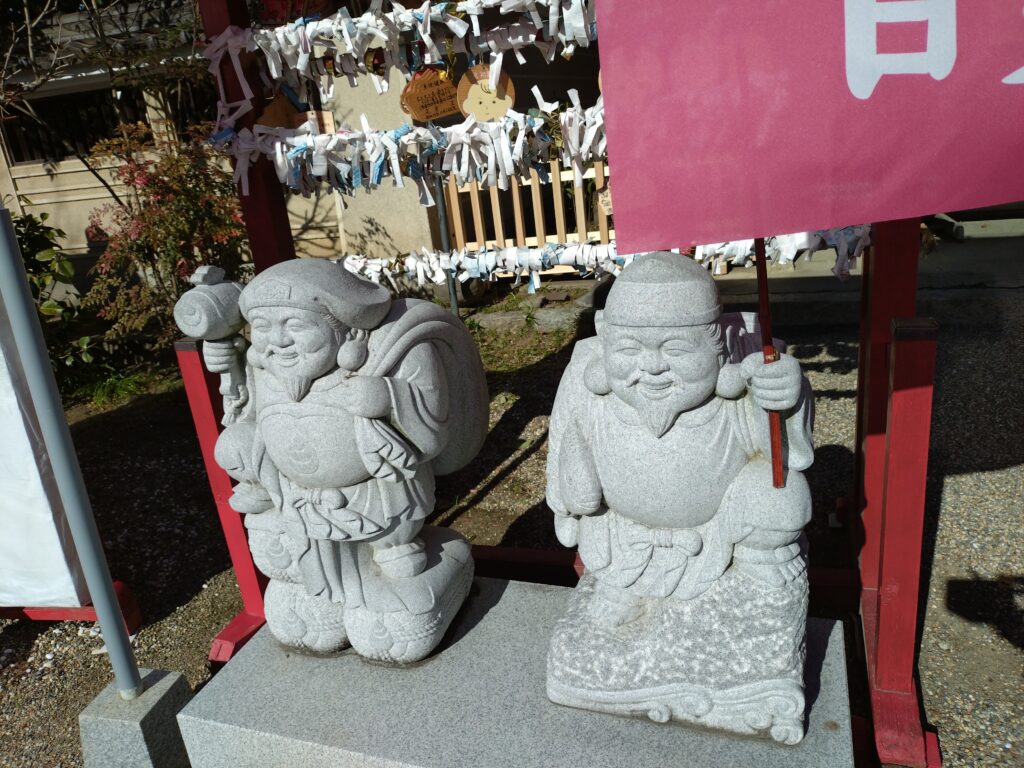
On the right sits Ebisu, the smiling god of prosperity and good fortune, holding his iconic fishing rod. Often paired with Daikokuten (left), these two deities are popular symbols of success, especially during the New Year.
Ebisu (えびす様) is one of Japan’s most beloved deities, especially during the New Year season. Recognized by his cheerful smile, fisherman’s hat, and the large red sea bream he carries, Ebisu represents good fortune, business success, and prosperity through honest effort.
He is unique among Japan’s “Seven Lucky Gods” (Shichifukujin), as the only one who originated purely from Japanese folklore. While others were introduced through Buddhist or Taoist influence, Ebisu is entirely homegrown — a detail that gives him a particularly strong cultural connection to local communities.
Originally revered as the patron of fishermen and merchants, Ebisu’s role has expanded over the centuries to encompass anyone who works hard — from farmers to office workers, creatives, and entrepreneurs. He’s seen as a gentle guardian who rewards sincerity, diligence, and perseverance. His image inspires not just hope for wealth, but respect for the process that leads to it.
During the first ten days of January, many shrines hold Tōka Ebisu (十日えびす) — a festival dedicated to this smiling god. Visitors come to pray for prosperity, receive fukusasa (lucky bamboo branches), and purchase hamaya, omamori, or other charms for success. The atmosphere is lively, filled with ringing bells, joyful voices calling “Shōbai hanjō!” (May your business flourish!), and often accompanied by music or traditional performances.
At places like Miwa Ebisu Shrine in Nara, the celebration is quieter and held later — usually around February 5–7, known as Hatsu Ebisu. This timing reflects local tradition and gives visitors a more peaceful, reflective experience. Even outside festival days, Ebisu’s presence is felt through the symbols left at his shrine: offerings, charms, and sometimes even small decorative rakes (kumade) used to “rake in” good fortune.

At Miwa Ebisu Shrine, decorative rakes (kumade) and lucky charms are displayed outside the shrine office. These items are believed to “rake in” good fortune, especially for business success. Visitors can choose one according to their wishes for the year ahead.
③🌊 The Seven Lucky Gods – A Brief Glimpse
While Ebisu is perhaps the most visible during New Year celebrations, he is also part of a larger group known as the Shichifukujin, or Seven Lucky Gods. These deities represent different forms of luck — from wealth and longevity to happiness, wisdom, and artistic success. Together, they form a kind of spiritual dream team, offering a broad range of blessings.
The Seven Lucky Gods are often depicted riding on a treasure ship (Takarabune), and images of them appear frequently in New Year’s decorations and lucky charms. Many people even take part in the custom of visiting seven different shrines in one outing — one for each god — to start the year fully blessed.
Ebisu’s unique position as the only Japanese-born member gives him a special place within the group. While others such as Daikokuten (wealth), Benzaiten (art & beauty), and Hotei (happiness) draw their roots from India or China, Ebisu remains a symbol of something closer to home — local, grounded, and deeply human.
Though this article focuses mainly on Ebisu, those interested in the full stories and symbolism of the Seven Lucky Gods can explore further. Each one offers a unique perspective on what it means to live well, succeed, and find joy.
👉 Want to meet the rest of the Seven Lucky Gods?
Click here to explore their stories and blessings:
🔗 📖 Japan Life & Spirit #3 – Meet Shichifukujin: Japan’s Lucky Deities
🌿Kaha’s Note
Over the past few years, I’ve had the opportunity to visit many shrines and temples, each offering its own beauty and sense of connection. But there’s something truly special about hatsumōde — the first shrine visit of the New Year.
This year, I began quietly at a small countryside shrine just after midnight on December 31st. Later, I made a point to visit two places that feel deeply personal to me: Tenkawa Benzaiten and Miwa Shrine. I have a strong spiritual bond with both, and I wanted to begin the year by acknowledging that connection.
Instead of simply asking for blessings, I offered words of intention — quietly saying, “This is what I’m setting out to do.” I expressed gratitude for the protection I’ve received, and humbly asked for continued guidance in the year ahead. That simple act of greeting the divine helped me start the year with a renewed sense of purpose and clarity.
In recent years, it has become my custom to visit certain shrines at meaningful moments throughout the year — often once in late December to give thanks, and again in the New Year to offer a fresh greeting.
Each visit brings its own quiet magic.
At every shrine, I experienced small but powerful signs — sudden rain showers, soft rays of light, a gentle breeze when speaking to the deities, or even a rainbow glow between the trees. I chose to see them as auspicious signs, quiet affirmations from the divine.
As I step into this new year, I carry those moments with me as reminders of trust, connection, and presence.
Wishing you peace, growth, and joyful beginnings in the year ahead!
👉This video was captured last year at Miwa Ebisu Shrine.
On that day, the sacred tree stood quietly in the light — a peaceful, grounding moment before the start of the New Year.
(Watch: https://youtube.com/shorts/SwBNDD7f3F0)
👉A quiet return to Miwa Ebisu Shrine — and a surprising moment🌈.
That day, the sacred tree shimmered with rainbow light.
Many believe such signs mark divine presence. I felt it too.
May this year bring you peace, joy, and little miracles. (Watch:https://youtube.com/shorts/BeYYBmqLEbo?feature=share)
🔗 Explore More
Curious to see more stories, images, and reflections on spiritual life in Japan?
Click below to return to 8rainbow.work, where you’ll find seasonal insights, sacred landscapes, and personal notes from along the journey.

コメント