
🎍Lead-in
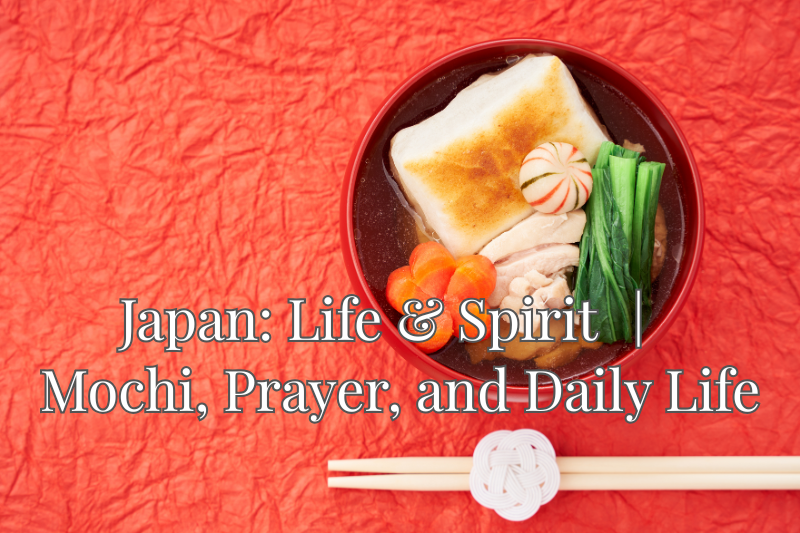
In Japan, the end of the year and the New Year season are closely connected with mochi, traditional rice cakes.
Some people take part in mochi-pounding ceremonies or events at the end of the year, preparing for the days ahead. These customs have been passed down for generations.
During the New Year, mochi appears everywhere —
it is offered to the deities,
displayed as decorations,
and of course enjoyed as food.
From kagami mochi placed on home altars to bowls of ozōni soup,
rice cakes carry both cultural and spiritual meaning.
That said, mochi is not only for special occasions.
Throughout the year, it is enjoyed in many different ways —
sweet or savory,
simple or creatively prepared.
From everyday snacks to seasonal treats,
mochi quietly weaves itself into daily life.
And nothing compares to the taste of freshly pounded mochi —
soft, warm, and deeply comforting.

Traditional mochi pounding
✨ What is Mochi?
Mochi is a traditional Japanese rice cake made from glutinous rice (mochigome),
which is different from the regular rice eaten in daily meals.
Unlike ordinary rice, glutinous rice contains a special type of starch
that becomes sticky and stretchy when cooked.
This is why, after steaming and pounding,
it turns into soft, elastic mochi instead of fluffy rice grains.
Regular rice is soft and slightly sticky when cooked,
but glutinous rice becomes much stickier and more elastic,
allowing it to be pounded, stretched, and shaped into mochi.
Freshly made mochi is especially special —
warm, tender, and gently sweet.
It can be shaped into rounds or squares,
or filled with sweet bean paste, depending on the region and occasion.
Although it looks simple,
mochi carries deep cultural meaning,
symbolizing unity, strength, and good fortune in Japan.
🥣Shapes of Mochi
Mochi comes in different shapes,
and it is sometimes said that square mochi is more common in eastern Japan,
while round mochi is more popular in western Japan.
However, both shapes can be found in many regions today.
Even in Kansai, you can easily buy both round and square mochi,
and each household has its own preference.
For ozōni (New Year soup),
round mochi is used in my family’s tradition for the New Year,
but this also depends on the family and region.
Some households enjoy clear broth,
while others prefer miso-based soup.
In the end,
there is no single “right” way —
each style reflects local culture
and personal tradition.

Round mochi

Square mochi on the grill
🍡 Sweet or Savory?
Mochi can be enjoyed in both sweet and savory ways,
making it a very versatile food.
On the sweet side,
it is often served with kinako (soybean powder),
sweet red bean paste,
or in warm desserts like oshiruko.
On the savory side,
grilled mochi is enjoyed with soy sauce and seaweed (isobe-yaki),
added to soups,
or paired with simple seasonings.
Whether sweet or savory,
mochi easily adapts to different flavors —
from simple comfort food
to creative home recipes.

Mochi with kinako
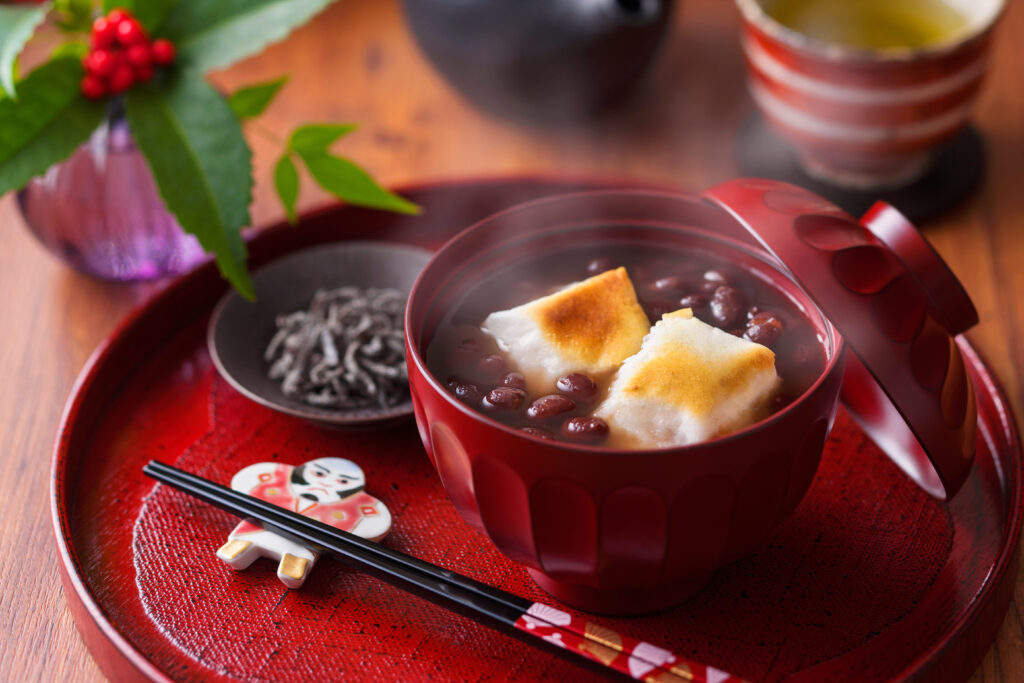
Zenzai with mochi – The difference between oshiruko and zenzai varies by region.
In general, oshiruko is smoother with more liquid,
while zenzai often has whole beans and a thicker texture.

Grilled mochi with seaweed and soy sauce
🥣 Ozōni – New Year Soup Traditions
Ozōni, a traditional New Year soup with mochi,
varies greatly by region and household.
Some families use dashi-based clear broth,
while others prefer white miso,
and in some areas, even chicken-based soup is common.
Mochi can be boiled round mochi or grilled square mochi,
depending on local custom and personal taste.
In my family,
we enjoy ozōni with clear broth,
boiled round mochi,
green vegetables,
kamaboko (fish cake),
and anago (sea eel).
It is our familiar New Year comfort dish.
A friend told me that in her family,
the soup changes over the first three days of the year:
clear broth on the first day,
white miso on the second,
and chicken soup on the third.
Another friend always buys white miso in Kyoto
to prepare her family’s traditional ozōni.
Each household has its own story,
and sharing these differences often leads to lively conversations.
In Nara, there is a unique style of ozōni.
It uses white miso broth
with vegetables such as taro, daikon, and carrots,
cubed tofu, and round mochi.
What surprised me most was how it is eaten —
the mochi is taken out of the soup
and dipped in sweet kinako.
When I first heard this, I was truly surprised.
I had always thought mochi dishes were either sweet or savory,
never both at once —
but this tradition showed me how creative and playful
Japanese food culture can be.
🎍 Kagami Mochi – A New Year Offering
🍊 What is Kagami Mochi?
Kagami mochi is a traditional New Year decoration made of two round rice cakes stacked on top of each other, with a mandarin orange placed on top.
It is usually displayed from the end of December and offered to the household deity or Shinto gods as a prayer for good health, happiness, and a prosperous year.
The round shape symbolizes harmony and continuity, while the stacked layers represent the passing of time and generations.

Traditional kagami mochi for New Year
🌿 Decorations & Their Meanings
Kagami mochi is often decorated with symbolic items:
🍊 Daidai (Mandarin orange)
The word daidai sounds like “generation after generation” in Japanese,
so it represents family continuity, long life, and prosperity.
🌿 Urajirō (fern leaves)
These leaves are green on the front and white underneath.
They symbolize purity and honesty,
and because new leaves grow over old ones,
they also represent family growth and renewal.
🟢 Kombu (kelp)
Kombu sounds similar to yorokobu (“to rejoice”),
so it symbolizes happiness and celebration.
🍂 Dried persimmons
They produce many fruits,
symbolizing abundance and good harvests.
Their sweetness represents a wish for
a gentle and fulfilling life.
🔴 Mizuhiki (decorative cords)
These cords symbolize connections and bonds
between people and families.
Together, all these decorations express
wishes for health, prosperity, harmony, and happiness
throughout the year.
🌿 Different Styles & Regional Variations
Kagami mochi can look different depending on the region or family tradition.
Some use simple designs, while others add decorative cords, paper streamers, or seasonal greenery.
🏠 Modern Kagami Mochi Today
Today, many households use modern versions made of plastic or decorative materials.
Inside, individually wrapped mochi are stored, making them easier to keep and eat later.
Not every family makes mochi at home anymore, and since mochi hardens quickly, these modern styles are practical and convenient for daily life.

Modern kagami mochi for easy display
🍊 After the New Year – Eating Kagami Mochi (Kagami-biraki)
New Year decorations are not just for display.
In mid-January, families hold a tradition called Kagami-biraki —
“breaking” the kagami mochi and eating it together.
The mochi is not supposed to be cut with a knife.
Instead, it is gently broken by hand or with a wooden tool,
to avoid “cutting” good fortune.
The pieces are then cooked in many ways:
- in ozoni (New Year soup)
- as sweet red bean soup (oshiruko / zenzai)
- grilled and topped with soy sauce or kinako
Eating it is believed to bring
health, strength, and good luck for the year ahead.
🌿 Other Flavored Mochi
Mame mochi (bean mochi)
is made by mixing whole black beans into the rice dough.
The beans add a gentle nutty flavor and a slightly salty taste.
Simple, nutty, and deeply comforting.
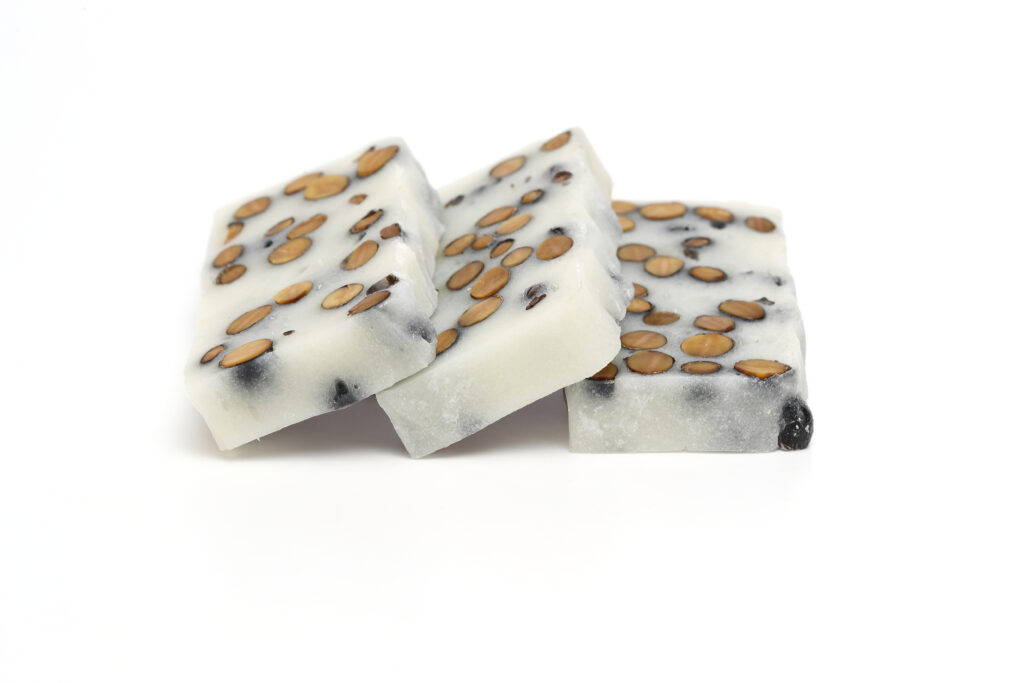
Mame mochi is often sold in small packaged portions at shops.
Yomogi mochi (mugwort mochi)
is flavored with wild Japanese mugwort leaves.
It has a fresh herbal aroma and a soft green color,
often enjoyed in spring.
Aonori mochi
is mixed with green seaweed powder,
giving it a subtle ocean scent and vibrant color.
These varieties show how mochi changes
with the seasons and local ingredients.
Mochi is not just a food —
it reflects Japan’s close relationship with nature.
🌟Kaha’s Note
When I was a child, while my grandmother was still alive, our relatives would gather to make mochi together at the end of the year.
We had a wooden mortar and mallets, and looking back now, I realize how special it was to eat freshly pounded mochi.
Children had an important role too — we shaped the mochi into small rounds.
It was an annual family tradition, with everyone coming together.
Fresh mochi tastes incredible.
We ate it with sweet red bean paste or kinako (roasted soybean powder),
and kinako was always my favorite.
Mame-mochi (mochi with beans) was especially popular.
It disappeared the fastest, so we always made extra.
I remember my father or mother cutting it when it became a little firm and storing it in a cool place.
We don’t do mochi-pounding anymore,
but I still have my own New Year food traditions —
making ozoni with store-bought round mochi,
and always buying mame-mochi.
This year, I received mochi at a shrine and kept it in the freezer,
enjoying it little by little.
Mochi, after all, feels essential to the New Year.
You can also easily make simple soups or desserts using store-bought mochi.
Please give it a try and enjoy it in your own way.
🌈 Explore More
Return HOME
Discover more stories about
Japanese life, spirituality,
nature, and gentle everyday moments
here at Rainbow Awakening.


コメント