

A deer, eating peacefully beside an old university building.
Part of Nara’s rhythm—natural, gentle, and unmistakably symbolic.
- 🌸 Lead-in
- ✨ Note before we begin
- 🦌 Sacred Deer — The Messengers Who Walk With Us
- ⛩Kasuga Taisha — Where the Gods Arrived on the Wind
- 🐉 The Five Dragon Gods of Kasuga — A Journey of Rain and Blessing
- 🌳 Tōdaiji Temple (東大寺)— Where Stillness Speaks Louder Than Words
- 🦌 Deer-Themed Treasures — My Joyful Little Finds
- 🕯 Seasonal Highlights & Living Traditions
- 🧳 Local Eats & Travel Tips
- 🕊 Kaha’s Note
- 🟦 Start Your Journey
- 🟩 Next Topics
- 🟨 Inspiration Snapshots
- 📝 Explore more
🌸 Lead-in
Nara has always felt like home to me—
not just a place I once lived, but somewhere my soul could rest.
My first job brought me here, and from the very start,
I felt a gentle sense of belonging—as if the city itself knew me.
Though I don’t live in Nara now, I’m close by and return often.
Every visit brings a comforting warmth, like meeting an old friend.
✨ Note before we begin
If you’re looking for practical guidance or seasonal tips for your trips, I’ve gathered links to helpful tourist resources at the end of this post.
If you enjoy visual guides or want to plan a visit, don’t miss it!
But for now,
I invite you to walk with me—on a small spiritual journey through Nara Park(奈良公園).
A place where sacred energy lingers… and gentle stories rise from the stone and trees.
🦌 Sacred Deer — The Messengers Who Walk With Us
In Nara, deer are not just wildlife. They are divine messengers—believed to have carried the thunder god Takemikazuchi-no-Mikoto to Kasuga Taisha on a white deer centuries ago.
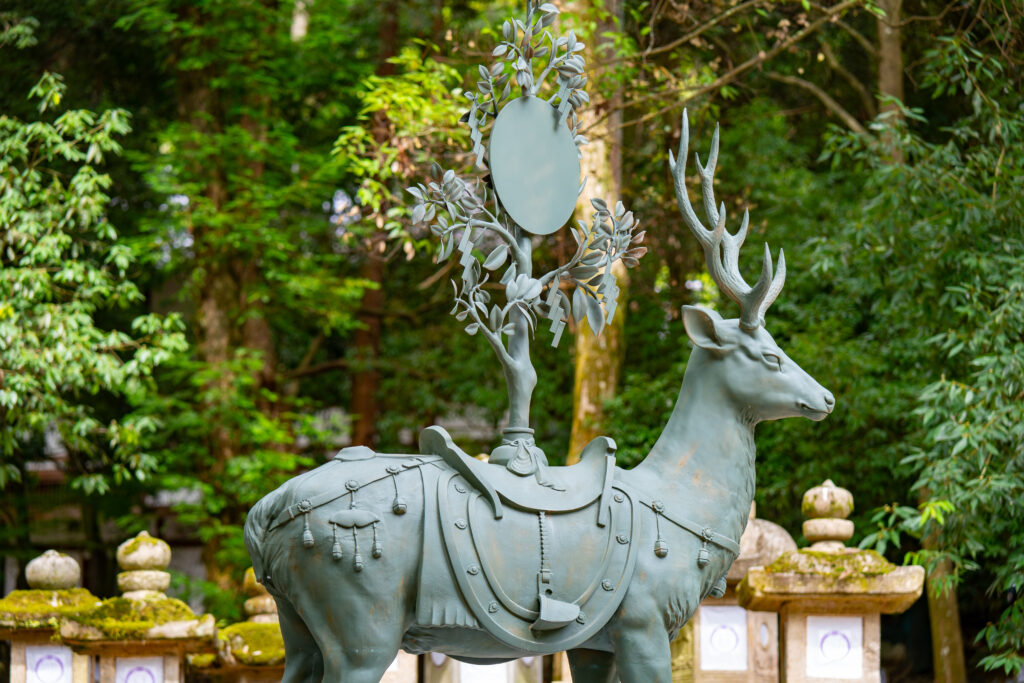
📝A statue of the sacred deer—carrying a divine presence on its back. A tribute to the legend of Takemikazuchi, the thunder god who arrived in Nara riding a white deer.
Since then, harming a deer in Nara was once punishable by death. Today, They roam freely in and around Nara Park—a community of around 1,200 to 1,300 deer, protected as national treasures. They bow when you offer them deer crackers. They stroll past lanterns, nap beneath shrines, and look you in the eye with surprising calm.

📝 In Nara, the sacred walks beside you—quietly, gently.
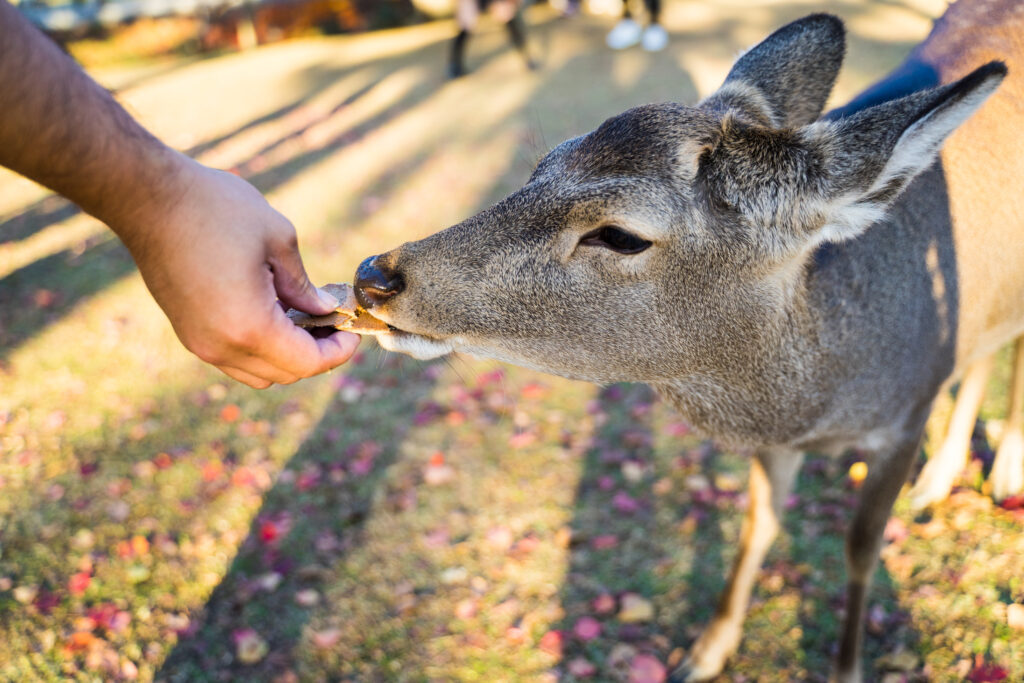
📝Deer eating ”Shika-Senbei“:You can feed them “deer crackers” in the park. Some are friendly and gentle and others are ….sometimes aggressive to get their treat!
⛩Kasuga Taisha — Where the Gods Arrived on the Wind
Nestled in the forest at the foot of Mount Mikasa, Kasuga Taisha Shrine (春日大社) was founded in 768 by imperial command. It enshrines four powerful deities, and still hosts over 2,200 rituals each year.
Just like the revered Ise Grand Shrine, Kasuga Taisha undergoes a Shikinen Zōtai — a full renewal of its main buildings — every 20 years. This tradition continues an unbroken cycle spanning more than a millennium, with the 60th renewal completed in 2016.
The vivid red halls, wisteria-laced gardens, and rows of ancient lanterns all whisper stories from centuries past. During Golden Week, over 200 wisteria varieties bloom in the shrine’s garden—violet curtains swaying like divine veils.
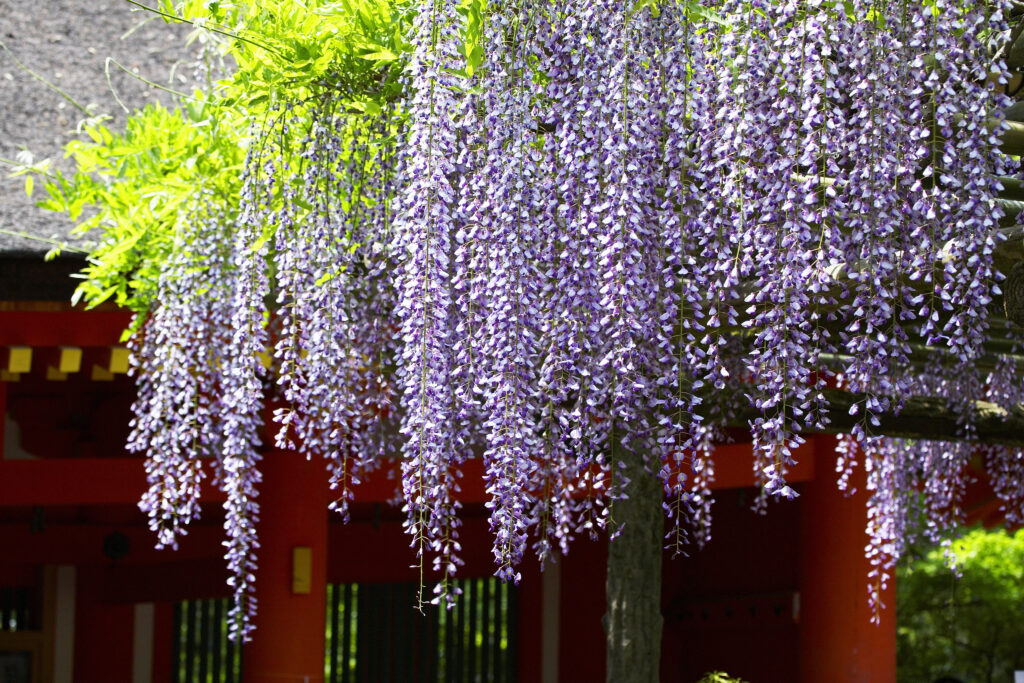
📝 The shrine’s crest bears the wisteria(藤)—graceful, eternal, and alive with devotion.
🐉 The Five Dragon Gods of Kasuga — A Journey of Rain and Blessing
Among Kasuga’s lesser-known spiritual paths is the Five Dragon Gods Pilgrimage—a mystical route connecting sacred spots where dragon deities are said to dwell. These dragons are protectors, bringers of rain, and lifters of fortune.
From the main shrine to hidden forest shrines like Kōzan Ryūōsha, each stop invites prayer and reflection. The dragons’ presence is quiet but powerful, believed to still answer the call of rain-seekers when all else fails.
This sacred path deserves its own story—a journey of quiet power and whispered prayers.I’ll walk it in detail soon—and I hope you’ll join me when I do.
🌳 Tōdaiji Temple (東大寺)— Where Stillness Speaks Louder Than Words
Tōdaiji’s wooden gate rises like a passage into another time. Inside, the Great Buddha (大仏) sits—15 meters tall, cast in bronze, and radiating silent presence. One hand raised in blessing, one palm open in welcome.
A nearby pillar has a hole at its base, said to match the Buddha’s nostril. Children squeeze through, giggling. A few brave adults try and fail(It’s said to be about 30cm wide!), laughing all the same. It’s said to bring luck and smooth your path ahead.
A short walk uphill reveals Nigatsudō, a lesser-known hall with one of the most breathtaking views in Nara.

📝The Great Buddha of Tōdaiji: Eyes of calm, hands of blessing—this Daibutsu holds centuries of stillness.
He has 966 curls on his head, each one said to hold wisdom and radiate enlightenment.
His right hand is raised in the Abhaya Mudra—a gesture of fearlessness and protection.
His left hand rests open in the Varada Mudra—a symbol of compassion and welcome.
Visitors can also take part in the temple’s legacy through a simple, meaningful act: contributing a roof tile.
These tiles bear handwritten prayers or names, and are used in the temple’s ongoing preservation work.
It’s a quiet gesture that becomes part of something enduring—a personal wish held by centuries-old wood and stone.

📝 Sunset from Nigatsudō (二月堂): The city glows beneath temple eaves. A view worth every step.
🦌 Deer-Themed Treasures — My Joyful Little Finds
All around Nara, deer-themed goods pop up like delightful surprises—on shelves, in small local shops, and even tucked into handmade corners of the city. I couldn’t resist gathering a few, and every time I look at them, they make me smile.
Here’s a peek into my little collection of favorites. Each one carries a timeless joy—like a whisper of Nara’s stillness, always nearby.
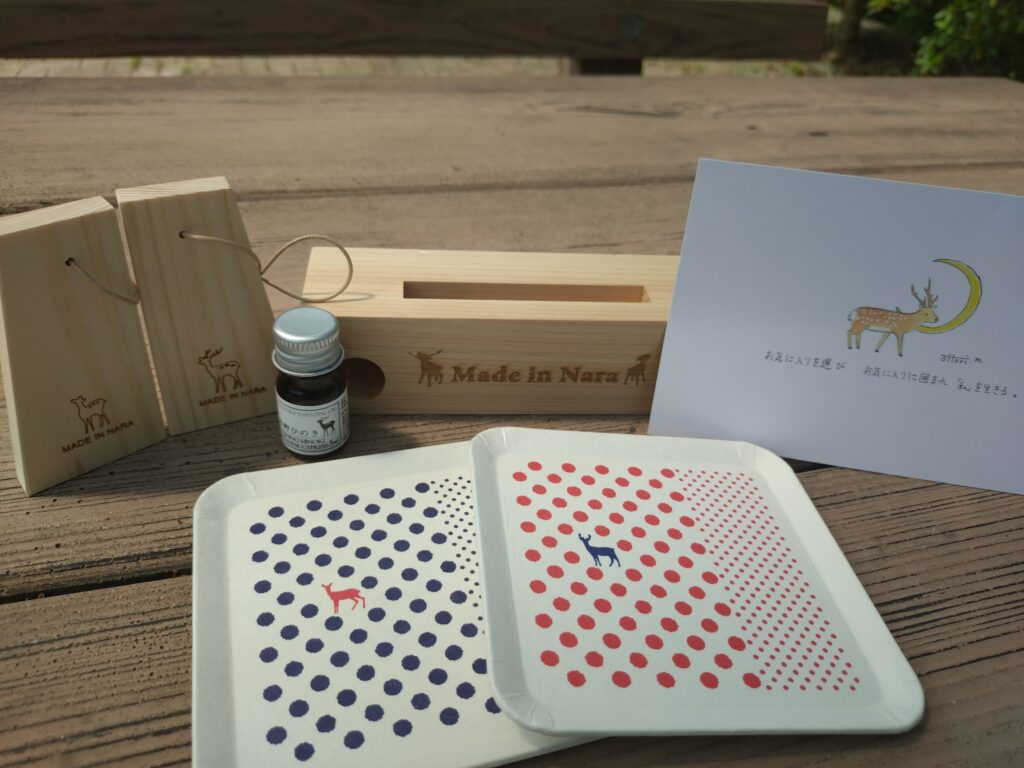
📝 In the Center; Cedar Phone Stand: Sleek and simple, this wooden phone stand is light, sturdy, and features a carved deer silhouette I love.

📝 : Yoshino Hinoki Oil & Hinoki Deodorizing Blocks
Essential oil made from Japanese cypress—fresh, clean, and a deer-shaped label that’s just too cute. And tiny but powerful blocks for shoes or drawers—naturally fresh, and the scent keeps the bugs away too.

📝 Washi Tray: Made of Japanese washi paper—great for holding sweets, jewelry, or keys. So useful and charming.

📝 “Choosing what I love, surrounded by the things I love, I live as my true self.” A postcard that feels like a wish.
🕯 Seasonal Highlights & Living Traditions
● Tokae (August)
For ten days each August, Nara Park glows with thousands of lanterns. The event, called Tokae, turns stone paths into rivers of light. It’s beautiful. Reverent. And truly unforgettable.
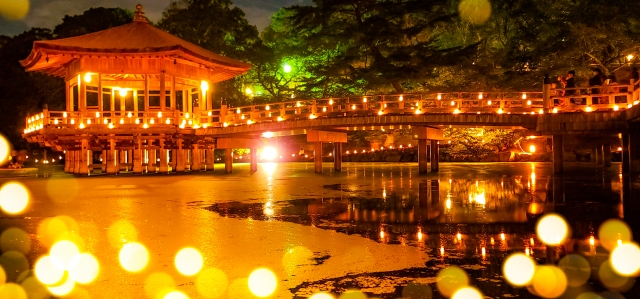
📝Candle-lit path at Tokae:A thousand lights, a single hush—Tokae invites you into the stillness of night.
● Horn-Cutting Ceremony (November 8th&9th this year-2025)
To protect humans and deer alike, male deer have their antlers gently removed in a ritual that dates back to the Edo period. Held in a roped-off arena near Kasuga Shrine, this ceremony is both practical and deeply respectful. (Check the time and place beforehand!)
● Manyō Botanical Garden (Year-round)
Adjacent to Kasuga Shrine, this garden is a living anthology. Over 300 plants found in the Manyōshū poetry collection bloom across the seasons—each paired with a poem that once praised its beauty.

📝 “Yamafuji”-Wisteria in Manyō Garden I saw this April
Wisteria—each blossom carries a poem, each path a verse.
And there’s more…
🏮 Chūgen Mantōrō (August 14–15): 3,000 stone and bronze lanterns are lit at Kasuga Taisha during Obon.
🌸 Cosmos Bloom at Hannyaji Temple (Oct–Nov): Over 150,000 cosmos fill temple grounds with soft color and stillness.
🎑 Uneme Festival (Full moon in mid-autumn): A poetic celebration with flute music and lantern-lit boat processions at Sarusawa Pond.
🎎 Kasuga Wakamiya On-Matsuri (Dec 15–18): Bugaku, Gagaku, and a vibrant procession across Nara’s spiritual past.
👹 Setsubun at Kasuga Taisha (Feb 3): Bean-throwing and ancient dances to drive away evil and welcome spring.
🔥 Omizutori (March 1–14): Part of Tōdaiji’s Shuni-e rite, this 1,200-year-old fire ritual purifies the path for spring. Monks carry massive torches along the balcony of Nigatsudō—sparks fall like blessings onto the crowd below.
🧳 Local Eats & Travel Tips
If you’re near Kintetsu Nara Station, these are some of my friends’ and my go-to food spots in Nara—full of character, warmth, and great taste.
🍴 Local Flavors to Savor
Some gourmet friends shared their favorite culinary finds—places where local warmth meets delicious creativity. And of course, some are my favorites, too!:
- Katatsumuri (お台所&サロン かたつむり): A small, gallery-like café offering seasonal lunch and melt-in-your-mouth desserts. Cozy, cute, and thoughtfully vegetarian-friendly. https://www.instagram.com/katatsumuri5963/
- Allez!! Le Trèfle (アレ!! ル トレッフル): A sommelier’s haven of Japanese wines and flavor-balanced dishes, with non-alcoholic options that shine just as brightly.
- toi Inshokuten (toi 印食店): A neighborhood gem serving Michelin-level curry—rich, soulful, and fragrant. https://www.instagram.com/toi_insyokuten/
- Gohan no Aida (ごはんの間): Homestyle set meals with crisp tempura, the kind of comfort that feels like coming home. https://www.instagram.com/gohanno_aida/
- Maverick (マーベリック): —playful, joyful comfort food that surprises with every bite. https://www.instagram.com/theburgerstandmaverick/?hl=ja
- fajii (ファジー): Crepes so light they almost float, paired with coffee and a calm vibe—perfect for a mellow afternoon.https://www.instagram.com/fajii.cp/
- Shōrai (松籟): Known for winter hot pots, but its summer bento and elegant shaved ice are grown-up delights meaningfully arranged.https://www.instagram.com/explore/locations/1016318076/song-laishourai-matsunooto/
- Cozy Cafe(コージーカフェ):Everyday comfort food and simple, heartfelt sweets—served in a cozy, natural-style café full of charm.https://www.instagram.com/cozy03836/
Curious where to find them? You can look them up on Instagram—it’s a fun way to explore before you visit! Or simply show the names at Kintetsu Nara Station or near Sarusawa Pond’s tourist desk, and they’ll point you right there—or pop them into Google Maps for instant directions. And if you’re more of a visual wanderer, photos are coming, hopefully soon, to complete the journey.”
🧭 Useful Resources
Planning a trip—or just curious about Nara?
Here are some helpful resources and joyful discoveries to round out your visit:
🌐 Official Travel Info
・💻Visit Nara Official Website
https://www.visitnara.jp
Find seasonal highlights, cultural guides, maps, and more. Available in English.
📍 Tourist Info Centers:
・🍃Kintetsu Nara Station: Small, but convenient and English support available.
・🍃Sarusawa Pond Area (above the convenience store): Spacious, with pamphlets, maps, computer access, and sometimes origami workshops.
🗣 Ask about English volunteer guides—reservations may be required, but these local experts make the experience even more special.
👩English Volunteer Guides
・🎤Nara City SGG Club (Volunteer guides) – Email: narasgg20@gmail.com
👉For the latest information, please check their official websites.
🕊 Kaha’s Note
Some places stay with you long after you leave.
For me, Nara Park is one of them.
It’s not just the temples, the deer, or the festivals.
It’s the small moments—
The way a deer pauses to look at you.
The soft crunch of leaves under your feet.
The feel of history resting just behind the next tree.
Whether you come for photos, peace, or simple curiosity…
I hope Nara Park leaves its gentle imprint on your heart, too.
🟦 Start Your Journey
This blog journey has already begun.
Here are a few stories to start with.
👉Divine Thread Pre-#1 part 1 :The Lineage of the Kami: A Gentle Introduction
👉Soulful Shares>Spirit Snippets#1: Ancient Japanese Language Katakamuna:Your Name Has a Spell
🟩 Next Topics
Themes currently in the works—coming soon.
👉Divine Thread: Tenkawa (Benzaiten) (Working Title)
👉Divine Thread: Goddess of Mt.Fuji:Konohanasakuya-hime(Working Title)
👉Featured Series: Gion Festival in Kyoto (Working Title)
🟨 Inspiration Snapshots
These are glimpses of inspiration captured in everyday life.(Updated Weekly).
👉Back to HOME
📝 Explore more
Want to explore more places and stories in Japan?
Browse the Rainbow Map.Explore the full map of this blog—colorful paths, hidden turns, and all.
👉 Return to the main page


コメント