
- ✨ Lead-in
- 😺What Exactly Is a Maneki-neko?
- 🐾Symbolic Meanings of the Maneki-neko
- 🐾The Stories Behind the Maneki-neko
- 🐈⬛ Danō Hōrin-ji — Temple of the Black Maneki-neko(黒招き猫で知られるお寺)
- 🐉 Kamo River Dragon Deity – The Guardian of Water & Weather(加茂川龍神 ― 八大龍王)
- 🐾 A Prayer for Protection — for You, and for This Journey
- 🐈⬛Kaha‘s Note
- ✨ Explore More
✨ Lead-in
If you spend any time in Japan,
you’ll eventually notice a small cat raising one paw—
sitting quietly at shop entrances, watching over restaurants,
appearing in homes, and even decorating everyday products.
Just today, I saw it printed on a beer package at the supermarket.
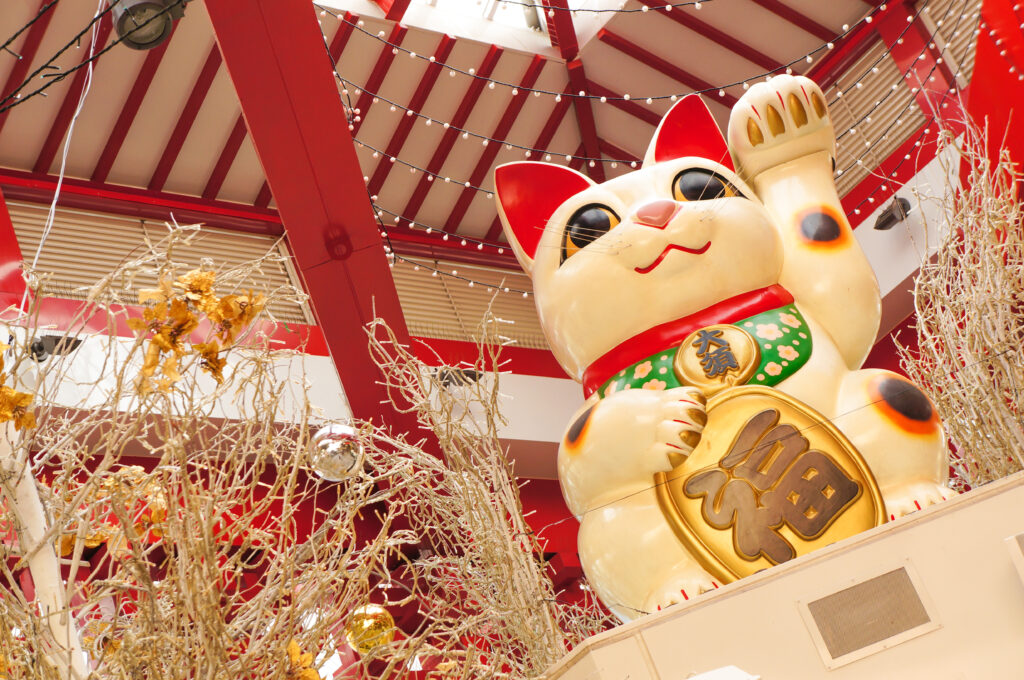
This is the Maneki-neko, the “Beckoning Cat,”
a beloved symbol of welcome and good fortune in Japanese culture.
But the more I look at it,
the more I realize there is far more to this little figure
than its charming smile.
Different paw positions, heights, and colors are said to hold different wishes—
for luck, protection, good relationships, or prosperity.
So today, I wanted to learn a little more
about how the Maneki-neko lives within Japanese culture,
and why it continues to be such a meaningful symbol for so many people.
😺What Exactly Is a Maneki-neko?
Although the Maneki-neko is familiar to many people today,
its meaning goes far beyond being a cute or decorative cat.
At its core, the Maneki-neko is a symbolic gesture—
a small figure embodying the wish to welcome something positive into one’s life.
The raised paw is not simply a wave;
it represents an invitation for good fortune, relationships, safety, or prosperity
to “come closer.”
What makes the Maneki-neko unique in Japanese culture
is that it sits at the intersection of folk belief, everyday spirituality, and prayer.
It is not a formal religious object like a statue at a shrine,
nor is it merely a commercial icon.
Instead, it has lived in the space between those worlds—
a familiar guardian that people keep near their doors, shops, or workspaces
to subtly protect the flow of their days.
Over time, different gestures, designs, and colors
came to represent different kinds of blessings,
and the Maneki-neko grew into the richly layered symbol it is today.
🐾Symbolic Meanings of the Maneki-neko
The gestures of the Maneki-neko are often interpreted
as small invitations—each one expressing a different kind of blessing.
These meanings vary across regions and traditions,
but the following associations are commonly recognized in Japan.
■ The Raised Paw
- Right paw raised
Invites financial luck, prosperity, and success in business. - Left paw raised
Welcomes people—customers, supportive relationships, and good connections. - Both paws raised
Suggests an invitation for both protection and prosperity,
though some say it can also resemble a gesture of surrender,
so it is less often seen.
■ The Height of the Paw
- High (above the ear)
Said to call in larger blessings from afar. - Lower (near the face)
Invites small, everyday forms of good fortune.
■ Colors and Their Common Interpretations
(These meanings are cultural interpretations and can differ by source.)
- White – good luck, positive beginnings
- Black – protection from misfortune
- Red – health and safety
- Gold / Yellow – wealth and abundance
- Pink – love and good relationships
The richness of these variations shows
how the Maneki-neko has been embraced not only as a decoration,
but as a familiar symbol of hope woven into daily life.
🐾The Stories Behind the Maneki-neko
The true origin of the Maneki-neko is not known,
and several stories have been passed down through generations.
Rather than a single historical point,
its beginnings live in a collection of small legends.
One popular story tells of a temple cat who raised its paw
to beckon a traveler away from a sudden lightning strike—
an act that saved his life and brought prosperity to the temple.
Another tradition suggests that merchants in Edo (old Tokyo)
kept cats to protect their shops from pests,
and over time, crafted small cat figures as charms to invite good customers.
Because of these overlapping tales,
many places in Japan are associated with the “birth” of the Maneki-neko—
each offering a piece of its long, gentle journey through Japanese life.
🐈⬛ Danō Hōrin-ji — Temple of the Black Maneki-neko(黒招き猫で知られるお寺)
Among the many temples in Kyoto, Danō Hōrin-ji(朝陽山 檀王法林寺)—
fondly called “Dannō-san” by locals—
is especially famous for its Black Maneki-neko charm,
believed to hold jinzūryoku, a sacred spiritual power.
🖤 Origin of the Black Cat Charm(黒猫お守りの由来)
According to temple tradition passed down since the Edo period,
this right-paw-raising Black Maneki-neko is regarded as
the messenger of a nighttime guardian deity
and is said to gently guide its owner toward good fortune.
It remains one of the temple’s most cherished and symbolic charms.
But to understand why this little black cat is so special,
it helps to know the history behind Danō-san itself.
🏯 The History of Danō Hōrin-ji(檀王法林寺の歴史)
The site originally held an older temple that, over centuries,
suffered repeated natural disasters and human conflict.
By the late Sengoku period (1558–1569),
that former temple had completely disappeared.
In the early Edo period, the temple was revived by
Taichū Shōnin(袋中上人, 1552–1639),
a widely traveled and deeply learned monk of the Jōdo (Pure Land) school.
He attempted to journey to Ming China for further studies,
but when entry into the country was not permitted,
he landed instead in the Ryukyu Kingdom (Okinawa).
There, he dedicated himself to teaching Pure Land Buddhism,
leaving a lasting cultural influence—
and some traditions even link his presence
to the early roots of Eisa, Okinawa’s iconic spirit dance.
After returning to Japan,
he reestablished this temple as Danō Hōrin-ji,
a place of prayer and compassion.
Its principal image, a graceful Eleven-faced Kannon,
dates back to the Heian period and preserves the temple’s ancient lineage.
🌙 Shuya-jin and the Black Cat(主夜神と黒猫のつながり)
Danō-san is also home to a unique spiritual presence: Shuya-jin(主夜神),
a guardian deity believed to watch over people during the night
and guide them away from unseen misfortune.
The Black Maneki-neko is understood to be Shuya-jin’s divine messenger.
Bringing this charm into one’s home is said to invite
both protection and quiet good fortune.
When seeking Shuya-jin’s blessing, worshippers chant:
「をん ばさんば えんち しゅやしん そわか」
On basanba enchi shuyashin sowaka
—three times, to call upon the guardian’s presence.
On the first Saturday of each month,
the sacred image of Shuya-jin is revealed.
I visited on that day myself,
and the atmosphere felt quietly charged—
as if the guardian spirit were very near.
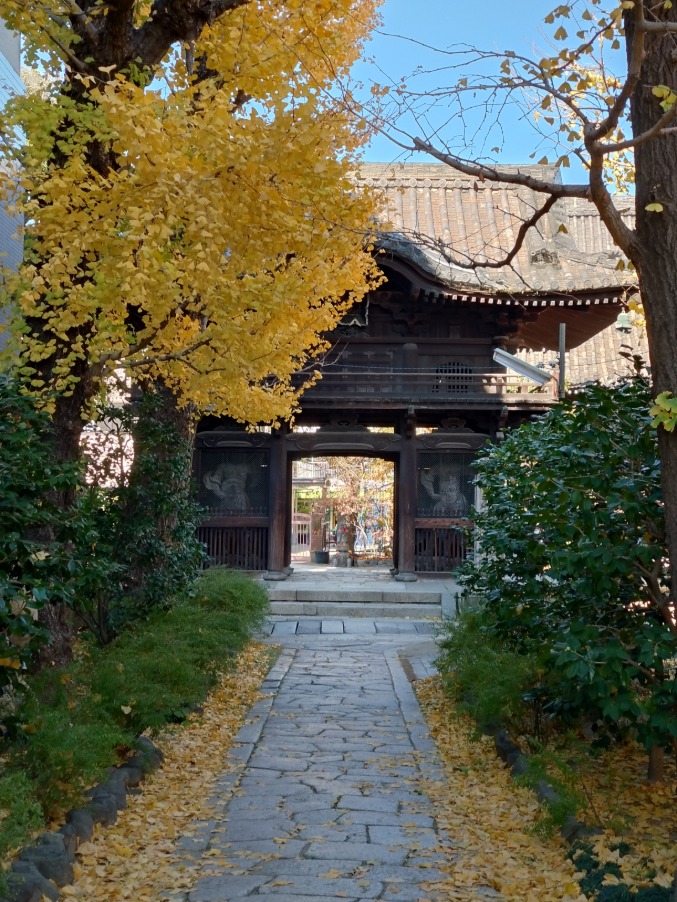
A golden path leading to the temple gate — autumn quietly preparing the way to meet the Black Maneki-neko’s guardian deity.
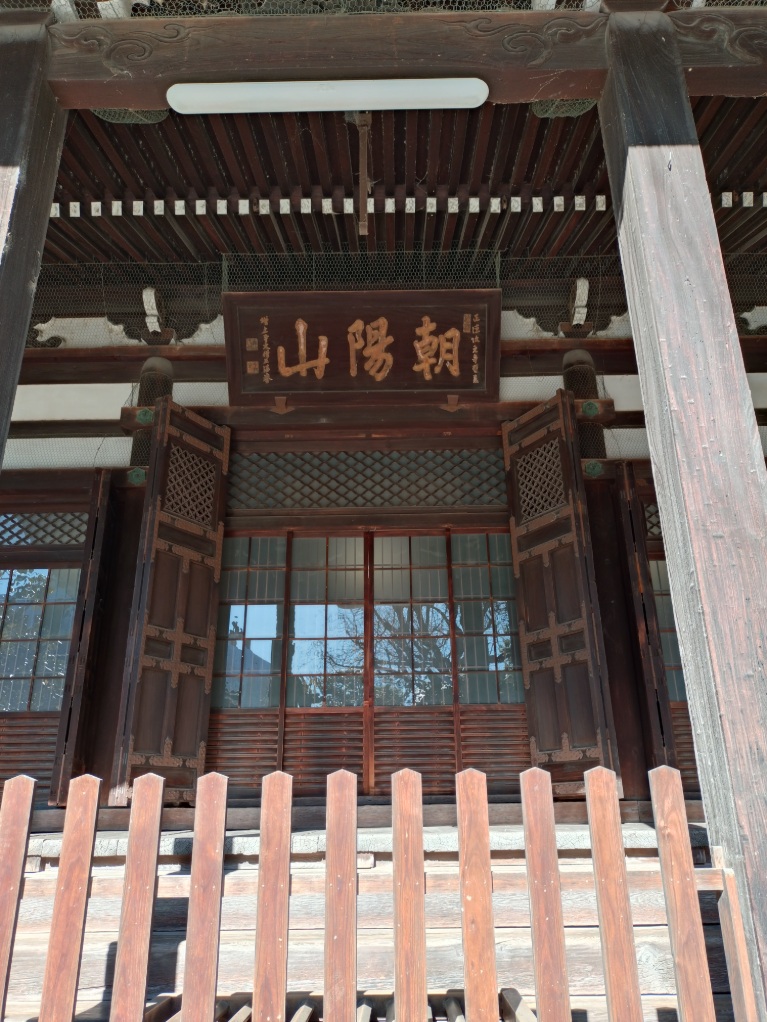
The main hall of Danō-Hōrinji, founded on the former site of an ancient temple lost to fire and disaster — later revived by the monk Fuchū Shōnin.
🐉 Kamo River Dragon Deity – The Guardian of Water & Weather(加茂川龍神 ― 八大龍王)
This temple also enshrines a powerful dragon deity:
Kamo River Ryūjin (加茂川龍神 or 八大龍王) — a protector believed to safeguard people from drought, floods, and other water-related misfortunes.
According to temple records, the dragon deity was enshrined here in June of 1666, by imperial order of Emperor Reigen.
Since then, the dragon has been revered as a guardian of the weather, the seasons, and the flow of blessings.
Every year, on the first Saturday of June, the temple performs the Ryūjin Hōyō (Dragon Deity Ritual), during which a secret image of the Kamo River Dragon is revealed to the public.
✨ Mark your calendar!
It’s a rare and sacred moment when the dragon’s presence is felt most strongly.
🐾 A Prayer for Protection — for You, and for This Journey
During my visit, I offered a quiet prayer to both deities:
Shuyashin, the nighttime guardian who watches gently through the Black Maneki-neko,
and the Dragon King, whose flowing power protects and guides.
I prayed for protection, clarity, and gentle blessings for everyone who finds their way to this post.
And if you’d simply like to see a small moment from my visit—
✨ here is a quiet glimpse of the Black Maneki-neko charm at the temple:
https://youtube.com/shorts/RIAFBaAzPK0?feature=share
Just a simple moment, but perhaps a gentle blessing finds you too.
🐈⬛Kaha‘s Note
I also offered a special prayer for my own Black Maneki-neko charm —
that its ancient jintsūryoku (divine mystic power) may awaken fully,
and that it may guide me with wisdom, luck, and protection as I continue this path.
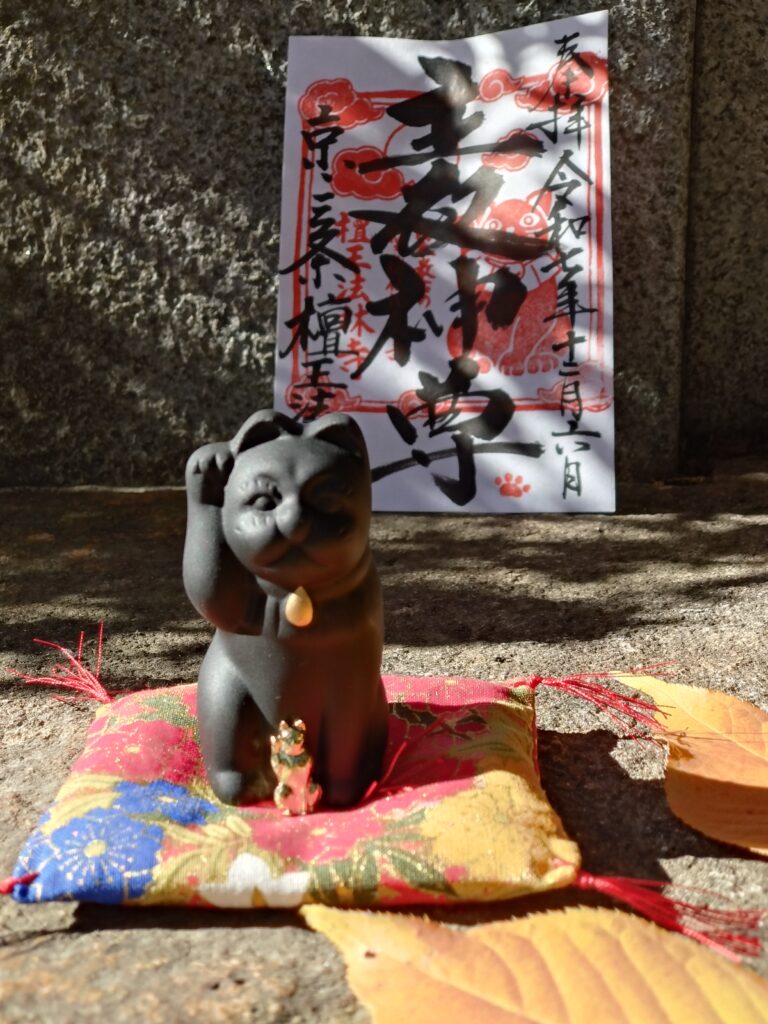
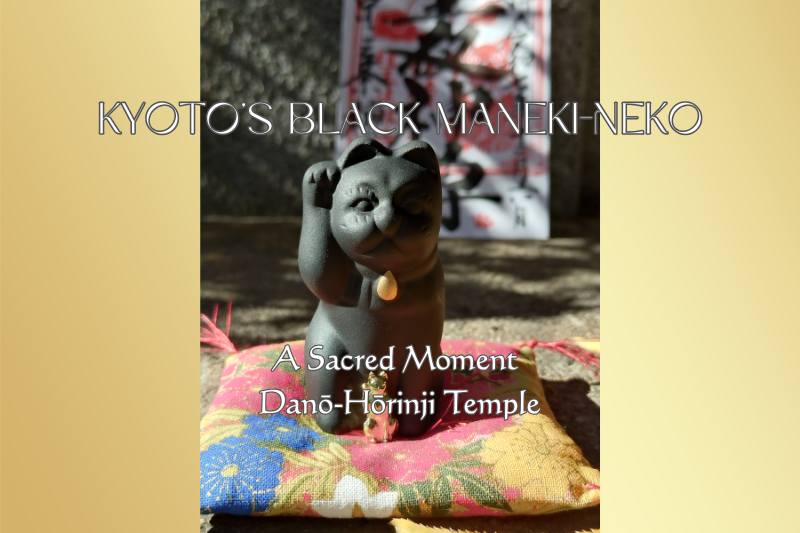
The Black Maneki-neko, my goshuin, and a tiny golden charm for my wallet — a small moment of blessing under the autumn sun.
✨ Explore More
If this story spoke to you,
you might enjoy exploring other sacred places, gentle moments,
and spiritual threads from across Japan.
May the next page bring you the guidance you’re seeking.
🏡 Return HOME → https://8rainbow.work


コメント