

🐇Lead-in
Each year, in a quiet corner of western Japan, a sacred gathering unfolds. It is the month of Kamiarizuki—the time when the deities of Japan are said to gather in Izumo for a sacred council, where the invisible threads of fate are woven.
Kamiarizuki, known as “the Month of the kami (deities),” is the only time in the year when all the kami leave their shrines across Japan and travel to Izumo for sacred deliberation.
Though I had visited here once before, years ago on a rushed day trip with friends, this journey felt different—deeper, more personal. This time I came with intention: to truly connect with the land, its stories, and the sacred presence that lingers through it all.
I chose this moment carefully, drawn by something quiet and old, something that called to me through the winds and the myths. The city itself felt warm and welcoming, dotted with gentle smiles—rabbit statues and cheerful figures of Ōkuninushi around every corner. They made me smile, too.

Rabbit of Izumo—En-kun and Yui-chan—greeting visitors in front of a local shop, with smiles and the promise of connection.

Daikoku-san, the local form of Ōkuninushi, god of connections, abundance, and good fortune, standing warmly at the edge of the sacred and the ordinary.
And yet, beneath the charm and playfulness, there was something deeply sacred. A stillness. A strength. As I walked from the sacred Inasa Beach to the solemn torii of Izumo Taisha, I could feel it rising from the ground beneath my feet—like the memory of a thousand prayers, still echoing in the air.
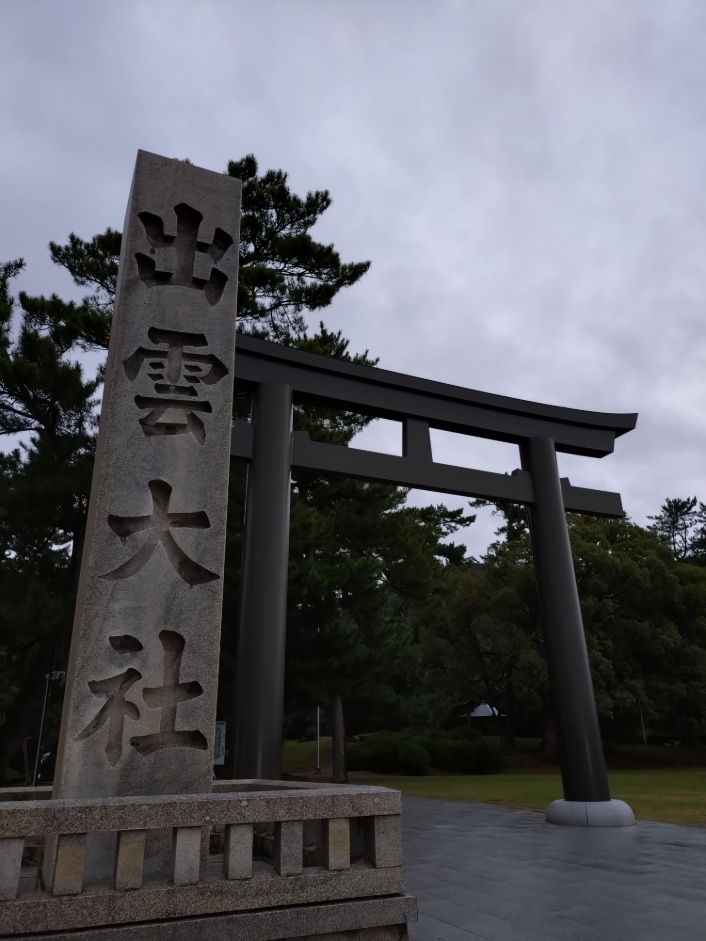
Izumo Taisha’s torii on a day of shifting skies—thunder at the start, lightning in the distance, and sunlight breaking through just after prayer. A breath of Ryūjin in the air.
This journey was more than a visit. It was a quiet reunion—with stories I’ve long carried, and perhaps with something greater than myself.
🎥 A Short Video from Izumo:
If you’d like a visual glimpse into this sacred landscape, we’ve created a short video capturing the atmosphere of Izumo—where myths meet the sea, and kindness leaves quiet footprints.
🔗 Watch it here on YouTube
(Just under a minute—feel free to visit after reading or bookmark for later.)
🌀Izumo: The Land Where Deities Gather
🌊⛩️ Izumo: Where and Why?
①Where is Izumo?
Located in Shimane Prefecture, facing the Sea of Japan, Izumo may appear quiet and remote—but in myth and memory, it is the heart of divine history.

Shimane Prefecture (highlighted in orange) is located on the western coast of Japan’s main island, Honshu. Though often overlooked on modern travel routes, it holds deep spiritual and historical importance in Japanese mythology.
②Why Izumo?
In ancient Japanese cosmology, the world was divided into two realms: Takamagahara, the heavenly plain, and Ashihara no Nakatsukuni, the middle land—earth. While the heavenly deities looked down from above, it was Ōkuninushi, a powerful earthly kami, who built order, healing, and harmony in the land below.
As the heavenly realm sought to bring the earthly world under its rule, Amaterasu Ōmikami, the Sun Goddess, sent divine messengers to negotiate. What followed was a sacred dialogue—not a battle, but a divine transfer of authority, now known as the Kuni-Yuzuri or “Transfer of the Land.”
Ōkuninushi’s peaceful surrender, on the condition that a grand shrine would be built in his honor, marked a turning point in mythological history—and sanctified Izumo as a place where heavenly and earthly powers aligned. (We will explore this story more deeply in a future post.) This myth, though ancient, still shapes the spiritual identity of Izumo today.
From the windswept shore of Inasa Beach, where the deities are said to arrive, to the sacred halls of Izumo Taisha, the land breathes with myth.
To stand in Izumo is to stand where heaven once touched earth—and where, perhaps, it still does.
③Inasa Beach and the Arrival of the Deities
Inasa Beach may appear quiet—its wind smooth, its tide gentle—but it holds a powerful place in Japan’s mythological memory.
This is no ordinary shoreline. According to ancient belief, it is the very place where deities from all over Japan arrive each year during Kamiarizuki, the “Month of the kami.”
While most of Japan enters “Kannazuki” (the month without deities), Izumo becomes the sacred host of their divine assembly. Their arrival is not just symbolic—it is a deeply spiritual event. And it is said to begin here, on this beach.
Every autumn, on the 10th night of the lunar 10th month (usually falling in late November on the modern calendar), a sacred ritual called Kamimukae Shinji (“Welcoming of the Deities”) is held on these sands. Torches illuminate the shore, voices rise in ancient chant, and the ocean carries unseen footsteps to the land.
I had long hoped to witness or share this ancient ritual—an offering of light and prayer to guide the gods ashore. Though I cannot attend the ceremony this year again, simply standing on these sands during Kamiarizuki felt like an echo of that welcome.
I hope to share more about this sacred tradition in the future. For now, I offer this quiet glimpse of the place where it all begins.
The rock that rises from the beach is known as Bentenjima. Today, it is said to enshrine Tamayorihime-no-Mikoto, a revered female kami associated with sacred water and divine lineage.
During the era of Shinbutsu-shūgō (syncretism of Shinto and Buddhism), the site was once associated with Benzaiten, the Buddhist goddess of music and fortune—but the current enshrinement honors the original Shinto tradition.

The sacred rock known as Bentenjima at Inasa Beach, said to be the arrival point for deities during Kamiarizuki. The small shrine atop now enshrines Tamayorihime-no-Mikoto.
When I stood on this beach, there were people around—but I waited for a moment when no one was in view. I wanted to capture its stillness, the quiet breath of the sacred that lingers beyond what the eye can see. There was no ritual that day, but I could feel it—that brief thinning of the veil, as if the sacred had just passed by.
There is also a quiet custom here: pilgrims collect a small amount of sand from Inasa Beach, and later exchange it with the sacred sand behind the Sogano-yashiro (素鵞社) at Izumo Taisha. This ritual of sand exchange is believed to offer protection, purification, and blessings from Susanoo-no-Mikoto, the deity enshrined there. It is said that returning home with the sacred sand creates a link between one’s own land and the sacred grounds of Izumo.


The sacred sand of Inasa Beach—pilgrims take a small amount to exchange with sand from Sogano-yashiro behind Izumo Taisha.
The blessed sand is then brought home and gently sprinkled on one’s land, a quiet ritual of connection, purification, and divine protection.
As one walks the path between Inasa Beach and Izumo Taisha, this presence of Tamayorihime continues—her small shrine standing quietly along the Kami-mukae-michi, the sacred path of the gods’ welcome.

The Path to Tamayorihime: the path leading to the shrine of Tamayorihime no Mikoto—quiet, green, and full of breath. A sacred stop along the ancient “Kami-mukae no Michi,” where the deities are welcomed from the sea.

Spiral Messenger: along the path, I found a tiny visitor—a snail slowly making its way through the leaves. In spiritual traditions, encountering a snail near a shrine is seen as a sign of gentle protection, inner growth, and spiritual awakening. The spiral of its shell reminds us that sacred journeys unfold one quiet step at a time.
🔮 A Sacred Time of Connection
From late November (starting on the evening of the 29th) through December 6th, Izumo enters its most sacred season—Kamiarizuki, or “the Month of the Deities.”
During this time, it is believed that kami from all over Japan arrive in Izumo to participate in Kamihakari, a divine council where they discuss the weaving of fate, relationships, harmony, and the future of the world.
The season unfolds through a series of sacred rites:
- Kamimukae Shinji (Welcoming Ceremony) – held on the evening of November 29th at Inasa Beach, where torches and prayers guide the deities ashore.
- Kamiari-sai (Festival of the Deities’ Presence) – held at Izumo Taisha over several days, especially on November 30th, December 4th, and 6th.
- Karasade-sai (Farewell Ceremony) – held on December 6th as the deities return to their home shrines.
Though the council remains unseen, its presence is unmistakably alive in the air of Izumo. It is said that prayers made during this season may be carried directly to the divine assembly—especially when offered with sincerity and clarity of heart.
While these gatherings are unseen, the air in Izumo feels unmistakably alive.
It is said that prayers offered during this season may be carried directly to the divine assembly, especially if made with clear intention and open heart.
There is an old saying in Japan: “Do not visit other shrines during Kamiarizuki—the gods or goddesses are away.”
But not all deities are said to leave. One beloved figure, Ebisu, is often thought to remain behind—either because he couldn’t hear the call or simply didn’t feel the need to leave. As the god of prosperity, laughter, and safe travels, Ebisu is a gentle reminder that divine presence remains close, even when others have departed.
And some believe this season is actually a special time to honor your personal guardian deity, no matter where you are—through gratitude, stillness, and quiet listening.
So if you find yourself praying at a shrine outside of Izumo this month, don’t worry. The gods may be gathering elsewhere, but the divine is never truly far.
Even if you cannot be in Izumo, if you feel called, consider lighting a candle, writing a wish, or simply sitting in quiet prayer during Kamiarizuki. Connection begins with intention.You never know—your voice may be reaching farther than you think.
🌸 Coming Next in the Divine Thread #9 Part 2 …
✨ Izumo Taisha cannot be fully captured in a single visit—or a single post.
There is so much more to share about its sacred grounds, the stories of Ōkuninushi, the many rabbit guardians, and the power of en-musubi.
🧵 What’s Next on This Spiritual Journey
- Who is Ōkuninushi, the central deity of Izumo Taisha?
- Why are there so many rabbits throughout Izumo?
- What does “en-musubi” (karmic connection) really mean—beyond romance?
We’ll explore all of this and more in the next part of the Divine Thread.
Stay tuned—the sacred story continues.
🌈 Explore More
Want to explore more sacred places, stories, and seasonal messages from Japan?
🔗 Go back HOME – Return to the main page of 8rainbow.work for more posts, spiritual reflections, and upcoming messages from the Divine.

コメント