
🌿 Lead-in
She is no ordinary goddess.
If you think, “She is a nice goddess to know, but she is not the main character.”
Or, “She’s just a dancer,” or “She’s a bit risqué, not exactly graceful,” — you are making a mistake.
Uzume is powerful beyond compare. She shifts any heavy or dark energy into joy, happiness, and laughter in ways no other deity can.
Most people know her for one famous scene — the wild dance before the Heavenly Rock Cave (see Divine Thread #3). Her dance was not just entertainment. It was a sacred act that re-opened the world.
I didn’t know much about her at first. But when I first visited Ise, strange synchronicities began to unfold. My first visit to an Uzume shrine happened entirely by accident— a wrong bus, an unexpected stop, and a small shrine I had never heard of.
Yet it was only later that I realized she had been with me all along — since my childhood — leaving hints in laughter, visions, and dreams, patiently waiting for me to put the pieces together.
💃 Who is Ame-no-Uzume (天の鈿女)?
Ame-no-Uzume-no-Mikoto (天鈿女命「日本書紀や古語拾遺」・ 天宇受売命「古事記」) is the Shinto goddess of laughter, sacred dance, and all kinds of arts. She is the original mood shifter — using movement, humor, and courage to change the course of events.
📜 The Meaning of Her Name
The meaning of “Uzume” has long been debated.
- According to the Kogoshūi, it comes from O-Zu-me (強女) — “the strong woman,” a title that celebrates physical and spiritual resilience.
- In the Nihon Shoki, the kanji 鈿 (uzu) refers to hair ornaments. This gives her name the meaning “the woman with hair decorations.”
In ancient Japan, this was far more than an aesthetic detail. Hair decorations, combs, and ornaments were the ceremonial attire of miko — shrine maidens and shamans. They marked the wearer as someone prepared to step between the worlds of human and divine.
✨ The Sacred Comb
Uzume is also known as Kushiakarutama-no-Mikoto, linking her to the sacred comb (櫛). In Japanese tradition, combs (kushi) carried layers of meaning:
- The sound kushi echoes kushi(奇し), meaning “wondrous” or “mysterious,” suggesting spiritual potency.
- Combs were thought to guard the spirit and invite transformation.
- In ancient rites, a comb could be placed in the hair to invoke divine favor or hidden in clothing as a protective charm.
This makes Uzume not only a dancer but a figure of ritual authority, dressed in the sacred regalia of a mediator between realms.
🎭 The Dance That Opened the World

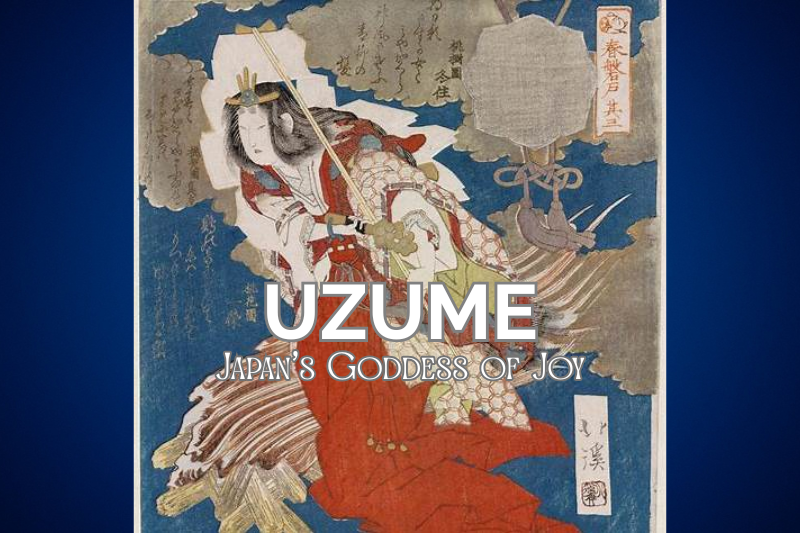
“Uzume Performing on a Tub to Reawaken Light” — Traditional ukiyo-e depicting the iconic scene of Uzume overturning a tub and dancing before the cave entrance. This imagery inspired the ritual dance known as kagura, symbolizing the power of joy to dispel darkness. (Public Domain)
In the Amano-Iwato myth, Amaterasu hid herself in a cave after a bitter conflict, and the world fell into darkness. The gods gathered outside, searching for a way to coax her back.(See Divine Thread #3)
Uzume turned an upturned tub into a stage. She adorned herself, let her kimono slip, stamped her feet, and danced with wild abandon. She was bold, a little risqué, and utterly unafraid to break decorum. The gods roared with laughter — not mocking, but joyful, surprised, alive again.
Drawn by the noise, Amaterasu peeked out. In that instant, the stone door was flung open, and light returned to the world.
Her dance was not just entertainment. It was a deliberate, sacred act — the use of joy to break the seal of despair.
🦊 Syncretism with Uka-no-Mitama
In the Kojiki (古事記) and Nihon Shoki (日本書記), Uzume and Uka-no-Mitama(宇迦之御魂命)— the kami of grain and food — are distinct. But from the medieval period onward, in the era of Shinbutsu-shūgō (神仏習合: Shinto-Buddhist syncretism), they were often identified as the same deity. This blending connects fertility, abundance, performance, and divine laughter.
In some folk traditions, Uzume could appear in the form of a white fox — echoing the fox messengers of Inari shrines, where Uka-no-Mitama is often worshipped.
📜 Names and Titles
In classical sources, Ame-no-Uzume-no-Mikoto appears under many names, each reflecting a facet of her character and role:
- Ame-no-Uzume-no-Mikoto (天宇受売命 / 天鈿女命) – The most common forms in the Kojiki and Nihon Shoki.
- Miyabi-no-Kami (宮比神) – “The Elegant Deity,” evoking grace and refinement.
- Ōmiyanome-no-Kami (大宮能売命 / 大宮売神) – “The Great Palace Lady,” hinting at her ritual role within the imperial court.
- Sarume-no-Kimi (猿女君) – Ancestral title of shrine maidens and court dancers who served as ritual performers.
- Nafudono (名婦殿) – “The Noble Lady,” a title of respect.
- Okame-sama (おかめ様) – A folk name linking her to the round-faced, smiling bringer of good fortune in popular culture.
✨ Divine Functions
According to the Kogoshūi, the practice of tama-shizume — calming and pacifying the spirit — originates from Uzume herself. She is revered as:
- Goddess of performing arts: dance, music, and theater
- Patron of actors, entertainers, and artistic expression
- Guardian of fertility, marriage harmony, and relationship bonds
- Bringer of safe travel and protection on journeys
- Bestower of agricultural abundance and prosperity
- Protector in martial arts and warrior skills
Her blessings range from artistic inspiration to earthly well-being — a rare combination that makes her both a muse for the arts and a guardian in practical life.
😊 Okame / Otafuku Connection
Uzume is also associated with Okame or Otafuku — round-faced, smiling figures from Japanese folk culture. These characters symbolize humor, charm, and good fortune. Their masks are still used in folk dances that, in spirit, continue Uzume’s tradition: making people laugh, shifting heavy moods, and inviting blessings through joy.

⛩️Where is She Worshipped?
Japan is dotted with countless shrines dedicated to Ame-no-Uzume, reflecting her broad appeal from ancient rituals to modern devotion. Among them, I’ve personally visited three that left a particularly lasting impression:
✨ Sarume Shrine 佐瑠女神社 (Ise, Mie)
My first encounter with a shrine to Uzume was pure chance — I had no plan to visit her shrine — in fact, I took the wrong bus and ended up at Sarutahiko Shrine. There, tucked beside it, was Sarume Shrine (佐瑠女神社). I bowed in front of Uzume for the first time, and at that very moment, a sudden wind flipped the purple banners high into the air — as if she herself was dancing in welcome.

Sarume Shrine in Ise: a quiet sanctuary dedicated to Ame-no-Uzume-no-Mikoto, found unexpectedly yet full of gentle presence.(2024) When I visited, the shrine was open as usual. But for the time being, it is under construction, and Uzume’s sacred image is temporarily enshrined inside the main hall. The new building is expected to be completed around December.
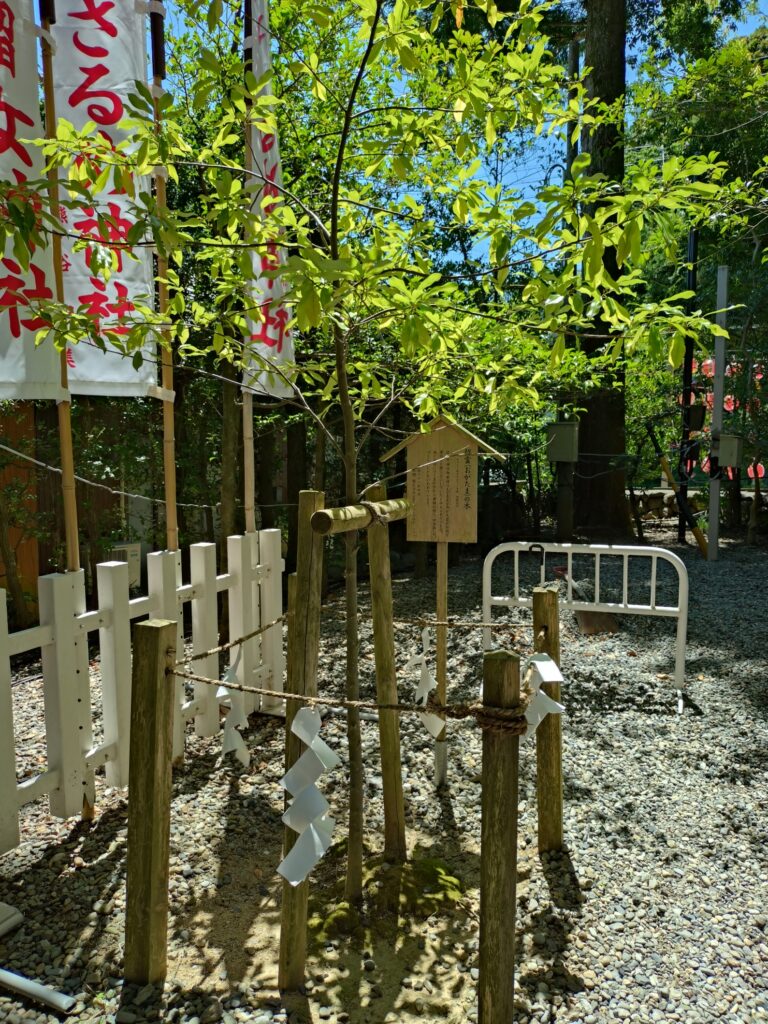
A sacred tree (Ogatama no ki: 招霊[小賀玉]の木) at Sarume Shrine—tradition holds that this represents the branch Uzume held in her dance that lured Amaterasu from the cave.
The name ogatama is believed to have evolved from okitama (招霊), a term meaning “to invite or summon spirits.”
🌊 Futami Okitama Shrine 二見興玉神社(Futami-no-Ura, Mie)
Famous for the Meoto Iwa “wedded rocks” offshore, this shrine also enshrines Uka-no-Mitama (a form of Inari). In one of the small side sanctuaries, I discovered an Uzume statue standing quietly—a clear signal of the spiritual overlap between abundance and joy, deeply woven into regional belief.

Meoto Iwa (夫婦岩:“Wedded Rocks”)The sacred Meoto Iwa bound by a shimenawa rope—symbolizing divine union and balance.

Futami Okitama Shrine – Red Torii Gate Leading to the Sacred Site
A striking red torii framing the path to the sea at Futami Okitama Shrine, setting the mood for reverence and transition.

Futami Okitama Shrine – Uzume Statue
Statue of Ame-no-Uzume at Futami Okitama Shrine, capturing her legendary dance before the Heavenly Rock Cave. She holds a sacred tree branch in her right hand and a ritual implement in her left, embodying motion and invitation.
🌸 Tsubaki Ōkami Yashiro 椿大神社(Mie Prefecture; North American Branches)
In Japan, Tsubaki Ōkami Yashiro is one of the oldest shrines in Mie, home to Sarutahiko and Ame-no-Uzume among others.

Tsubaki Grand Shrine – Shrine Signboard
Signboard depicting Ame-no-Uzume-no-Mikoto (left) and her husband Sarutahiko Ōkami (right), guardians of performance and pathfinding.

Tsubaki Ōkami Yashiro – Uzume Shrine(鈿女本宮)Gate
The vermilion torii in Tsubaki Ōkami Yashiro, where Ame-no-Uzume-no-Mikoto is enshrined as the goddess of joy, the arts, and dance.
In North America, the first branch of Tsubaki Grand Shrine emerged in Stockton, California, in 1986—the first postwar Shinto shrine on the mainland. It later moved to Granite Falls, Washington, in 2001. In 2023, the go-shintai (sacred spirits) of Sarutahiko, Uzume, and others were formally relocated to Shin Mei Spiritual Centre on Knapp Island near Victoria, British Columbia.
🌉 The Heavenly Descent and Meeting Sarutahiko
The myth of Tenson Kōrin — the “Descent of the Heavenly Grandson” — is one of the defining moments in Japan’s creation cycle. It tells how Amaterasu sent her grandson Ninigi-no-Mikoto from the High Plain of Heaven (Takamagahara) down to the earth to rule. But as Ninigi prepared to descend, he and his divine entourage encountered a problem.
At what is often called the Heavenly Bridge — or, in some traditions, a crossroads between realms — stood a towering deity with a long nose, fierce eyes, and an imposing presence: Sarutahiko Ōkami, guardian of the earthly realm. His appearance was so unlike the heavenly deities that most of the gods hesitated. Who would dare approach and ask his name, or learn his intentions?
Amaterasu did not waver.
She said to Uzume, “You go.”
This was no small request. In all the myths, very few deities receive a direct mission from Amaterasu herself — Uzume, and Ichikishimahime (a water goddess sometimes linked to Benzaiten), among the rare examples. The choice spoke volumes about Uzume’s character: her courage, her quick wit, and her unmatched gift for connection.
🌞 A Fearless Introduction
Uzume stepped forward without hesitation. She met Sarutahiko’s gaze, unflinching, and asked his name. Her confident and open presence melted away the tension. She listened, spoke plainly, and bridged the divide between heaven and earth.
Some traditions say that this meeting marked the beginning of their partnership, and that Uzume and Sarutahiko later became husband and wife — a divine couple embodying guidance and joy.
💫 Leadership with Lightness
This episode reveals a side of Uzume that the cave dance alone cannot show. She was not only a performer or mood-shifter, but a diplomat and leader who could turn an intimidating standoff into a path forward. Her bravery lay not in brute force, but in the ability to meet anyone — even a god who seemed alien and threatening — with openness and skill.
In this way, she opened the way for Ninigi’s descent, just as she had once opened the cave for Amaterasu.
🦊 The Fox Mystery
I’ve had psychic readings a few times. When I first began receiving clearer messages in meditation, I felt an urgent need to know: Who are my guides?
During one session, the reader said she saw several.
“The first,” she told me, “is a large blue column.ーstrong, simple, trustworthy, direct, and supportive in its energy.”
That struck a chord — I often saw blue when I meditated.
Then she continued, “The second one I see looks like…”
I leaned forward, eager for the answer.
“…a fox.”
A fox???
That threw me completely off.
She burst out laughing — not mocking, but as if something about this fox was irresistibly funny. “It’s making me laugh,” she said. “It’s doing these funny moves.”
I was lost.
She explained, “It has a cat-like or feline face. It helps you keep things light, makes sure you laugh. Maybe it’s not even a fox — maybe it’s wearing a mask. But the energy is joyful, playful, happy, almost childlike. It can lift any heavy or overwhelming energy. And it also helps you connect with animals.”
🌀 Many Months of Puzzling Over It
The fox was a mystery to me for some time. In Japan, we have Oinari-san, a fox spirit, but I had never felt much of a connection to it. I was sure that this was something outside of Japan — maybe Native American? I felt I had lineage there, but their descriptions never included a fox this jolly. Nothing quite fitted.
Then, one day during the Lionsgate season, I had a vision:
A dragon and a fox flying side by side, a mountain rising behind them. I felt certain it was Tenkawa. The fox had a wide, knowing smile.
💡 The Click
Suddenly, it all clicked.
I started researching afterward — and found a note in a reference saying that Uzume sometimes appears as a fox.
Of course!
A funny, dancing fox that makes people laugh! Who else could it be?
It wasn’t random at all.
She had been giving me hints — wrapped in humor, masked in mystery — until I could finally see her.
🌙 A Dream from Long Ago
About ten years ago — around the time I began to have more vivid dreams that felt like premonitions or glimpses of past lives — I had one that stayed with me.
In the dream, I was in a grand, old Japanese estate. A beautiful woman appeared, dressed like an ancient princess in layered robes reminiscent of jūnihitoe. But unlike the perfectly formal image I expected, the front of her kimono was open at the chest.
She was striking — wild, unconventional — yet her face was determined, poised, and unmistakably noble. She didn’t seem “crazy” at all.
She strode quickly at the head of a group of attendants, saying with crisp determination, “Let’s go!” The pace was brisk, almost urgent, as if leading them on an important mission.
At the time, I didn’t understand what I was seeing. Why would I dream of such a princess, so vivid and unlike anything I’d imagined before?
Years later, as I learned more about Uzume — especially her role in guiding the heavenly descent — it clicked.
It was her.
I can’t say for certain if this was the actual scene from myth, but I feel it was something Uzume herself showed me — to leave me a clear hint I would one day understand.
Perhaps this was a glimpse of that very moment before she stepped forward to meet Sarutahiko, opening the way for Ninigi-no-Mikoto to descend. A vision from the boundary between heaven and earth.
🌼 Childhood Moments
When I was a child, my mother and I would sometimes get into arguments — neither of us willing to back down. The air would grow heavy, the tension thick.
And then, out of nowhere, one of us would start laughing. Not a polite chuckle, but a sudden, unstoppable burst. Within seconds, the other would join in.
It happened more than once. And each time, the argument would dissolve instantly, as if the reason for fighting had been absurd all along.
One day, a friend happened to witness it. She tilted her head, smiled, and said, “You two are funny.”
At the time, I just thought it was one of those quirks between my mother and me.
Now I see it differently.
It was the same kind of energy shift Uzume is famous for — breaking through heaviness with laughter, loosening what’s stuck, and letting joy rush back in.
💖 Kaha’s Note
The snobs, the complainers, the perpetually unsatisfied, the solemn and severe — Uzume’s presence shifts their energy in an instant. She can turn a stubborn silence into a shared smile, a heavy room into a space alive with warmth.
She removes obstacles the way only she can: not by pushing them aside, but by dancing right through them, dissolving their weight with joy and laughter.
Uzume is a shapeshifter — witty, clever, fun, joyful all at the same time. She is reliable in the most unusual way: not with rigidity, but with a playful steadiness that keeps you moving forward without fear.
A good friend of mine once told me, “You carry yourself like an ordinary soul, but your life is anything but — full of things most people wouldn’t dare to try.”
That’s Uzume’s energy!
I LOVE Uzume. And I believe you will, too, once you know her.

On my last visit to Tsubaki Ōkami Yashiro, I paused at the chozuya (water purification basin). That’s when a black butterfly—a rare, elegant visitor—fluttered right in front of me. In Shinto symbolism, a black butterfly seen at a shrine is thought to be a messenger of the kami. It drifted and hovered just long enough for me to take photos and even a video! In that moment, I felt certain: that was Uzume herself, dancing through my world to send her blessing across the lands.
May her dance—her lightness, her joy, and her mischief—bless all who meet her in spirit.

🔗Now available:
👉 Rainbow Awakening Messages│Messages from the Divine: A special Lionsgate Message from the Divine Couple (Shared on the12th of August!)
Receive blessings of love, hope and guidance from Goddess Uzume and God of guidance, Sarutahiko.
👉 Rituals and Reverences #3│Scented Vessels and Incense Rituals Exploring simple, creative ways to burn incense with intention.
🌈Explore More:
Want to explore more places and stories in Japan?
👉 [Return to the main page](https://8rainbow.work)


コメント