
🎯 This post is exploring Japan’s sacred snake (serpent) deities and the shrines/temples where they are venerated. In the Year of the Snake, these ancient energies are believed to be especially potent in Japanese tradition.
🌄 Lead-in
In the Year of the Snake, serpent-related shrines across Japan are drawing pilgrims seeking blessings, protection, and spiritual encounters. One of the most visited among them is Ōmiwa Shrine (大神神社 or 三輪神社) in Nara—a sacred place revered not only for its ancient roots but for the mysterious deity said to dwell within it: Ōmononushi, the god who often appears in the form of a white serpent/snake.

The entrance stone marker of Ōmiwa Shrine, engraved with the kanji 大神神社. This iconic torii leads worshippers into one of Japan’s oldest and most sacred Shinto sites.
But this mountain shrine is more than just a popular destination. It is the center of one of Japan’s most poignant and mystifying myths—a tale of divine love, secrecy, and spiritual sight.
In this post, we begin to explore the deep mythology behind Ōmiwa Shrine through the story of Yamato Tōtōhi Momoso-hime no Mikoto (hereafter referred to as Momoso-hime), a shaman-princess whose sacred union with a god reveals the thin veil between the human and the divine.
📍Note:
The name Ōmiwa Shrine is written in Japanese as 大神神社. While the kanji “大神” can be read as Ōkami (“Great God”), in this context, it is pronounced Ōmiwa, referring to Mount Miwa (三輪山), the sacred mountain that is the shrine’s divine focus. Both “大神” and “三輪” appear throughout Japan’s ancient texts and geography.
🔮 The Shamaness of Miwa
Momoso-hime, a daughter of Emperor Kōgen and sister to Emperor Kaika, was not only of royal blood—she was revered for her purity and spiritual gifts. In ancient narratives, she is depicted not merely as a noblewoman, but as a shamanic figure, one who could sense and commune with the unseen.
The most famous legend surrounding her tells of a mysterious lover who visited her nightly, never revealing his face. Intrigued and longing to know the truth, she tied a sacred thread to his garment and followed it at dawn. The thread led her to the base of Mount Miwa, where she discovered that her lover was none other than Ōmononushi, the god of the mountain—who often takes the form of a massive white serpent.
In another version of the tale, she is guided to open a lacquered box, within which she finds a tiny white snake curled inside—a sacred form of the god. Startled, she cries out. The god, ashamed of being seen, transforms into a man and silently departs for the mountain. In despair, Momoso-hime is said to have ended her life using a chopstick from the box—thus giving rise to the name Hashihaka Kofun, her legendary tomb.
Her story touches on archetypes of the priestess who dares to see the divine, the sacred bride, and the spiritual cost of seeking truth beyond human limits.

The main worship hall of Ōmiwa Shrine. The large ema (votive plaque) for the Year of the Snake shows a white serpent with an arrow—a powerful symbol of divine guidance and protection.

A close-up view of the ema. The white snake is believed to be an incarnation of Ōmononushi, the mountain deity enshrined at Ōmiwa.
🐍 Who Is Ōmononushi? — The Serpent Deity of Miwa
Ōmononushi is one of Japan’s oldest and most mysterious kami. In the Kojiki, he is treated as an independent mountain god and is the father of Himetataraisuke-yorihime, consort to Emperor Jimmu. This positions him as both protector and progenitor of the early Japanese state.
In contrast, the Nihon Shoki identifies him as the nigimitama—the “gentle spirit” aspect—of Ōkuninushi, the great land-forming deity and mythic ruler of Izumo. This dual identity reflects the fluidity of Japanese kami theology, where gods may appear in multiple roles or forms.
Ōmononushi is closely tied to serpents, a recurring image in Japanese spirituality that symbolizes fertility, mystery, wisdom, and ancestral power. His choice to appear as a white snake, rather than a human figure, adds to his mystique as a god who is both intimate and untouchable.
⛩️ The Sacred Space of Miwa — Where the Mountain Is the God
Ōmiwa Shrine stands apart from all other shrines in Japan—not for what it has, but for what it chooses not to build.
There is no main sanctuary (honden). Worshippers instead bow toward Mount Miwa itself, believed to be the living body of the god. This practice, known as Kannabi Shinkō, reflects Japan’s earliest nature-worship traditions, where mountains, forests, and rocks were not symbols, but deities in themselves.
A signature feature of the shrine is the Miwa Torii, a unique triple torii gate (mitsutorii) composed of three interconnected structures. It marks the invisible border between the seen and the sacred. The mountain path beyond is off-limits to the general public, preserving its mystery.

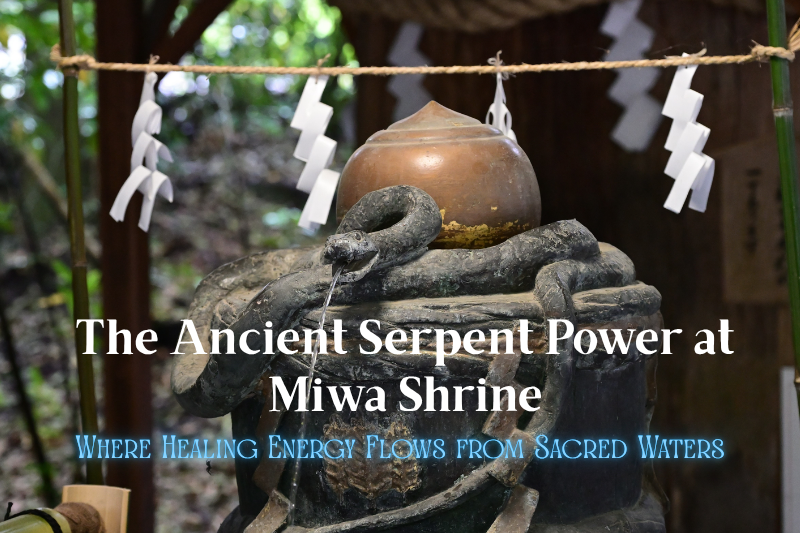
The sacred spring of Ōmiwa Shrine. Visitors can bring their own bottles and, with a small donation, collect water said to carry the healing energy of Mount Miwa. Known as kusuri-mizu or “medicinal water,” it flows near a deity associated with healing and recovery. This spring is not only refreshing, but deeply spiritual—connecting the body and soul through the mountain’s sacred power.
🎥 Experience Mount Miwa in Motion
Watch the short video filmed at its sacred spring.
🌿 Sacred Water & Blessing Chant (Sacred Portal)
https://youtube.com/shorts/rNOX07F6Pkw
Ōmiwa is also part of Yamatohime-no-Mikoto’s sacred journey to find a permanent home for Amaterasu. While Ōmiwa Shrine plays an indirect role, a nearby sacred site—Hibara Shrine, located about 20 minutes on foot from the main precinct—is believed to be the first place Amaterasu was enshrined before the founding of Ise. Thus, Ōmiwa is a spiritual crossroads where the traditions of serpent and sun intertwine.
🧭 The Crossroads of Myth and History — The Layered Sacredness of Ōmiwa Shrine
Ōmiwa is not merely a single-deity shrine—it is a mythic convergence point. Beyond Ōmononushi, the shrine area is associated with many layers of belief:
- Ichikishimahime-no-Mikoto: A goddess of water, beauty, and the arts, linked with Benzaiten, and one of the Munakata sisters.
- Jōju Inari Shrine: A local Inari shrine on the grounds of Ōmiwa, honoring prosperity, wishes fulfilled, and agricultural blessings.
- Sukunabikona-no-Mikoto: The god of medicine, wisdom, and co-creation. Closely tied to Ōmononushi, he is said to have worked beside him to heal the land—a theme we’ll explore in a future post.

The vibrant red shrine dedicated to Ichikishimahime-no-Mikoto. A peaceful pond with koi fish lies nearby, adding to the gentle beauty of this sacred corner.
Ōmiwa Shrine encapsulates Japan’s rich tapestry of mythology. It is not a static place, but a living portal between eras, stories, and sacred forces. Through the threads of women like Momoso-hime, through hidden gods and visible mountains, we are invited to see what cannot be seen—and feel what the ancients never forgot.
🕊Kaha’s Note
I’ve been visiting Ōmiwa Shrine for over 15 years now.
It all began on a New Year’s morning in a year that would change my life. That January, I dreamed of a white snake coiled gently in a circle—a symbol of good fortune in Japan. Soon after, an extraordinary opportunity came into my life. Looking back, I wonder if that vision was Benzaiten, quietly watching over me.
Later, a spiritual person I met told me something that confirmed what I already felt:
“Ōmiwa Shrine is your shrine. You have a deep connection with it.”
From that moment on, I began visiting more intentionally—not just to pray, but to receive its sacred spring water, believed to carry the energy of the mountain itself.
Every time I visit, I also stop by Byōdō-ji, a historic temple near the shrine. It was once the jingu-ji, the original Buddhist temple affiliated with Ōmiwa. At its heart is a quiet hall dedicated to Fudō Myōō, the Immovable Wisdom King.
What left a deep impression on me was the Iwaya Fudō, a sacred rock altar tucked behind the hall. As I stood before it, I felt a raw, grounding power—a direct line to the mountain itself. It reminded me that this faith is not just about form or structure, but about presence.

A quiet forest path blanketed in fallen leaves, leading to Iwaya Fudō—a sacred rock altar behind Byōdō-ji, deeply connected to the spirit of Mount Miwa.
I’ve climbed Mount Miwa three or four times—some with friends, others alone. Each time, it felt like another thread was quietly pulled into place.
What began as a simple encounter has become something sacred—a place that gives me quiet strength, and a sense of being gently held.
Maybe you, too, will find that a place you once visited casually becomes your sacred place.
🔗Now available:
👉 Rainbow Awakening Messages│A Message from Amaterasu
A powerful message of protection and healing filled with wisdom
👉 Rituals and Reverences #3│Scented Vessels and Incense Rituals Exploring simple, creative ways to burn incense with intention.
🌈Explore More:
Continue your journey through the sacred atmosphere of Mount Miwa.
🎥 A Glimpse of Omiwa Shrine (HELLO JAPAN)
https://youtube.com/shorts/EFxVjnLOfsQ


コメント