

🌾Lead-in
In Japanese tradition, some deities are known not through dramatic myths,
but through quiet continuity in daily life.
Ukano-Mitama is one such presence —
a kami associated with grain and nourishment,
and with the sustaining force that supports both nature and human livelihood.
Rather than standing at the center of heroic narratives,
this deity has long been felt through harvest, rice,
and the simple act of being sustained.
⛩️ Who is Ukano-Mitama?
Ukano-Mitama (宇迦之御魂神) is revered in Shinto tradition as a deity of grain and life-sustaining nourishment.
The name “Uka” refers to food or grain, while “Mitama” signifies a sacred spirit — suggesting a divine presence dwelling within nourishment itself, especially rice, which has shaped Japanese ritual, culture, and daily life for centuries.
In the Kojiki, Ukano-Mitama is described as a child of Susanoo-no-Mikoto (素戔嗚尊) and Kamu-ōichi-hime (神大市比売). Although the classical texts do not explicitly define the deity’s gender, later religious interpretation has often regarded Ukano-Mitama as feminine — a presence closely aligned with earthly life, harvest, and agricultural abundance.
Variant traditions recorded in the Nihon Shoki (日本書紀) associate food-related deities with the primordial lineage of Izanagi and Izanami, reinforcing the understanding that nourishment itself was viewed as sacred from the earliest acts of creation.
Unlike many other kami, Ukano-Mitama does not appear in dramatic mythological episodes. Instead, the deity is recorded primarily within genealogical contexts, suggesting a foundational and sustaining role rather than that of a mythic protagonist.
This quiet positioning is meaningful.
Ukano-Mitama is understood not as a deity of spectacle, but as a primordial presence connected to the sustaining forces of life itself.
Gradually, reverence for this deity spread across many regions of Japan.
Today, Ukano-Mitama is enshrined not only in major shrines dedicated to agriculture and prosperity, but also in smaller auxiliary sanctuaries and quiet sacred spaces — places where reverence remains intimate and rooted in everyday life.
🦊 Ukano-Mitama and Inari Worship
Over time, Ukano-Mitama became closely associated with Inari faith.
In many Inari shrines across Japan, the principal kami enshrined is understood to be Ukano-Mitama —
a divine presence linked to grain, harvest, and prosperity.
The fox statues seen at Inari shrines are not the deity itself,
but sacred messengers (kenzoku) serving the kami.
However, in contemporary popular belief, some people affectionately regard the fox itself as a divine presence.
This blending reflects how living faith evolves through familiarity and devotion.
In folk tradition, foxes are sometimes described as playful or trickster-like beings.
Because of this, it is often said that when a wish is granted, one should return to offer thanks —
a gesture of respect that maintains harmony with the unseen.
Such expressions highlight the relational nature of Japanese spirituality,
where gratitude is considered part of spiritual balance.
🌟 Origins of Inari Devotion
The development of Inari worship is deeply connected to ancient reverence for rice as the foundation of life.
Early traditions recorded in fragments of the Yamashiro Fudoki describe events involving rice that later gave rise to the name “Inari,”
often interpreted as relating to the growth or manifestation of rice (ine-nari).
Historical shrine records at Fushimi Inari Taisha trace formal enshrinement of the kami to the year 711,
when the deity was venerated on the sacred peaks of Mount Inari by the Hata clan.
Themes of agricultural abundance, silk production, and communal prosperity became central to the faith.
Over time, devotion expanded beyond agriculture to include livelihood, safety, and well-being in everyday life.
Today, Ukano-Mitama is enshrined not only in major Inari shrines,
but also in smaller auxiliary sanctuaries throughout Japan —
quiet places where reverence is intimate and rooted in daily existence.
📷 Ukano-Mitama at Sacred Sites
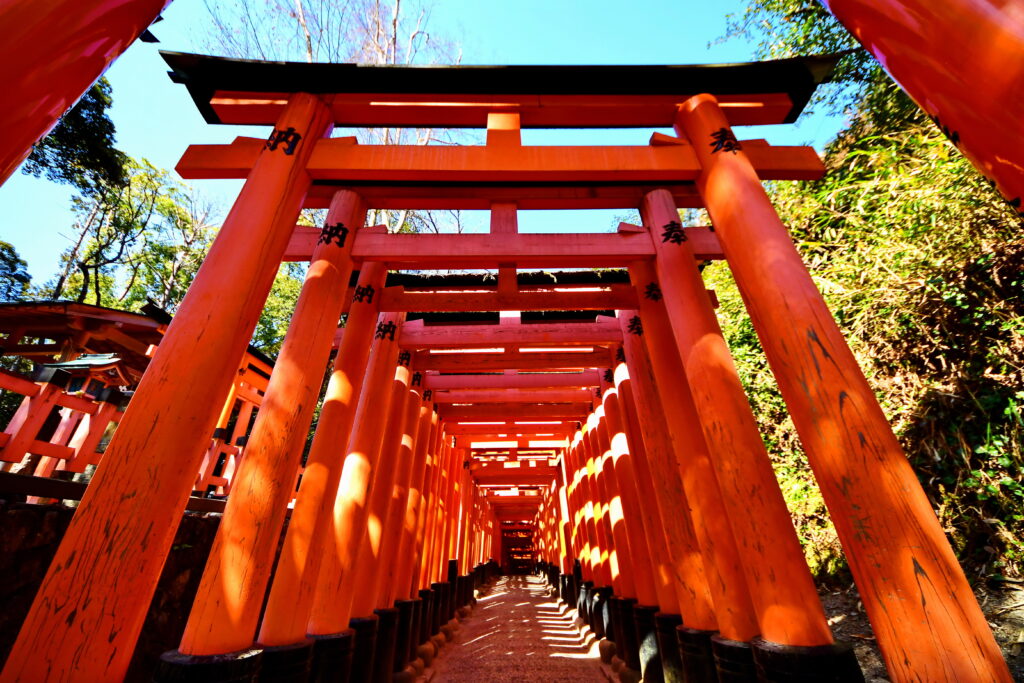
Fushimi Inari Taisha, Kyoto —
Vermilion torii gates symbolizing long-standing devotion to Inari faith and the continuity of nourishment and abundance.

Fushimi Inari Taisha, Kyoto —
Fox statues regarded as sacred messengers of the kami, often affectionately associated with Inari in popular belief.

Tenkawa, Nara —
A small auxiliary shrine beside Tenkawa Benzaiten, quietly enshrining the presence of Ukano-Mitama.
🎥 Watch the Sacred Light in Motion
A quiet glimpse of light appearing
at Ugano-Mitama Shrine in Tenkawa, Nara —
a brief shimmer in a sacred space.
🌿 Kaha’s Note
In Japan, Inari shrines can be found almost everywhere.
In earlier times, when agriculture shaped daily survival, the ability to harvest and eat was directly tied to life itself. Reverence for grain was therefore reverence for existence.
Today, while food remains sacred, many people visit Inari shrines seeking blessings for success in work, business prosperity, and stability in everyday life. The meaning of “abundance” has quietly expanded.
When I visited the small shrine of Ukano-Mitama in Tenkawa, I felt warmly received.
There was a sense of quiet affirmation — as if my steps had been acknowledged.
I returned during the New Year to offer thanks,
and I hope to visit again.
🌈Explore more
🌿 Related Reading
If you are interested in Japanese deities and their place in everyday life,
you may also enjoy the posts below.
🔗Introduction to Japanese Deities – Divine Thread (Part 1)
🔗Introduction to Japanese Deities – Divine Thread (Part 2)
A quiet collection of sacred places,
nature encounters, and spiritual reflections from Japan.
New journeys and seasonal moments continue to unfold.


コメント