
- 🌄Lead-in
- 🕊️ A Story Many Know — and Yet, Few Remember This Way
- 🌩️ Prelude to the Cave: Misunderstanding, Oath, and Desecration
- 🔥 The Cave of Retreat — A Goddess Who Felt Deeply
- 🌸 The Kami Who Waited — Harmony in Devotion
- 🏞️ The Journey with Yamatohime — Finding a Home for the Sun
- 🌾 Two Shrines, One Harmony
- 🌸 A Personal Pilgrimage — Listening to the Light
- 🌅 Kaha’s Note – After the Dawn
- 🌟 Now Available:
- 🧵 Explore more:
🌄Lead-in
Amaterasu Ōmikami is not only the sun goddess of Japan —
She is the supreme deity, honored as the ancestral kami of the imperial line and enshrined at Ise Jingū, her most sacred Shinto shrine in Japan.
Across the country, over tens of thousands of shrines honor her name.
Her radiance draws all beings toward it — not in fear, but in reverence.
She is a presence that both blesses and balances.
For generations, she has been cherished as a symbol of harmony, renewal, and divine truth.
And yet — for some, her image has been clouded by the weight of history.
Political shadows, war memory, and state misappropriation have left scars that still shape how some perceive her.
But perhaps now is the time —
Not to reject, but to reunite.
To gently move beyond the distorted image that history painted,
And return to the truth of who she is:
A goddess of light, yes —
But also of kindness, of depth, of immense strength without force.
This is not about mythology.
It is about remembering.
And so, we begin.
🕊️ A Story Many Know — and Yet, Few Remember This Way
The story of Amaterasu retreating into the cave is one of Japan’s most iconic myths.
Many know it ends with the world losing its light — and finding it again.
But why did she hide? What happened before the darkness fell?
In this post, I’d like to walk you through the heart of that story —
not just the moment she disappeared, but the reasons behind it,
and the divine cooperation that brought her back.
This is not just a tale of myth —
it’s a story of misunderstanding, grief, and healing.
🌩️ Prelude to the Cave: Misunderstanding, Oath, and Desecration
Before Susanoo, the storm god, descended to the underworld (Yomi) in hopes of seeing his deceased mother, Izanami, he went to bid farewell to his sister Amaterasu, the Sun Goddess.
However, Susanoo was so powerful that as he approached the heavens, the mountains shook and the rivers roared. His thunderous presence alarmed Amaterasu. She suspected he had come to attack and invade the heavenly realm.
To resolve this misunderstanding, the two deities agreed to perform a sacred oath-taking ritual, known as ukei. In this ritual, they each created gods and goddesses from the other’s sacred possessions, and the nature of the resulting deities was interpreted as proof of Susanoo’s true intentions.
(See “Divine Thread pre-#1” in this blog for more on this ritual.)
The outcome was favorable: Their nature revealed the sincerity of Susanoo’s intent, so his innocence was confirmed. He was not there to wage war.
However, although the misunderstanding had been cleared, Susanoo was still offended by the suspicion itself. Feeling insulted and angry, he began to lash out destructively.
He rampaged through the heavenly fields, ruined rice paddies, and finally committed a terrible sacrilege:
He threw the hide of a flayed heavenly horse into Amaterasu’s sacred weaving hall.
The shock and chaos led to the death of one of Amaterasu’s beloved weaving maidens.
This tragic act deeply wounded Amaterasu — not only ritually, but also emotionally.
It brought the defilement of death into her most sacred space and took the life of a cherished companion.
The world trembled not just with thunder, but with grief.
🔥 The Cave of Retreat — A Goddess Who Felt Deeply
After repeated disruptions by her younger brother Susanoo — breaking sacred order, destroying ritual spaces, and bringing grief to the heavens — Amaterasu did not strike back.
Instead, she withdrew into Ame-no-Iwato, the Heavenly Rock Cave.
And with her retreat, the light of the world faded.
This was not escape.
It was a sacred pause.
Some traditions say she hid away out of sorrow or offense.
But there are deeper readings — from modern spiritual voices — that suggest it was a moment of emotional clarity.
Perhaps she felt something she couldn’t yet carry:
Overwhelm. Irritation. A sense of something that could not be forgiven.
Feelings so sharp they required space to process.
She chose quiet over reaction.
And that, too, is strength.
Even deities have thresholds.
🌸 The Kami Who Waited — Harmony in Devotion
The Japanese deities, rather than seizing on her absence, acted with deep respect.
They didn’t debate her role.
They didn’t divide heaven among themselves.
They moved as a supportive team — as they often do in Japanese mythology.
Their shared goal was clear: not to control, but to restore balance.
Among them was Ame-no-Uzume, goddess of joyful daring.
She stepped forward and danced — a kind of dance no one dares to try: so bold, so full of life, it stirred laughter among the gathered kami.
It was not entertainment.
It was an offering of presence.
And it worked.
Amaterasu, still within the cave, heard the joy — and peeked out.
At that exact moment, as planned, the deities presented a mirror.
And one of them called out:
“A being more divine than yourself has appeared.”
Surprised, she looked — and saw her own reflection.
Her own radiance. Her own power.
And in that moment of recognition, the door shifted.
Before she could return on her own, Tajikarao, the deity of strength, pulled her gently from the cave.
The stone door flew off and landed far away, never to be used again.
Light had returned to the world.
Not through control — but through cooperation.
Amaterasu’s presence was not restored by persuasion or power, but by love.
By the harmony of many beings working together — not to force, but to welcome back what never stopped being sacred.
Maybe she is one powerful demonstration of true leadership —
deeply respected, deeply loved,
a presence of compassion, who trusts and uplifts the deities around her. Just her return was enough to dissolve the darkness.
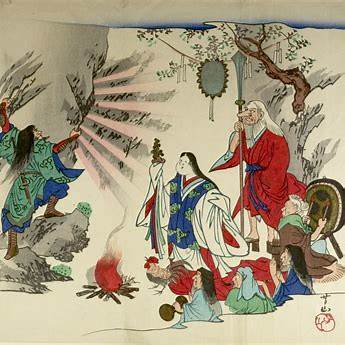
Amaterasu emerges from the Heavenly Rock Cave, greeted by the assembled gods — Utagawa Kunisada (Toyokuni III), 1856. Public domain.
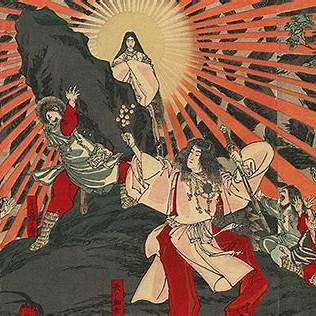
Origin of Iwato Kagura Dance — Utagawa Kunisada (Toyokuni III), 1856, depicting the opening of the Heavenly Rock Cave. Public domain.
🏞️ The Journey with Yamatohime — Finding a Home for the Sun
In ancient Japan, Amaterasu was once enshrined within the Imperial Palace in Yamato.
But during the reign of Emperor Sujin, a devastating epidemic spread across the land.
It was believed that keeping Amaterasu and Yamato Okunitama — the local tutelary deity — in the same space disturbed divine balance.
To restore harmony, Amaterasu’s sacred objects were moved.
First to Kasanui by Princess Toyosukiirihime, and later passed on to Yamatohime-no-Mikoto, daughter of Emperor Suinin.
She was entrusted with a mission:
To find a permanent home for the sun goddess.
Yamatohime traveled for over thirty years — through Yamato, Ōmi, Mino, and beyond — not seeking splendor, but resonance.
Finally, by the banks of the Isuzu River in modern-day Ise, she received a divine message:
“Ise, a beautifully sacred land. In this place, I wish to dwell.”
According to some source, it is said that Amaterasu had long set her sights on this region —
not only because it was beautiful, but because she foresaw its harmony.
Thus, the Inner Shrine (Naikū) was established, and it became the eternal home of the sun goddess.
Her path would later inspire the creation of the saiō — royal priestesses from the imperial family who, centuries later, would be appointed to serve at Ise Shrine.
But Yamatohime herself was something so original, so sacred, so divine —
a chosen priestess, guided not by tradition, but directly by the voice of the goddess.
🌾 Two Shrines, One Harmony
It is often said that, Amaterasu appeared in a dream to Emperor Yūryaku, expressing a desire for companionship.
But according to some interpretations — including insights from Yamatohime Seiki studies —
it was Yamatohime herself who received the dream, and conveyed the message to the imperial court.
She wished not to eat alone anymore.
She wanted Toyouke-no-Ōmikami, the goddess of food and sacred offerings, to be with her.
Toyouke was invited from Tanba and enshrined at Gekū, the Outer Shrine.
Amaterasu remained at Naikū, the Inner Shrine.
Together, they form a divine harmony —
one who shines from the heavens, and one who sustains from the earth.
A volunteer guide at Ise once shared something I found deeply touching:
At mealtime, Amaterasu is not alone.
She is said to be joined by:
- Toyouke-no-Ōmikami, of course,
- Tajikarao, the powerful deity who pulled open the rock cave, serving as a protector-her bodyguard!
- And Ninigi’s mother, who stays by her side during those sacred moments.
(Ninigi, her grandson, descended to earth — see Divine Thread Pre-#1.)
Even among deities, presence matters.
🌸 A Personal Pilgrimage — Listening to the Light
For a long time, I wanted to visit Ise.
But I kept putting it off.
There were other deities I felt more closely connected to at the time — nearby ones — and I thought, “Maybe later.”
Then, in the year of the dragon, something changed.
I was watching a transmission video by someone who is my mentor now,
when a clear, powerful energy surged through the space — especially above my head.
I heard distinct popping sounds — like sacred static, crackling and bright, as if something unseen had arrived.
In that moment, I knew:
“I have to go to Ise.”
When I finally made the journey, it didn’t feel like a first visit.
It felt like returning to something ancient, something waiting.
And I kept returning.
Each time, the connection deepened.
One morning at New Year, just before waking,
I caught a glimpse — golden and soft —
of a dragon shimmering in light,
as if Amaterasu had taken that form to appear before me.
Later, before my next visit to Ise, I felt a brief hesitation —
just a flicker of doubt.
So I turned to the oracle.
I drew a card from the Japanese kami deck —
and there she was. Amaterasu!
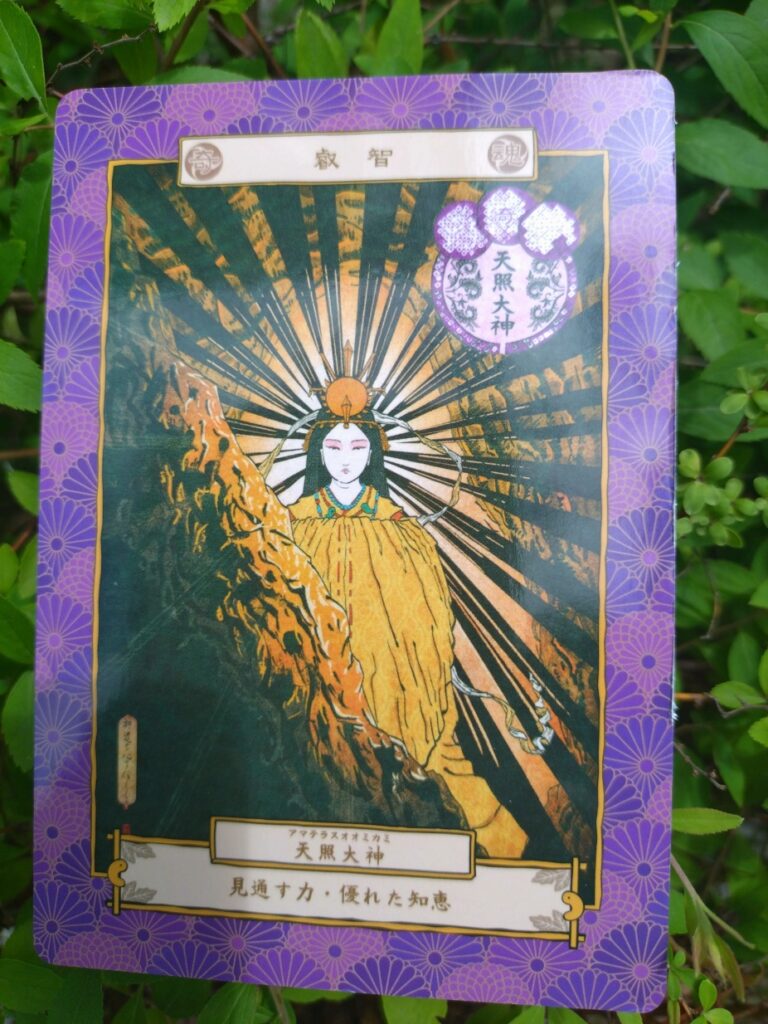
Oracle card drawn just before my spring journey to Ise — the sun goddess herself, Amaterasu. (The keyword on the card: Exceptional Wisdom The message:There are people waiting for you to appear.)
And that struck me deeply.
It felt like an invitation.
A nudge.
Maybe she was encouraging me to stop hiding —
and simply do what feels right.
Maybe that’s all this blog is.
Not a mission.
Not a declaration.
Just a gentle way to say:
“Here I am. I’m listening. I’m sending out light, too”
🌅 Kaha’s Note – After the Dawn

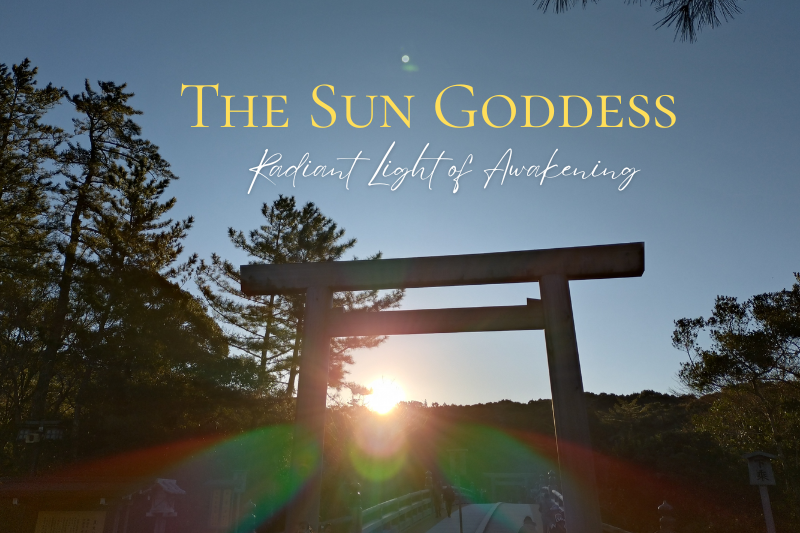
Sunrise at the torii bridge in Ise — a doorway into light.
Even after rituals, teachings, and stories—
what stays is not explanation, but feeling.
Amaterasu does not demand devotion.
She does not require belief.
But she welcomes recognition—
that light within, always present.
Seeing the sun, we remember:
“We are here to shine our light.”
And perhaps that’s all she’s ever asked of us.
To let the light shine from within —
We shine not because we are perfect,
but because we are each unique and irreplaceable.
Our light takes shape not despite our differences, but because of them —
the way stars shimmer differently in the same sky.
As we encounter others,
we reflect, resonate, and begin to glow in new colors.
Our paths gently weave together,
and in that weaving, something luminous awakens.
Through connection, we are transformed —
our lights no longer solitary,
but part of a radiant constellation
that none of us could form alone.
Just as Amaterasu shines on all without judgment,
her warmth finds every face —
reminding us not to strive for light,
but to remember that we already are its reflection.
🌟 Now Available:
👉 Rituals&Reveneces#1:Lunar Magic
Discover how to work with the phases of the Moon — and explore some helpful sites to guide your practice.
👉 Rainbow Awakening Messages: A Message from Amaterasu
A heart-opening message received during a visit to Ise Shrine
👉 A Lionsgate Message from Amaterasu Discover a special message from the sacred site
🧵 Explore more:
👉 Return HOME → http://8rainbow.work


コメント