
🌒Lead-in
Interestingly, in many cultures around the world, the sun is often personified as male and the moon as female.
But in Japan, it’s quite the opposite — Amaterasu, the Sun deity, is a goddess, while Tsukiyomi, the Moon god, is male.
This reversal offers a unique insight into the values and cosmology of Japanese mythology.
In Japanese mythology, the moon god Tsukiyomi is quiet — so quiet that his story nearly vanishes between the lines.
He is one of the three divine siblings born from the purification of the creator god Izanagi:
- Amaterasu, the sun,
- Susanoo, the storm,
- and Tsukiyomi, the moon.
While his name is sometimes read as “Tsukuyomi,” the older and regionally used reading “Tsukiyomi” is especially preserved in shrines like the ones in Ise.
The name itself evokes “reading the moon” — a hint at foresight, rhythm, and the unseen flow of time.
Yet while Amaterasu shines brightly in countless myths, and Susanoo storms through legend with fiery intensity, Tsukiyomi remains in the shadows.
There are few stories about him. Few shrines. Few words.
But perhaps this silence is not absence.
Perhaps it is presence of another kind — the presence of the moon: quiet, watchful, reflective.
In the hush of night, under pale silver light, one might begin to sense him.
A deity not of action, but of observation.
Not of pronouncement, but of knowing.
🌓Tsukiyomi in the Myths
Among the three deities born from Izanagi’s purification — Amaterasu, Susanoo, and Tsukiyomi — it is Tsukiyomi whose stories are the most elusive.
In the Kojiki, he is mentioned briefly as being born from Izanagi’s right eye, and appointed to govern the “Night’s Food Realm” (夜之食国). This title hints at his dominion over time, rhythm, and the quiet cycles of sustenance. But beyond this, the text falls silent.
In the Nihon Shoki and later traditions, one story stands out: Tsukiyomi is sent to represent Amaterasu at a divine feast. There, he witnesses the food deity — in some versions called Ukemochi (also known as Ōgetsu-hime) — producing a meal from her body. Depending on the telling, she pulls food from her mouth, nose, or other parts of her being.
Horrified by what he perceives as unclean or disrespectful, Tsukiyomi kills her.
Amaterasu, when she hears of this, is furious — not at the food goddess, but at Tsukiyomi. She refuses to ever see him again. From this divine separation, day and night are forever divided.
Interestingly, it is said that after Ukemochi’s death, grains and sacred crops sprang from her body — symbolizing rebirth, nourishment, and the cycle of life through death.
Some traditions even associate Ukemochi with Toyouke-Ōkami, the goddess of food, clothing, and shelter worshipped at Geku (the Outer Shrine of Ise).
So even in this rare myth, Tsukiyomi does not linger.
He appears, acts, and disappears.
But in his silence and in the aftermath, a rhythm is born — a pattern we still live by today.
🌗Symbolism: Silence, Cycles, and the Unseen
Tsukiyomi is not just a name in the myths — he is a presence felt in the spaces between.
In what little is written about him, there is a kind of intentional emptiness. A pause. A breath.
His name contains the word tsuki (moon) and yomi (to read), suggesting more than just lunar rulership.
It hints at a reader of time, a seer of rhythms, a quiet observer of the unseen.
Where Amaterasu blazes with light and action, Tsukiyomi seems to embody the pause between events — a stillness that contains knowing.
Some spiritual perspectives see him as a god of divination, reflection, and cyclical time.
In this sense, Tsukiyomi does not “rule” like a king — he orbits, watches, and reveals.
The moon governs tides, moods, fertility, sleep, and dreams. It pulls gently at us, even when we are unaware.
Tsukiyomi may be understood in the same way: a subtle influence, rarely acknowledged but constantly present.
This may explain why there are so few stories, so few shrines.
Perhaps his power is not in appearance — but in perception.
🌖Sacred Places: The Tsukiyomi Shrines of Ise
In Ise, there are two distinct shrines dedicated to the moon god Tsukiyomi — each quietly nestled within a different part of the city, and each holding a different character.
The first is Tsukiyomi-no-Miya (月夜見宮), located just a few minutes’ walk from Ise City Station. It is a betsugū (separate associated shrine) of Gekū, the Outer Shrine of Ise.
Though small and quiet, it feels profoundly anchored — surrounded by city life, yet curiously apart from it.
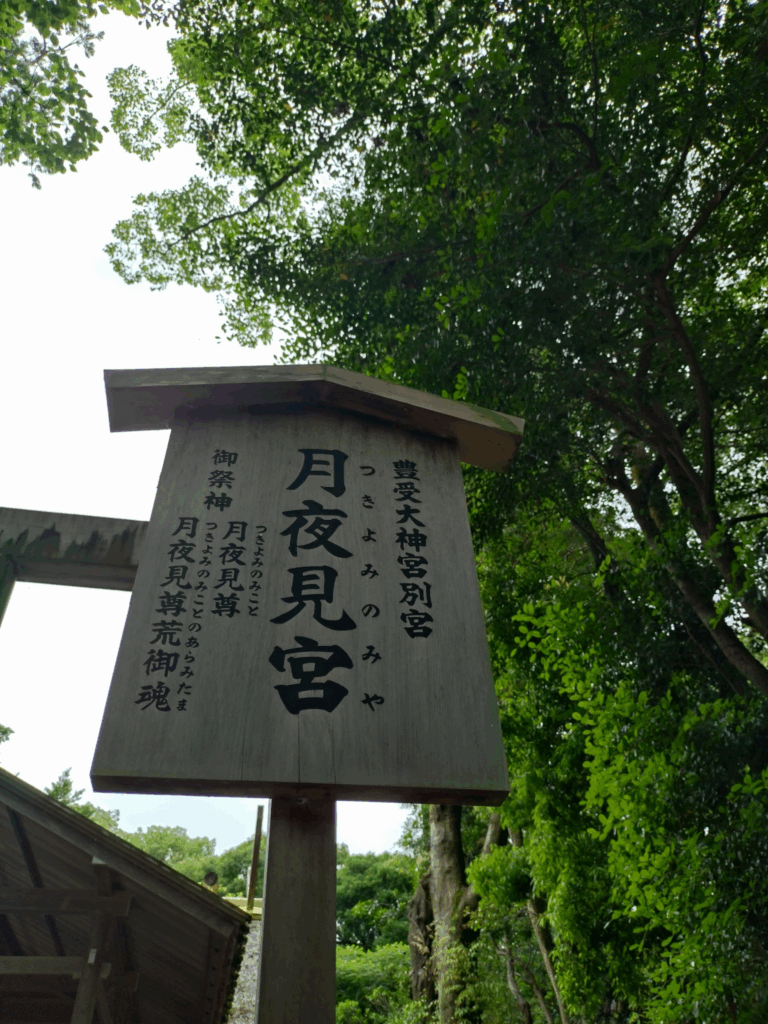
The name of Tsukiyomi-no-Miya is written on this wooden sign, quietly watching over the entrance to the inner shrine.
When I visited, a shrine attendant shared a story:
During a large fire that swept through the surrounding district, this shrine remained standing.
While nearby buildings were damaged or lost, the shrine itself was spared.
“It was as if the kami protected it,” the attendant said gently.
Whether one sees this as a historical fact or a sign of spiritual grace, the story lingers — much like the presence of Tsukiyomi himself.
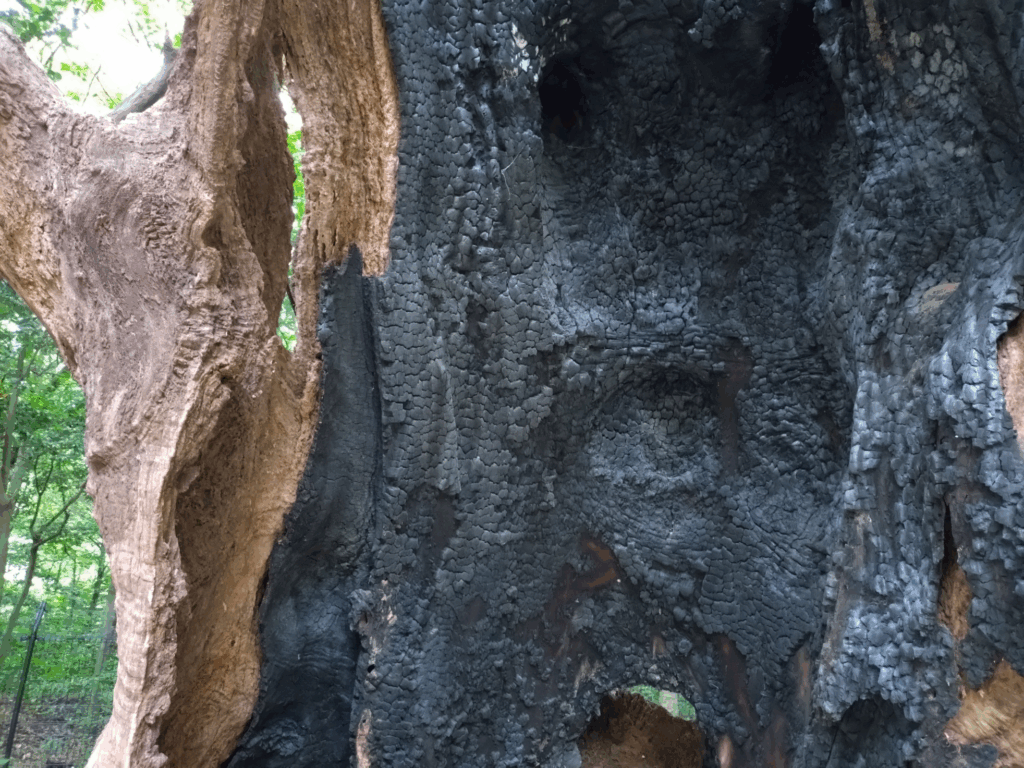
The charred heart of a sacred tree — still standing, still holding memory.
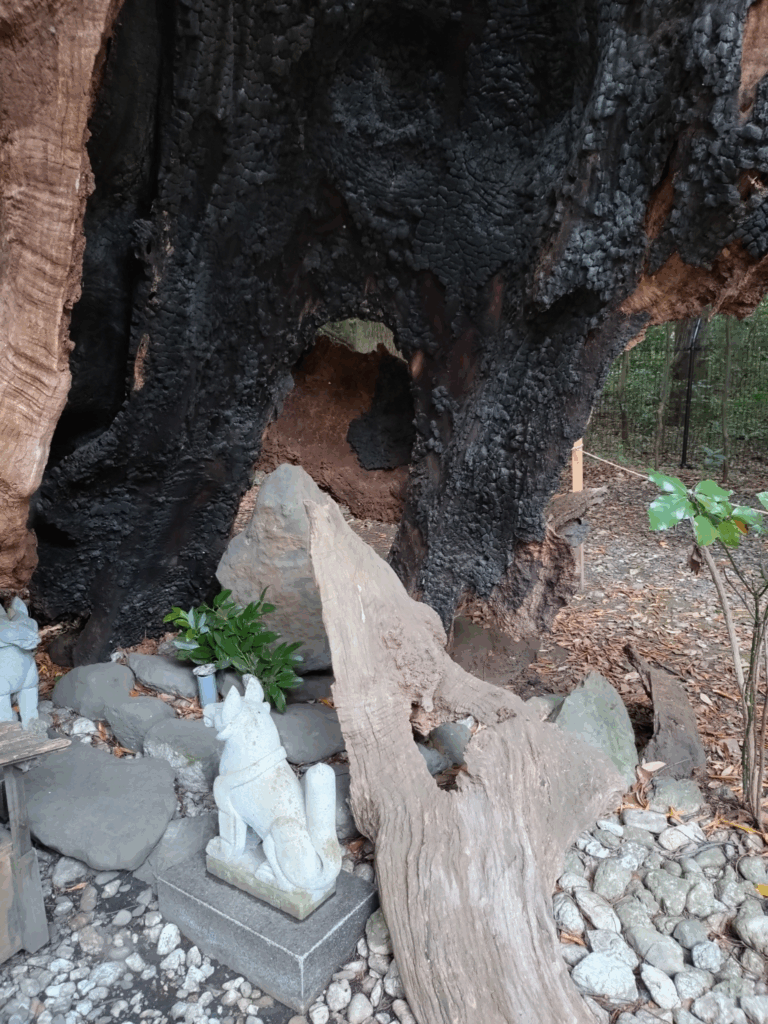
Beneath the fire-blackened tree, a quiet inari (稲荷) shrine remains — protected, remembered, revered.
The second shrine is further south — Tsukiyomi-no-Miya (月読宮) of the Inner Shrine complex.
Here, four shrines stand together: one each for Tsukiyomi-no-Mikoto, Izanagi-no-Mikoto, and Izanami-no-Mikoto, with the fourth said to be another aspect of Tsukiyomi.
This layout — with Tsukiyomi placed alongside the divine mother and father of the Japanese pantheon — gives a sense of ancestral depth.
The grounds feel more removed from the city, quieter, heavier with history.
I wasn’t able to include my photos from the other Tsukiyomi shrine (where Izanagi and Izanami are also enshrined) this time —
but I hope to introduce each of Ise’s sacred shrines in future posts.
Interestingly, these two shrines bear different kanji for “Tsukiyomi”: one uses 月夜見, the other 月読.
A local guide once explained to me that people often mix them up — not just in location, but in name.
Perhaps that, too, is part of Tsukiyomi’s elusive nature. Names shift, places blur, but the presence remains.
🌔Symbolism & Spiritual Interpretations of Tsukiyomi
Echoes of the Moon God across cultures and time.
🌀 Tsukiyomi and the “People of the Moon”
In the world of spirituality and mythic speculation, Tsukiyomi is sometimes linked—symbolically or cosmically—with ancient stories of “moon peoples” or lunar civilizations.
Some spiritual thinkers draw parallels between Tsukiyomi and the moon deities or ancestral myths found in other parts of the world, such as China or even ancient Israel. While there’s no direct historical connection, these stories are often shared as part of a larger narrative exploring how different cultures interpret the moon’s power—not just as a celestial body, but as a gateway to memory, emotion, and cycles of life.
In China, the moon goddess Chang’e, for example, represents immortality, exile, and longing. In some esoteric circles, people have speculated about a “lunar race” or ancient moon-linked lineage that transcends geography—suggesting that Tsukiyomi, too, may be part of this greater cosmic story.
These ideas are not rooted in mainstream historical studies, but they show how the moon continues to be a deeply symbolic force across cultures. For many, Tsukiyomi is not just a mythological figure, but a spiritual presence that speaks to universal themes of time, shadow, and the quiet power of reflection.
🌾 Timekeepers and Harvest: Tsukiyomi, Agriculture, and Inari
While Tsukiyomi is often remembered as a distant, elusive moon god, some see his role as more deeply woven into everyday life than it first appears.
In ancient Japan, the moon wasn’t just a light in the night sky — it was the clock of the agricultural world. The waxing and waning of the moon guided the planting and harvesting of crops, festivals, and sacred observances. The very rhythm of life was lunar. In this way, Tsukiyomi — as the guardian of night and time — may have had an unseen hand in sustaining the land.
This brings us to another intriguing connection: Inari, the kami of fertility, harvest, abundance and prosperity. Inari is often associated with foxes, rice granaries, and rural shrines, but some spiritual perspectives suggest that Inari’s realm overlaps with Tsukiyomi’s in more subtle ways.
The moon governs cycles — of time, of water, of fertility — and Inari governs abundance. Together, they could be seen as keepers of the sacred balance between growth and rest, action and reflection.
Inari appears almost everywhere in Japan — from grand shrines to tiny roadside offerings.
In some spiritual circles and worldviews, symbolic parallels have even been drawn between Inari Shrines and the ancient people of Israel, or Christ-like archetypes.
These ideas are not historical claims, but rather reflections of deeper spiritual echoes — where divine nourishment, protection, and mysterious appearances unite across traditions.
🌒Kaha’s Note
Tsukiyomi remains a mystery — a god with few words, few shrines, and few stories.
And yet, perhaps that is the point.
In the spaces where other deities shine with vivid myths and dramatic acts, Tsukiyomi lingers quietly in the background — not absent, but observant. Like the moon itself, he does not command the sky with thunder or flame. Instead, he reflects. He illuminates gently. He waits.
Visiting his shrines, speaking with the people who care for them, and hearing how stories and symbols remain — even in partial or fragmented forms — gave me a sense of why this presence matters. There is a strength in the hidden. A wisdom in silence. A power in showing up… even if no one quite knows how to describe you.
And perhaps Tsukiyomi is not a god we’re meant to define.
Perhaps he is a god we are meant to listen for.
🌘 At the moment, some information around these spiritual connections is scattered and open to interpretation. As I continue to deepen my understanding and gain more clarity, I would love to share new insights with you.
The journey with Tsukiyomi — much like the moon itself — unfolds slowly, in phases.

A moment at Tsukiyomi-no-Miya —
when sunlight filtered through the ancient tree,
and something silent, unseen, felt close.
🔗 Explore more moments of mystery and spirit.
Please Visit: 8rainbow.work
Let your heart wander through the hidden paths of Japan —
stories, shrines, and starlit skies await.


コメント