
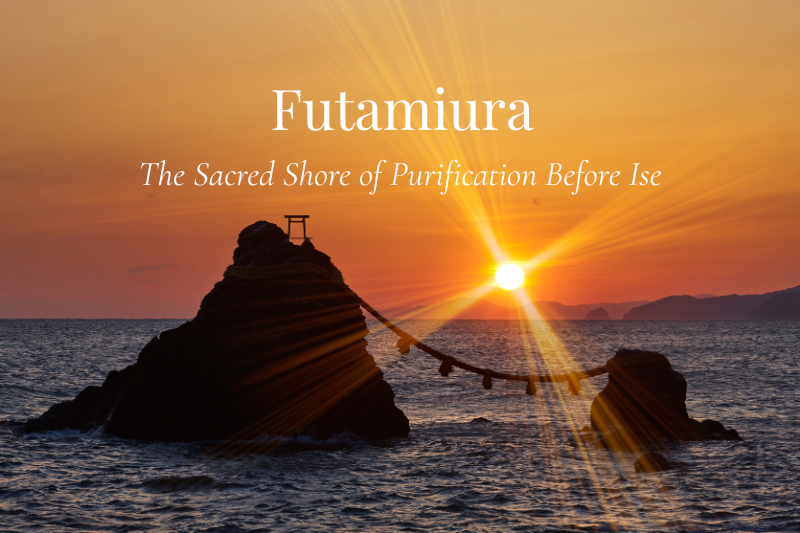
- 🌊 Lead-in
- ⭐Hama-sangu Today — A Quiet Shift in Practice
- 🪨 Okitama Shinseki — The Sacred Stone and the Presence of Sarutahiko
- 🐸 Frogs as Messengers of Sarutahiko — The Meaning of “Kaeru”
- 🌺 Mythic Presence — Uzume, Amaterasu, and the Sacred Coast
- 🌿Mythic and Historical Layer — Yamatohime and the Sacred Arrival
- 🌟Kaha’s Note
- 🌈 Explore more
🌊 Lead-in
In the pilgrimage tradition of Ise Jingu,
the sacred journey was not understood as beginning at the shrine itself.
Before reaching the forested grounds of Naikū,
many pilgrims first visited the coastal area of Futamiura,
a place long regarded as the formal starting point of the Ise pilgrimage.
This custom came to be known as Hama-sangu —
a coastal visit made prior to approaching the Grand Shrine.
Rather than serving merely as a scenic stop,
Futamiura functioned as part of the pilgrimage route itself.
Travelers arriving after long journeys would pause by the sea,
marking a quiet transition from ordinary travel to sacred approach.
Even today, the landscape of Futamiura retains this historical role.
The sea, the wind, and the open horizon continue to frame
the earliest stage of the spiritual journey toward Ise.
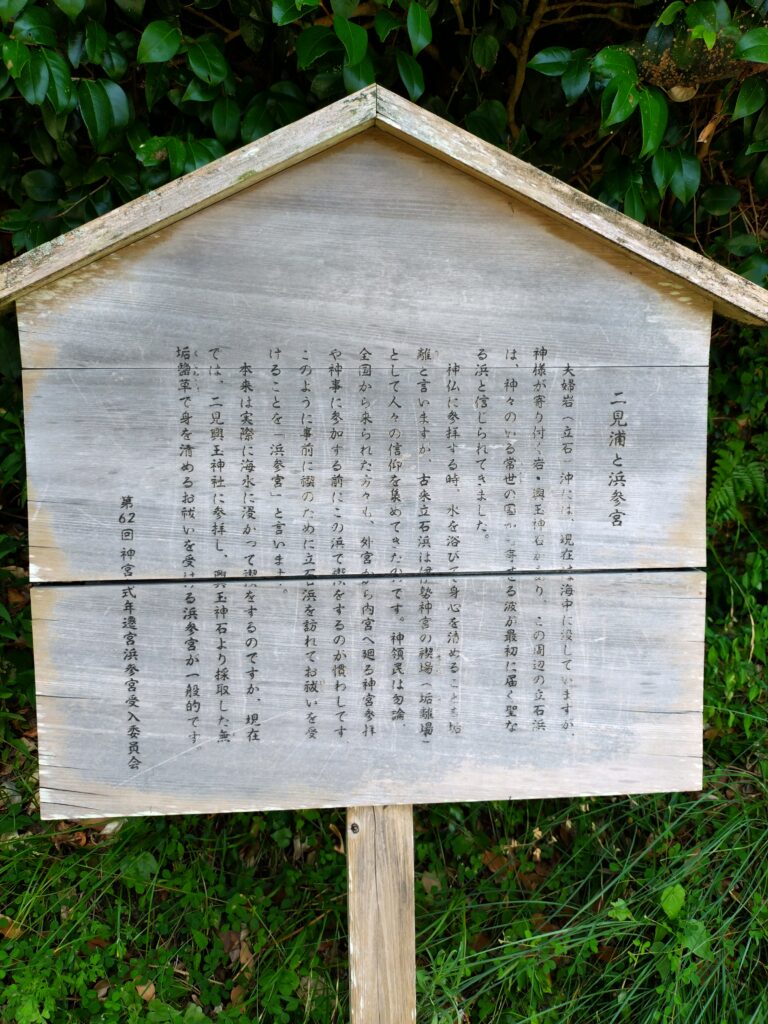
🪧 Hama-sangu Signboard Signboard explaining the tradition of Hama-sangu at Futamiura — a customary coastal visit made by pilgrims before proceeding to Ise Grand Shrine.

⛩️ Entrance to Futami Okitama Shrine Torii gate of Futami Okitama Shrine — a sacred threshold associated with the coastal stage of the Ise pilgrimage and the shoreline traditionally visited before approaching Ise.
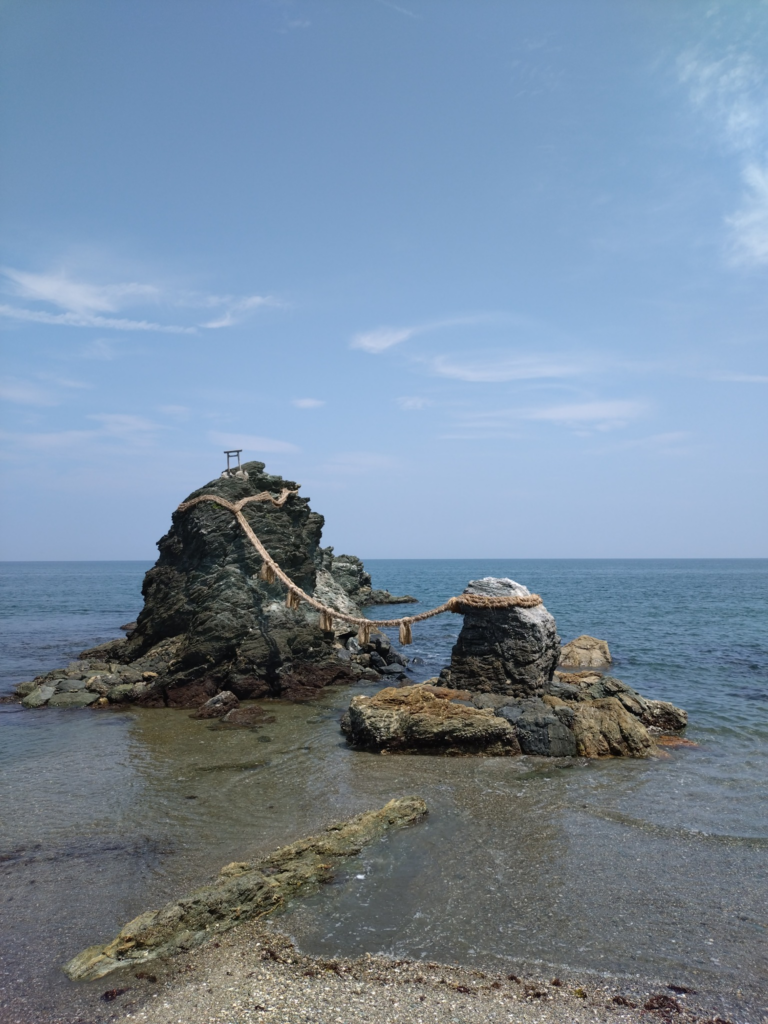
🪨 Meoto Iwa (Wedded Rocks) Meoto Iwa at Futamiura, sacred rocks facing the open sea and long connected to the traditional pilgrimage route to Ise.
This coastal landscape marked an early point of spiritual preparation before visiting the Grand Shrine.
During the Edo period, when pilgrimages to Ise became widespread among ordinary people, Futamiura was recognized as an established coastal stop along the traditional pilgrimage route.
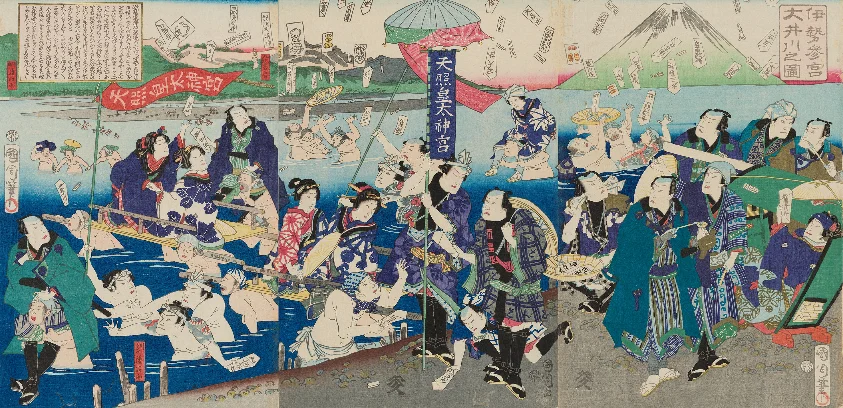
Ise Sankei Ōigawa no Zu by Toyohara Kunichika (19th century, Public Domain).
This ukiyo-e depicts pilgrims traveling toward Ise Grand Shrine along a historic pilgrimage route. The river crossing represents part of the cultural journey to Ise rather than a literal view of a specific sacred site.
⭐Hama-sangu Today — A Quiet Shift in Practice
The signboard at Futamiura explains that, in earlier times, pilgrims would purify themselves at the seashore before continuing their journey to Ise Jingu.
Historically, this purification sometimes involved entering the sea or washing the body with seawater as a formal act of preparation.
Today, however, this practice is rarely performed in the same physical manner.
Most visitors do not immerse themselves in the sea.
Instead, some quietly stand facing the ocean,
while others gently touch the seawater with their hands if they are aware of the tradition.
Many people simply visit Futami Okitama Shrine and offer prayers in their own way,
and there are also numerous pilgrims who proceed directly to the Grand Shrine without stopping at Futamiura at all.
In the modern era, the approach to sacred places is no longer uniform.
It is often said that a traditional Ise pilgrimage begins with Gekū before Naikū,
yet even this order is understood today as a general custom rather than an absolute rule.
For this reason, the act of reverence here takes many forms —
whether through formal prayer, quiet presence,
or simply standing at the shore with awareness of its historical role.
🪨 Okitama Shinseki — The Sacred Stone and the Presence of Sarutahiko
Beyond the well-known Meoto Iwa, the spiritual focus of Futami Okitama Shrine is closely connected to Okitama Shinseki (興玉神石)— a sacred offshore stone revered as an object of worship.
Although many visitors associate the site primarily with the Wedded Rocks,
the sacred stone itself lies within the sea and may only be partially visible depending on the tide and viewing angle.
According to local explanations, the stone is linked to Sarutahiko-no-Ōkami,
the deity regarded as a guide of paths and a protector of safe journeys.
Traditions tell that a sacred stone associated with Sarutahiko once became hidden beneath the sea and was later said to have reappeared in 1963 (Shōwa 38).
For this reason, Okitama Shinseki is not treated simply as a natural rock formation,
but as a continuing spiritual presence within the coastal landscape.

Coastal illustration showing the sacred offshore formations at Futamiura, including the area associated with Okitama Shinseki and Meoto Iwa.

Meoto Iwa and the surrounding sacred sea — the offshore stone connected to Okitama Shinseki is said to be visible between the rocks depending on conditions.
Beyond the space framed by the Meoto Iwa lies Okitama Shinseki, a sacred stone revered in connection with Tokoyo, the mythological eternal realm from which divine presences are believed to approach.
In this understanding, the Meoto Iwa are not only symbolic rocks, but are often regarded as serving a torii-like role — a sacred gateway through which the hidden stone beyond the sea is venerated.
The site has therefore long been associated with prayers for maritime safety and harmonious relationships.
🐸 Frogs as Messengers of Sarutahiko — The Meaning of “Kaeru”
Within the shrine grounds and along the coastal area,
numerous frog statues can be found facing the sea.
These frogs are traditionally regarded as messengers of Sarutahiko-no-Ōkami.
In Japanese, the word “kaeru” means both “frog” and “to return.”
Because of this layered meaning, frogs at Futami Okitama Shrine are associated with prayers for the safe return of important things.
For this reason, frog amulets are also offered at the shrine,
and many visitors pray for the return of what is precious to them —
whether it be loved ones, lost opportunities, or personal hopes.

A frog statue overlooking the sacred sea at Futamiura — symbolically connected to Sarutahiko and the prayer that what is important may “return.”
🌺 Mythic Presence — Uzume, Amaterasu, and the Sacred Coast
The spiritual atmosphere of Futami Okitama Shrine is shaped not only by the sea,
but also by the mythological figures connected to the Ise tradition.
Sarutahiko, known as the divine guide,
Ame-no-Uzume, associated with the myth of the Heavenly Rock Cave,
and Amaterasu, the Sun Goddess enshrined at Ise Grand Shrine,
are all symbolically connected within this sacred coastal setting.
There is also a small shrine dedicated to marine protection,
traditionally understood as offering protection from dangers of the sea.
This reflects the long-standing relationship between the shrine and the ocean.
Here, sea, stone, myth, and pilgrimage history
are not separate elements,
but quietly woven into a single sacred landscape.
🌿Mythic and Historical Layer — Yamatohime and the Sacred Arrival
According to shrine tradition and historical accounts,
Futamiura is also connected to Yamatohime-no-Mikoto,
the imperial princess who carried the sacred mirror of Amaterasu
in search of a permanent site for enshrinement.
It is said that when Yamatohime arrived in this coastal region,
her vessel was once anchored at Futamiura.
During this sacred journey, Okitama no Ōkami is believed to have emerged upon the offshore rocks,
protecting the divine procession of Amaterasu.
This narrative links Futami not only to purification practices,
but to the mythic movement of the Sun Goddess herself
toward the land where Ise Grand Shrine would ultimately be established.
Some traditions also suggest that the name “Futami”
originated from the moment Yamatohime turned back twice
to gaze upon the beauty of this coastline.
Through these layered traditions,
Futamiura is understood not merely as a coastal shrine,
but as a mythic point of arrival, protection, and divine transition
within the larger spiritual geography of Ise.
🌟Kaha’s Note
Learning about the tradition of Hama-sangu changed the way I experienced this place.
Rather than viewing Futamiura simply as a scenic coastal site,
I began to understand it as a historically significant place of purification
— a threshold where pilgrims once prepared themselves
before approaching the sacred forests of Ise.
With that awareness,
my visit naturally became more intentional.
I quietly touched the seawater with my hands and feet,
feeling the movement of the ocean
as a simple act of personal purification.
I had also brought a small power stone with me,
and gently cleansed it with the seawater,
following my own quiet way of prayer.
Within the shrine grounds,
I encountered many frog figures,
traditionally associated with Sarutahiko-no-Ōkami,
the divine guide of paths.
In Japanese, “kaeru” means both “frog” and “to return.”
Holding this meaning in my heart,
I offered a quiet prayer
that what is truly important may return
to its rightful place in my life.
There is also a place near the sacred shoreline
where amulets may be placed
in a position that receives the rising sun.
I chose to have my ofuda kept there for six months,
entrusting it to the light of the sun
and the protection of the sacred land.
At that moment, I bowed softly and prayed:
“I will return.”
This spring, I hope to come back once more,
not only to visit,
but to receive the quiet strength of this place again.
Understanding the history and sacred meaning of Futamiura
deepened the entire journey.
It was no longer just a stop before Ise,
but a living place of purification,
presence, and spiritual beginning.
Even now, I feel that this coastal shrine
holds a quiet yet powerful spiritual energy —
a place where the boundary between sea, myth, and prayer
is still gently alive.
🌈 Explore more
If the sacred shore of Futamiura resonated with you,
you may wish to explore the mythic and spiritual figures
deeply connected to this coastal pilgrimage tradition.
– Sarutahiko Ōkami — The Divine Guide of Paths
🔗 https://8rainbow.work/%f0%9f%a7%b5divine-thread-6-ise-series-part-1-sarutahiko-okami-tsubaki-grand-shrine/
– Ame-no-Uzume — The Goddess of Sacred Presence and Myth
🔗 https://8rainbow.work/%f0%9f%92%83divine-thread-5%e2%94%82-the-goddess-who-is-brave-bold-and-brilliantly-playful/
– Sacred Shore of Futami Okitama Shrine (Video)
🔗 https://youtube.com/shorts/0JA7HZo1U_U
Each place reveals a different layer of the sacred journey —
from purification at the sea,
to divine guidance,
and mythic presence within the Ise tradition.


コメント