- 🌿 Beginning Note for Part 1:
- 📚About the Kojiki and Nihon Shoki: Japan’s Earliest Myth Sources
- 🌌 Part 1 – Section ①
- The First Kami: Gods Born Alone
- 🌏 Part 1 – Section ②
- Izanagi & Izanami: Creation, Loss, and Purification
- ☀️🌙🌊 Part 1 – Section ③
- The Three Noble Children: Sun, Moon, and Storm
- 🔥 Part 1 – Section ④
- From Blood and Fire: Gods Born in Tragedy
- Notable Deities Born from This Tragedy:
- From Ōyamatsumi Came:
- About Hi-no-Kagutsuchi and other deities:
- 🌍 Part 1 – Section ⑤
- Ancient Source and Beyond: The Expanding World of the Kami
- 🌿 A Gentle Pause Before Moving On
- 🕊 Kaha’s Note
- 📝 Start Your Journey
- 🖼️ Explore more
🌿 Beginning Note for Part 1:
In Japan, the phrase “Yaoyorozu no Kami” (八百万の神) beautifully captures the belief in “eight million deities”—not as a literal number, but as a poetic way to express the countless deities woven into nature, life, and spirit.
For many people (myself included), trying to understand how these deities connect can feel overwhelming at first. Are there family trees? Is there some divine lineage?
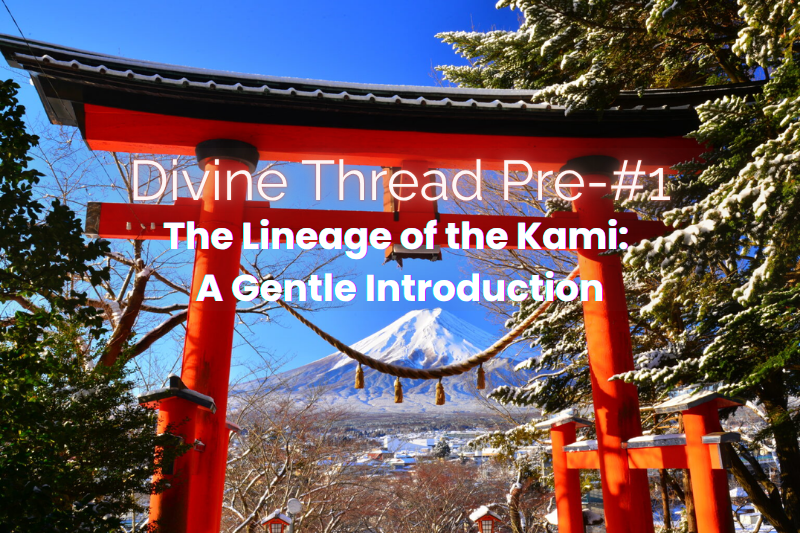
This post isn’t a complete map, but rather a gentle introduction to some of the kami who appear often in this blog.
Whether you’re new to Japanese myth or simply curious about who’s who, I hope this helps you feel more at home in the world of the kami.
And as always: Take what resonates. Leave the rest for later.
📚About the Kojiki and Nihon Shoki: Japan’s Earliest Myth Sources
Before we dive into the stories, here’s a quick note about the sources behind these myths.
This part feels important to me, especially for those new to these stories.
The tales you’ll read in this post are primarily based on the “Kojiki” (古事記)—Japan’s oldest surviving collection of myths, compiled in the early 8th century.
There’s also the “Nihon Shoki” (日本書紀), another foundational text from around the same period, written with a more formal and diplomatic tone for the imperial court.
These two texts are often referred to together as “Kiki” (記紀)—short for Kojiki and Nihon Shoki.
While they cover many of the same stories, there are differences in details, tone, and deity lists.
For this post, I’ve mainly followed the Kojiki version—since its narrative flow feels more intimate and poetic, fitting the tone of this blog.
🌌 Part 1 – Section ①
The First Kami: Gods Born Alone
In the beginning, there was no form, no sound, no sky or ground—only a vast, undivided space.
And from this silence, the first deities emerged alone, without parents, partners, or even bodies.
These were the Hitorigami (独神)—deities who came into being by themselves.
They did not speak or act in the myths, but their presence marked the beginning of all creation.
The Three Creation Kami (Zōka Sanshin):
- Ame-no-Minakanushi no Kami
“Lord of the Center of Heaven” – A silent principle of unity. Though rarely mentioned in myths, this deity is revered by many as a supreme creator presence, especially in modern spirituality. - Takamimusubi no Kami
A generative force, associated with yang energy and cosmic order. - Kamimusubi no Kami
A nurturing counterpart, sometimes viewed as feminine—connected to yin energy and life force.
These deities symbolize pure potential, not yet manifest but deeply essential.
🌏 Part 1 – Section ②
Izanagi & Izanami: Creation, Loss, and Purification
A divine couple appeared with purpose: Izanagi (“He Who Invites”) and Izanami (“She Who Invites”).
Standing on the floating bridge of heaven, they stirred the sea below and formed the first island. From there, they created land, deities, and elements.
But tragedy struck when Izanami gave birth to the fire god Hi-no-Kagutsuchi.
She died from her burns, and Izanagi, devastated, journeyed to the underworld (Yomi) to bring her back.
When he saw her decomposing form, she chased him away in rage, marking the beginning of death and rebirth in myth.
Izanagi then purified himself, and from this cleansing came:
- Amaterasu – The Sun Goddess, from his left eye
- Tsukiyomi – The Moon God, from his right eye
- Susanoo – Later revered as the god of misfortune-clearing and protection, from his nose
These are the Three Noble Children(三貴神)—bearers of light, time, and transformation.
☀️🌙🌊 Part 1 – Section ③
The Three Noble Children: Sun, Moon, and Storm
Born of sorrow and cleansing, these siblings shape the mythic world:
- Amaterasu – radiant and sovereign, ruling the heavens
- Tsukiyomi – quiet and distant, governing the cycles of night
- Susanoo – passionate and chaotic, tied to the sea and storms
Amaterasu and Susanoo performed a sacred test called ukei.
From this ritual, several new deities were born:
- Five male deities from Amaterasu, including Ame-no-Oshihomimi, father of Ninigi—Amaterasu’s grandson who later descended to Earth.
- Three goddesses from Susanoo, known as the Munakata Sanjojin (宗像三女神).
These include Ichikishima-hime, a water goddess often linked to music, eloquence, and purification—later associated with Benzaiten.
The trio is revered as protectors of sea voyages and spiritual transitions.
Yet Susanoo’s later recklessness—destroying rice fields and upsetting the heavenly order—was so extreme that Amaterasu hid in a cave, plunging the world into darkness.
Only music, laughter, and unity could coax her out again.
Their story reminds us that divinity holds both harmony and disruption.
🔥 Part 1 – Section ④
From Blood and Fire: Gods Born in Tragedy
After Hi-no-Kagutsuchi’s birth led to Izanami’s death, Izanagi, overcome with grief and rage, struck him down.
From Kagutsuchi’s spilled blood, many kami were born, each tied to elemental forces and sacred landscapes.
Notable Deities Born from This Tragedy:
- Ōkami no Kami – water and dragon deity (Niu Shrine, Nara / Kifune Shrine, Kyoto)
- Takemikazuchi – thunder deity associated with martial power and lightning (Kasuga Taisha, Nara)
- Ōyamatsumi – mountain deity considered the ancestor of mountain gods (Shrines and multiple sacred rock sites (Iwakura) in Tenkawa, Nara)
From Ōyamatsumi Came:
- Iwanaga-hime – goddess of stone and endurance (Kifune Shrine, Kyoto)
- Konohanasakuya-hime – goddess of blossoms and beauty, later revered as the goddess of Mt. Fuji (Sengen Shrine, Mt. Fuji), who marries Ninigi, Amaterasu’s grandson.
(Her story—one of beauty, strength, and impermanence—will unfold in a future post.)
About Hi-no-Kagutsuchi and other deities:
Hi-no-Kagutsuchi continues to be honored at various places across Japan, including Tenkawa Benzaiten Shrine (Nara), where he is enshrined alongside Ichikishima-hime and En no Gyōja, the founder of Shugendō mountain practice.
And the deities above are also enshrined at many places across Japan, but the locations mentioned here are the ones I’ve personally visited—including multiple sacred rock sites (Iwakura) near Tenkawa.
🌍 Part 1 – Section ⑤
Ancient Source and Beyond: The Expanding World of the Kami
Over time, many more kami came into being. Some are ancient. Some are local.
Some merged with deities that had their origins abroad, and others are remembered.
Divinity in Japan is not a fixed concept—it flows.
One way of understanding the kami is through their origins:
- Mythical Kami – From ancient creation stories
Examples: Amaterasu, Ōkuninushi - Natural Kami – Spirits of landscapes and natural forces
Examples: Sumiyoshi Sanjin (sea kami), the Kumano deities (associated with trees, sea, and waterfalls) - Imported Kami – From other lands and embraced locally
Examples: Benzaiten (from Hindu Saraswati), Bishamonten (from Indian Vaisravana), Fukurokuju (from Chinese Taoist tradition) - Deified Humans – Revered individuals from history
Examples: Abe no Seimei, Wake no Hiromushi
Another traditional way of categorizing kami divides them as:
- Amatsukami (Heavenly Kami) – Deities of the heavens
- Kunitsukami (Earthly Kami) – Deities of the earth and land
- Natural Kami – Spirits tied to elements of nature
- Ancestral Kami – Revered spirits of ancestors or cultural heroes
These shifting paths show us that divinity evolves, blends, and embraces many forms.
🌿 A Gentle Pause Before Moving On
The world of the kami began with quiet beginnings and moments of both creation and loss.
You don’t need to remember every name or story.
If just one name, one image, or one small feeling stays with you—that’s more than enough.
We’ll meet more of them soon, step by step.
🕊 Kaha’s Note
These myths may feel distant at first, but for me, they’ve never been just stories.
Many of these kami began to reveal themselves as I opened my heart and sought connection.
Now, I feel their unique energies—not only at their shrines, but sometimes even in my dreams. I hope that as you read on, you’ll find one or two who feel familiar to you, too.
📝 Start Your Journey
Now available
👉 Divine Thread #1 – Benzaiten: The Hidden Water Face of Saraswati
👉Divine Thread Pre‑#1 Part 2 – Meeting the Gods, Meeting the Land
🖼️ Explore more
🗺️ Return to Start Here: The Rainbow Map
Want to explore more places and stories in Japan?
👉 Return to the main page