
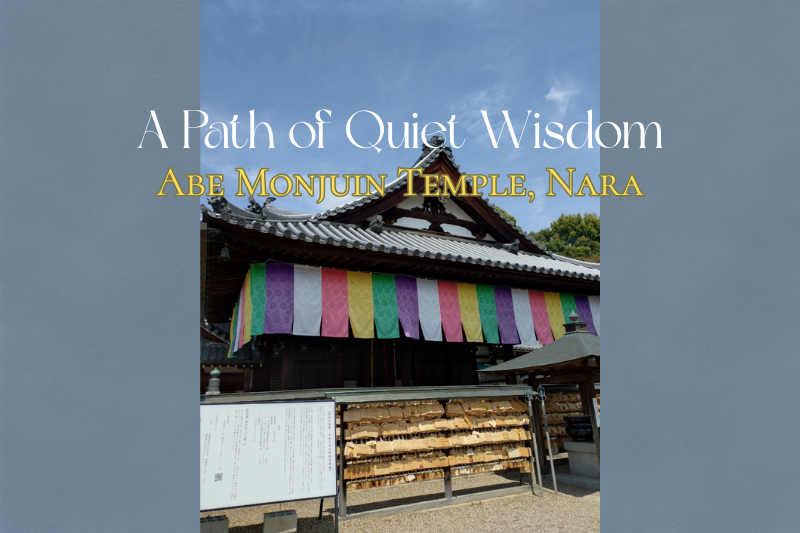
🌿Lead-in
There are places where wisdom is not taught,
but quietly felt.
Not through explanation,
but through a presence —
a stillness that gently aligns something within.
At 阿倍文殊院 (Abe Monjuin Temple),
that quiet presence seemed to emerge on its own.
This post gently follows the presence of Manjushri Bodhisattva,
the quiet rhythm of the Seven Visits at the Golden Pavilion floating hall,
and a moment of stillness within the ancient kofun.
✨Wisdom of Manjushri — Meaning and Devotion
In Japan, there is a well-known saying:
“Three people together bring the wisdom of Manjushri.”
This reflects a deeper understanding of wisdom —
not as something possessed individually,
but something that emerges through presence, connection, and shared awareness.
At 阿倍文殊院 (Abe Monjuin Temple),
this sense of wisdom has long been honored in both spiritual and practical ways.
The temple is widely known for prayers for academic success,
attracting students and visitors who seek clarity, guidance,
and a sense of direction in their lives.
The statues are deeply revered —
not only for wisdom,
but also for protection from evil and misfortune.
📜 History — A Temple of Enduring Wisdom
Abe Monjuin Temple is said to have been founded in 645,
making it one of the oldest temples in Japan.
Over the centuries, it has become closely associated with Manjushri Bodhisattva,
the embodiment of wisdom in Buddhist tradition.
The principal image, known as the “Monju Crossing the Sea,”
depicts Manjushri riding a lion and accompanied by four attendants —
a symbolic journey across the vast ocean to bring wisdom to all beings.
Created in 1203 by the renowned sculptor Kaikei,
the statue stands at nearly 7 meters tall,
making it the largest of its kind in Japan.
🌟Temple Highlights — Moments Within the Temple
🪨 Ancient Kofun — A Quiet Descent Within
Within the temple grounds lies an ancient kofun,
believed to date back to the Asuka period and designated as a Special Historic Site.
Stepping inside, the atmosphere shifts —
as if moving not only into the earth,
but gently inward.
As you step inside,
you encounter Ichigan Fudo —
a form of Fudo Myoo associated with the fulfillment of a single sincere wish.
Fudo Myoo is known as a guardian figure in esoteric Buddhism,
often depicted holding a sword to cut through illusion and protect the path of practice.
Visitors quietly make one intention,
light a candle, and offer their prayer in stillness.
Lighting a candle and praying there felt simple,
yet deeply focused —
as if the act of wishing itself became clear and still.

Entrance to the Ancient Kofun
The entrance to the Nishi Kofun,
an ancient burial mound from the Asuka period, quietly preserved within the temple grounds.
🏯 Main Hall — The Presence of Manjushri
Inside the main hall stands the principal image of Manjushri,
known as the “Monju Crossing the Sea.”
Riding a lion and accompanied by four attendants,
the figure represents a journey across the vast ocean —
bringing wisdom to those who seek it.
Created in 1203 by the renowned sculptor Kaikei,
the statue stands at nearly 7 meters tall,
making it the largest of its kind in Japan.
In his right hand, Manjushri holds a sword embodying a quiet, mysterious power,
while the lotus in his left symbolizes compassion and love.
Standing before it, I felt both its scale and its quiet intensity.
It was not overwhelming in a forceful way,
but carried a clarity that gently aligned something within.

Main Hall of Abe Monjuin Temple
The main hall enshrining Manjushri Bodhisattva,
a place long associated with wisdom and academic success.
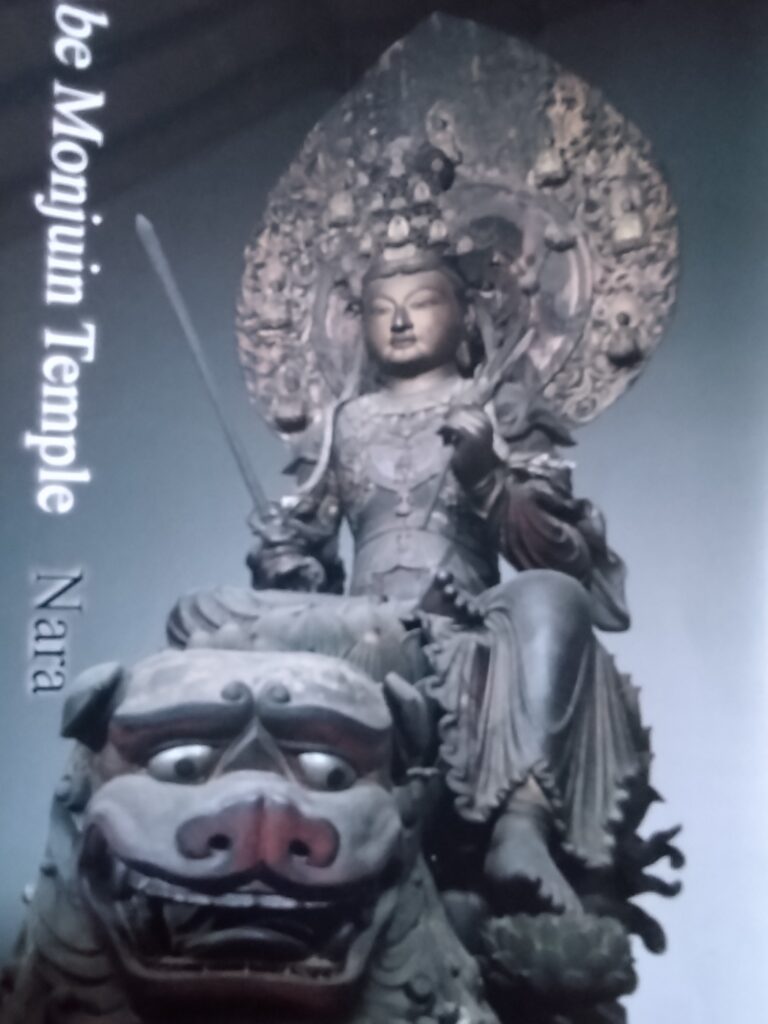
A depiction of Manjushri riding a lion,
holding a lotus symbolizing compassion and love,
and a sword representing a mysterious power.
(Image from temple pamphlet, shared for reference)
🌉Golden Pavilion — A Gentle Rhythm
The floating hall rests quietly upon the water,
surrounded by reflections of sky and trees.
From the outside, the space already carried a sense of calm,
as if inviting a slower, more mindful rhythm.
I later learned that a practice known as the “Seven Visits” (Shichi Mairi) is observed here,
a form of prayer in which one walks around the hall seven times
to ward off misfortune and invite blessings.
It is said that each person encounters seven unexpected difficulties in life,
and this practice is a way of gently releasing them,
step by step.
At the time, I simply paused and took in the atmosphere —
but knowing this, it feels like something I would like to experience next time.
I also did not realize that Benzaiten is enshrined within the hall.
Had I known, I might have approached it with a different awareness.

Golden Pavilion (Floating Hall)
A hexagonal hall on the water,
where the Seven Visits ritual is observed.
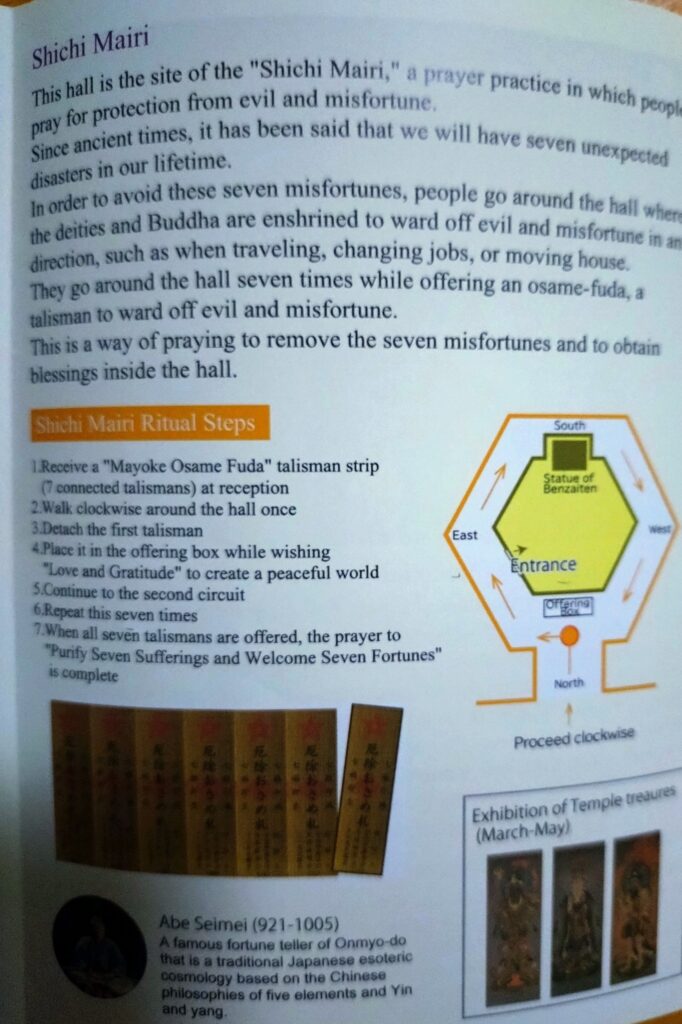
Shichi Mairi (Seven Visits Ritual)
A traditional prayer practice performed by walking around the hall seven times,
offering prayers to ward off misfortune and receive blessings.
(Image from temple pamphlet, shared for reference)
🌙Kaha’s Note
Abe Monjuin Temple was not only a place of learning or prayer,
but a space where something quietly came into alignment.
From the stillness within the kofun,
to the presence of Manjushri,
and the gentle rhythm of the floating hall —
each space carried a different quality,
yet all seemed to point toward the same place within.
While I was quietly praying,
a friend noticed something resting lightly in my hair —
a small piece of a cherry blossom.
In that moment,
it felt like a quiet yet powerful blessing.
Perhaps wisdom is not something to seek,
but something that settles,
when we pause long enough to listen.
🌈Explore more
If this place resonated with you,
you may enjoy exploring other sacred sites and quiet moments across Japan.
コメント