

🌾Lead-in
At Ise Jingu’s Gekū, the central deity Toyouke-no-Ōmikami is known as a miketsukami — a divine provider of food. She presides over sacred nourishment, preparing offerings for Amaterasu-Ōmikami, the sun goddess enshrined at Naikū.
According to tradition, about 1,500 years ago, during the reign of Emperor Yūryaku, the emperor received a divine message in a dream:
“I cannot dine in solitude with peace of heart. Call upon Toyouke from the land of Tanba.”
However, another version of the story tells us that it was Princess Yamatohime-no-Mikoto, a priestess and spiritual leader, who received the divine message and relayed it to the emperor — guiding the invitation of Toyouke to her present dwelling in Ise.
Whichever version one follows, it is this divine calling that is said to have led to Toyouke-no-Ōmikami being enshrined at Gekū.
Interestingly, the true identity of Toyouke-no-Ōmikami remains something of a mystery. Even local guides will sometimes admit that the origins of this deity are not entirely clear.
She is traditionally known as a miketsukami — a provider of sacred food — and is said to have come from the land of Tanba. More broadly, she is revered as a guardian of daily life itself, offering divine blessings of food, clothing, and shelter — the essentials of human existence.
Deeper meanings and regional connections may lie hidden behind her name.
Since then, the daily ritual of Miké — the offering of sacred food — has been carried out twice a day, morning and evening, without interruption for approximately 1,500 years.
Just like Naikū, Gekū is set within expansive, forested grounds filled with sacred stillness. Stepping into its precincts, one feels a deep atmosphere of reverence, where ancient tradition quietly continues in the present moment.
Gekū is rich with sacred places and layered stories — from venerable trees tied to imperial legends, to divine messengers in the form of white horses, to springs whose waters flow through centuries of ritual.
But among these many elements, there is one practice that forms the quiet, beating heart of this shrine: the daily offering ritual known as Miké.
In this post, we begin by focusing on this ancient and ongoing act of devotion — and later, we’ll briefly explore some of the other spiritual highlights that make Gekū such a uniquely sacred space.
This origin story is also inscribed on the official signboard at the entrance of Gekū, welcoming visitors into this sacred narrative.

Signboard at the entrance of Gekū (Toyouke Daijingu), introducing the enshrined deity and the daily Miké ritual.

The First Torii at Gekū, beyond the sacred Hiyoke Bridgeーthe “Fire Protection Bridge,” once built to protect the sacred grounds from fire.

A sacred evergreen branch, likely sakaki, tied with paper streamers to ward off impurity.

A five-sided beam cut for protection from evil.
🍚🔥 Miké: The Sacred Ritual of Daily Offering
① 🍶 A Quiet Ritual Rooted in Devotion
The ritual of Miké — daily offerings of sacred food — has been performed every morning and evening for over 1,500 years.
Though its origins are described in ancient legends, what remains most striking is its continuity.
Every single day, without pause, Shinto priests quietly walk to present food offerings — a gesture of gratitude and reverence to the divine.

🎥 Watch the priests in Motion
A sacred glimpse of the morning ritual at Gekū — Shinto priests walking solemnly toward the offering site:
👉Watch youtube▶️ Sacred Steps – Morning Ritual at Ise Jingu Gekū
② 🌾 What Is Offered: The Sacred Meal
The offerings in Miké are called shinsen, prepared fresh every day and presented with utmost purity.
They typically include:
- 🍚 Rice
- 🥬 Seasonal vegetables
- 🐟 Fish or seafood
- 🧂 Salt, 💧water, 🍶sake
These are cooked in the Imibiya-den (忌火屋殿), using fire kindled by traditional methods — a pure flame free from modern ignition, keeping the spiritual lineage unbroken.
📸 Images from Officially Permitted Displays
The following photos were taken from on-site exhibition panels at Ise Jingu, within areas where photography is clearly permitted.
These are not private or intrusive captures, but carefully selected images from official displays open to the public, used here for educational and respectful presentation.
Only a few representative photos are shown.
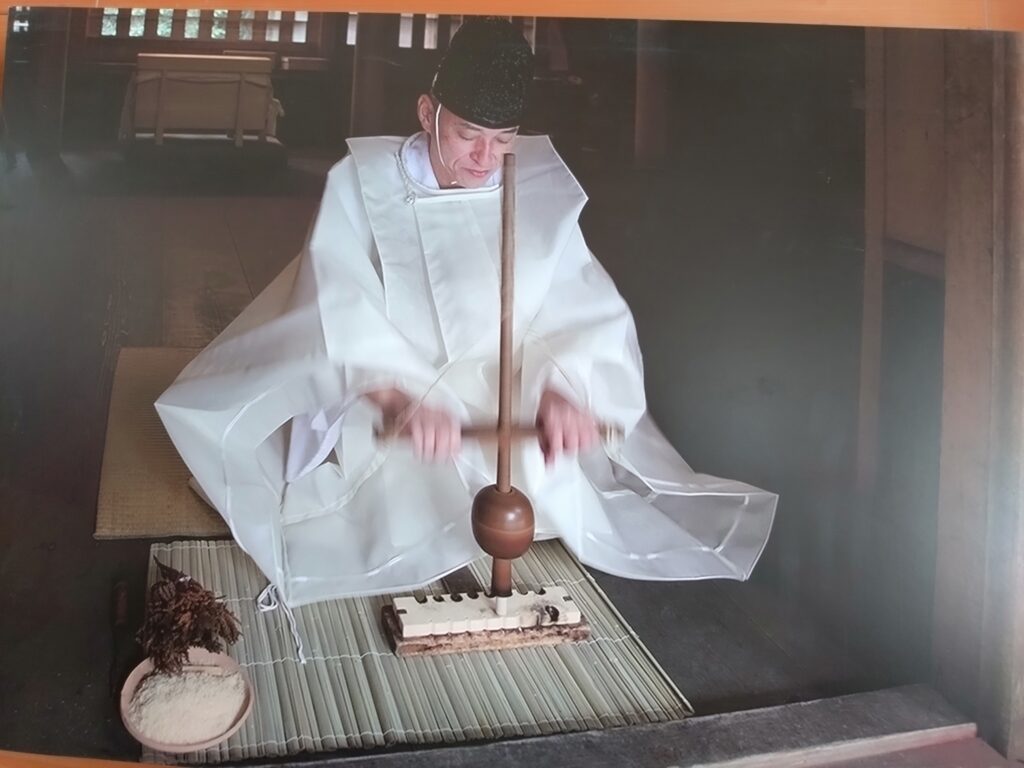
From public photo display at Ise Jingu Shinto priests using traditional fire-starting tools to create a “pure flame” for preparing sacred offerings.

Sparks of tradition — Shinto priests use pure, ancestral methods to ignite the fire for sacred offerings
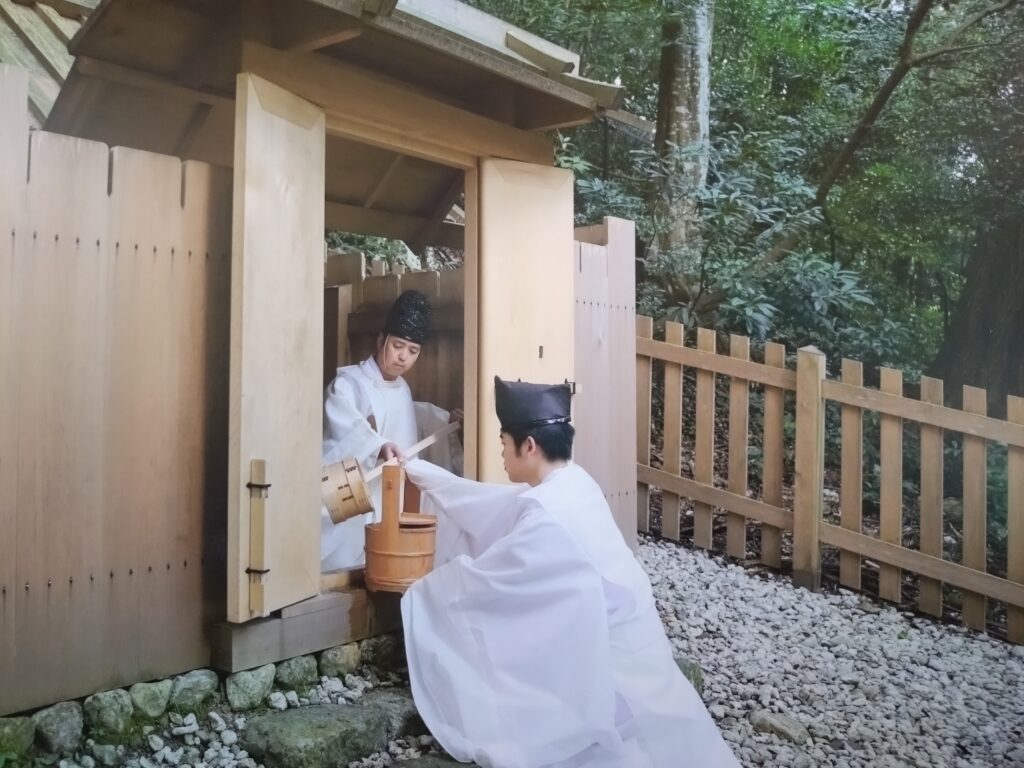
Water is carefully drawn from the inner sacred well, to be used for ritual purification and the Miké offerings.
📍 These images are shared here with the utmost respect for tradition and cultural sensitivity. Please visit Ise Jingu in person to experience the full depth of its sacred atmosphere.
③ 🔥 Meaning Beyond the Meal
Miké is not mere ritual — it is a quiet daily prayer of gratitude and connection. Every step the priests take is part of a living tradition that has continued, unchanged, for over 1,500 years.
The food is also prepared using traditional methods passed down through generations. Even the vessels used for the offerings are simple, unglazed earthenware — made from natural clay, designed to return to the earth.
This deep respect for purity and harmony with nature is present in every detail.
🌿 Sacred Spaces Beyond the Ritual: Highlights of Gekū
While Miké is the spiritual heart of daily ritual at Gekū, the Outer Shrine of Ise Jingu is also home to many other sacred sites.
Some of these are auxiliary shrines of great importance, while others are quiet corners that hold deep spiritual or historical meaning.
Let’s explore both.
① 🛕 The Three Betsugū – Auxiliary Shrines within Gekū
These three official betsugū (auxiliary shrines) reside within the sacred grounds and each represent a unique divine presence:
⛩️ Taga‑no‑Miya – The Sacred Heights
Among the three auxiliary shrines (betsugū) within Gekū, Taga-no-Miya is the most revered.
Located at the top of a quiet staircase behind the main sanctuary, it holds a distinct spiritual gravity.
Taga-no-Miya enshrines the aramitama — the dynamic and active aspect — of Toyouke-no-Ōmikami, the same deity revered in the main sanctuary of Gekū.
While the main hall honors the deity in her gentle, nurturing form (nigimitama), this auxiliary shrine is dedicated to her more vigorous, powerful presence.
The walk up to Taga-no-Miya is lined with ancient trees and stones, and the quiet ascent feels like a gentle purification of the heart.
Here, the divine feels close — not because of grandeur, but because of simplicity.

The entrance to Taga-no-Miya, marked by a wooden sign and watched over by towering trees. This auxiliary shrine enshrines the aramitama — the active, dynamic spirit — of Toyouke-no-Ōmikami.
🌬️ Kazeno‑Miya – Shrine of the Wind Deities
This shrine honors Shinatsuhiko-no-Mikoto and Shinatsuhime-no-Mikoto, deities of the wind.
Traditionally believed to offer protection and favorable weather — especially vital for agriculture — this sacred spot invites quiet prayer for balance with the natural world.
🪨 Tsuchi‑no‑Miya – Shrine of the Earth Deity
Tsuchi‑no‑miya is dedicated to the guardian of the land beneath, a stabilizing force that supports growth, structure, and daily life.
This shrine reminds us of our deep dependence on the soil — the base from which all things rise.
② 🌳 Other Spiritual Spots within Gekū
Beyond the formal shrines, there are subtle but powerful places throughout the forested precincts. These include:
💧 Shimomi‑no‑Miya – The Sacred Well
Tucked away within the quiet paths of Gekū lies Shimomi-no-Miya, a small shrine that houses a sacred well.
Although modest in appearance, it plays a vital role in the daily offerings of Miké.
Water used in these rituals is typically drawn from Kamino-Mii Shrine (Upper Well Shrine), which is not open to the public.
However, if the water there cannot be used—for seasonal, practical, or ceremonial reasons—this well at Shimomi-no-Miya serves as its spiritual substitute.
Unlike decorative fountains or tourist-accessible springs, this water is drawn with care, intention, and ritual purity.
It is not used casually or by visitors, but solely for the divine offerings made to the deities each day.
The presence of such a sacred well reminds us that even something as simple as water becomes sacred through reverence and intention.
In the quiet of this spot, one can feel the stillness of tradition — flowing, steady, and deeply rooted.
🌳 The Kusunoki of Taira-no-Kiyomori – A Living Memory
Near the entrance to Gekū, across from the purification pavilion, stands an ancient kusunoki — a camphor tree rooted in both soil and story.
According to tradition, when Taira-no-Kiyomori, a powerful court noble of the 12th century visited Gekū as an imperial envoy, a low-hanging branch brushed against his ceremonial eboshi.
He is said to have ordered the branch cut.
Centuries have passed, yet the tree remains.
Not merely as a relic of history, but as a living presence within the sacred grove — shaped by time, marked by memory, and still quietly growing.
Light moves through its leaves.
The past lingers, yet the present breathes.
It stands not only as history remembered,
but as resilience embodied.
🎥 Watch the Sacred Tree in Motion
A quiet glimpse of the ancient Kusunoki at Gekū — light moving gently through the leaves of the tree linked to Taira-no-Kiyomori:
👉 Watch on YouTube ▶️ https://youtube.com/shorts/pcU2CEW_y0g
☀️ Kaha’s Note
Visiting Gekū, when soft green light filters through the forest and sacred rituals continue quietly behind the scenes, offers a rare glimpse into Japan’s living tradition.
Whether you walk the paths in solitude or with reverence, each step echoes with over a millennium of devotion.
As I walked through the sacred grounds, I found myself repeatedly bathed in showers of sunlight filtering through the trees.
No matter how many times I visit, the gentle brilliance of that light feels like a quiet purification of both body and spirit.
There is something extraordinary about morning air at Gekū.
I sincerely encourage everyone to come, walk these peaceful paths, and experience this sacred stillness for yourself.
Each step holds a thousand years of prayer.
And in the light — you may feel something timeless shining through.

The sacred path at Gekū lit by morning light.

Morning light filters through the forest path at Gekū.
Visitors walk beneath soft rays, embraced by sacred stillness.
🌈Explore more
If this sacred moment resonated with you, we invite you to explore more reflections on Japanese spirituality, tradition, and quiet beauty.
🔗 Return HOME


コメント