

🌊Lead-in
Awaji Island, surrounded by quiet seas and wide open skies,
is known in Japanese mythology as one of the first islands created in the ancient story of Japan’s birth.
In the Kojiki, Japan’s oldest surviving chronicle,
the island first formed by the divine couple
Izanagi and Izanami
is called Onokoro-shima —
a mysterious island said to have emerged from the sea at the beginning of creation.
Today, Awaji still carries a quiet atmosphere
that feels deeply connected to those ancient stories.
During a recent spiritual journey to Awaji,
we visited places connected with Izanagi,
the kami associated with creation, purification, and renewal.
As we traveled through the island,
there were moments of deep rest, vivid dreams,
and quiet inner shifts that seemed difficult to fully explain.
Perhaps it was simply the peaceful atmosphere of the island,
or perhaps something older still lingers there —
woven quietly into the landscapes, waters, and stories that remain.
🏝️ Awaji Island and the Beginning of Japan
In ancient Japanese mythology,
the earliest kami were said to appear alone —
mysterious solitary presences known as Hitorigami.
(For more about the earliest kami, see
“🌿 Divine Thread Pre #1 — Part 1” →
https://8rainbow.work/%f0%9f%8c%bf-divine-thread-pre-1-part-1/ )
As the mythology gradually unfolds,
male and female kami begin to appear in pairs.
Among them,
Izanagi and Izanami
became the final divine couple
among the seven generations of divine beings described in Japanese mythology.
Together, they are said to have created the islands of Japan,
beginning with the mysterious island known as Onokoro-shima,
which is closely connected with present-day Awaji Island.
According to the mythology,
the two deities stood upon the floating bridge of heaven
and stirred the primordial sea below with a jeweled spear.
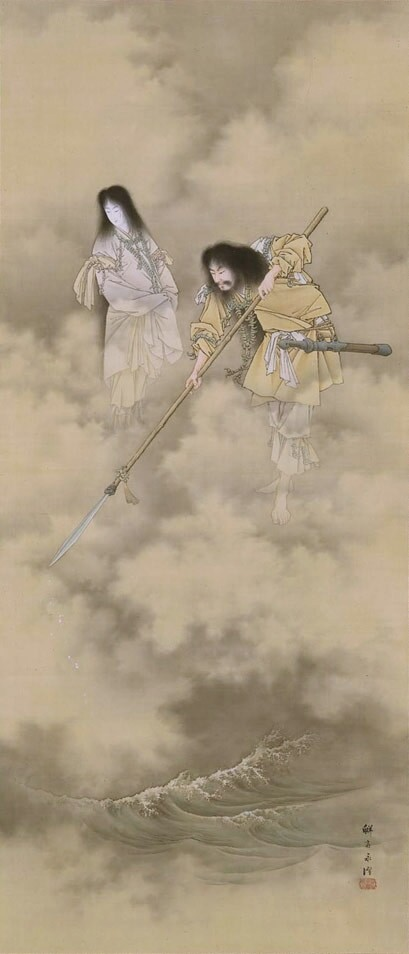
Izanagi and Izanami stirring the primordial sea with the heavenly jeweled spear.
Painting by Kobayashi Eitaku (1880s). Public domain via Wikimedia Common
As droplets fell from the spear,
the first island emerged from the waters —
marking the beginning of the land that would become Japan.
🔥 The Tragedy of Izanami
From the first island born from the sea,
the mythology of Japan continued to unfold.
According to the ancient stories,
Izanagi and Izanami
went on to create not only the islands of Japan,
but also many kami associated with nature,
the seasons,
and the forces that shape the world.
Yet the story takes a tragic turn
with the birth of the fire deity-
Kagutsuchi (火之迦具土神).
Severely burned while giving birth,
Izanami lost her life
and descended into Yomi —
the shadowy realm of the dead.
Unable to bear the loss,
Izanagi journeyed into Yomi,
hoping to bring her back from the land of darkness.
Before entering,
Izanami warned him not to look at her
until she had spoken with the deities of Yomi.
But unable to resist his longing and anxiety,
Izanagi lit a small flame
and looked upon her in the darkness.
There, he saw Izanami’s body transformed by death and decay,
surrounded by terrifying beings of the underworld.
Filled with shock and fear,
Izanagi fled from Yomi,
while Izanami, enraged by his betrayal,
pursued him from the darkness.
As he escaped,
various beings from Yomi chased after him.
According to the mythology,
Izanagi finally drove them away
by throwing peaches gathered near the entrance of the underworld.
Because of this story,
peaches later became associated in Japan
with protection and the warding away of harmful spirits.
🍑Kukurihime and the Boundary Between Worlds
At the boundary between Yomi and the world of the living,
Izanagi finally sealed the entrance to the underworld
with a massive stone.
It is said that the goddess
Kukurihime-no-Kami, a goddess said to mediate between worlds,
appeared during this moment of separation.
The ancient texts do not fully record her words,
yet after she spoke,
Izanami ceased her pursuit
and the boundary between the two worlds remained closed.
Because of this,
Kukurihime later became associated
with harmony, mediation,
and the tying together of connections and relationships.
Before the separation was complete,
Izanami declared in anger
that she would cause one thousand people to die each day.
In response,
Izanagi answered
that fifteen hundred people would be born each day instead.
Within the mythology,
death and birth became forever intertwined —
a continuing cycle of loss, renewal, and life itself.
💧 Misogi and the Birth of the Kami
After returning from Yomi,
Izanagi felt the impurity and sorrow of the underworld still clinging to him.
To cleanse himself,
he entered sacred water
and performed Misogi —
a ritual purification through washing and flowing water.
This act of purification became one of the most important spiritual foundations in Japanese tradition.
Even today,
its presence can still be felt
in practices such as purification at shrine water pavilions,
ritual washing,
and ascetic training beneath waterfalls.
According to the mythology,
powerful kami were born during Izanagi’s purification.
From his left eye emerged
Amaterasu,
the radiant sun goddess.
From his right eye came
Tsukiyomi,
associated with the moon and the night.
And from his nose appeared
Susanoo,
the powerful kami later connected with storms, purification, and protection.
These deities later became some of the central presences
within Japanese mythology and spiritual culture.
From grief, loss, and purification,
new light and new stories emerged once again.
⛩️ Izanagi Jingu — Kakuri no Miya
Izanagi Shrine
is regarded as one of the oldest shrines in Japan,
enshrining Izanagi,
the deity associated with creation and purification.
According to the shrine tradition,
after entrusting the rule of the nation
to Amaterasu,
Izanagi spent his final years in Awaji.
The shrine is also known as “Kakuri no Miya” —
a sacred place connected with the hidden or spiritual realm.
Even today,
the atmosphere of the shrine carries
a quiet sense of mythology,
continuity,
and ancient prayer.
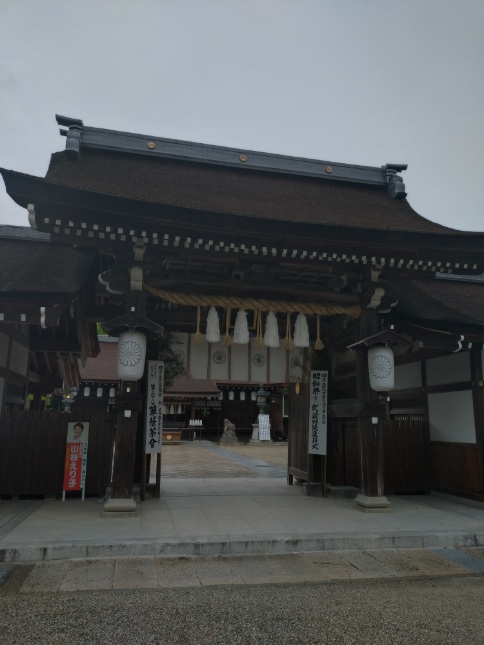
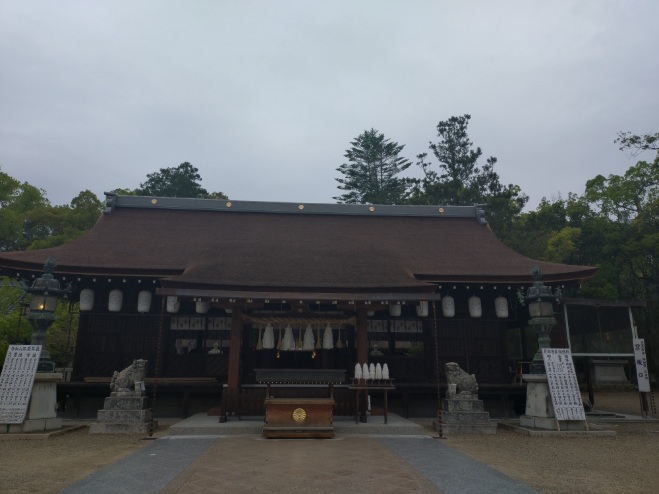
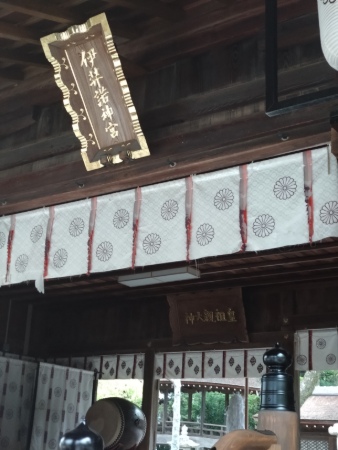
The quiet grounds of Izanagi Jingu in Awaji Island.
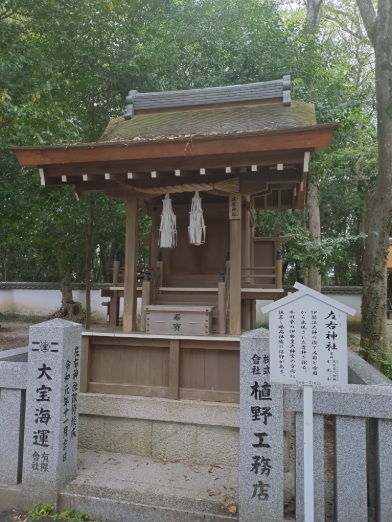
Sa’u Jinja (左右神社), where prayers for eye health are offered, is connected with the mythology that Amaterasu was born from Izanagi’s left eye and Tsukuyomi from his right during the ritual of purification.
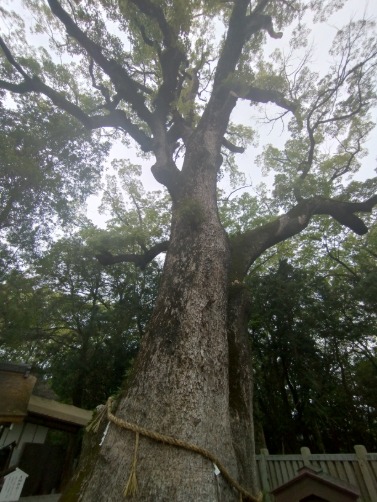
The sacred Meoto Okusu (Married Camphor Trees) at Izanagi Shrine is designated as a Natural Monument of Hyogo Prefecture.
According to the shrine tradition, two separate trees grew together as one, and are believed to be inhabited by the sacred spirits of Izanagi and Izanami.
Because of this, the trees have long been associated with prayers for harmonious relationships, safe childbirth, children, good fortune, and meaningful connections between people.
Nearby stands Iwakusu Shrine, whose enshrined deity is said to be Hiruko — described in the mythology as the first child born to Izanagi and Izanami, and later associated in some traditions with Ebisu.
⭐ Kaha’s Reflection
During this retreat journey,
I found myself encountering the names of many kami
in different places across Japan.
Some were connected with the sun and moon,
others with fire, purification,
protection,
or the forces of nature itself.
As the journey continued,
the stories of the kami began to feel less like distant mythology,
and more like quiet threads still flowing through sacred places,
landscapes,
and everyday life.
Perhaps this is one reason
these ancient stories continue to endure even now.
Even today,
their presence still seems to echo quietly
through the waters, forests, shrines,
and prayers of Japan.


コメント