
- 🔥 Who Is Konohanasakuya-hime? — The Goddess Within the Blossoms
- 🗻 The Mountain and the Flame — Her Sacred Bond with Mt. Fuji
- 🌸 Where She Still Blooms — Sacred Places Across Japan
- ✨ Sakura and the Sacred — The Symbolism She Carries
- 💫 A Living Goddess — Her Presence in Modern Spirit and Culture
- 🌿 Lessons in Bloom — Nature, the Feminine Divine, and What She Teaches Us
- 🌸 A Bloom That Still Lives
- 🕊Kaha’s Note — In the Stillness After the Bloom
🔥 Who Is Konohanasakuya-hime? — The Goddess Within the Blossoms
Konohanasakuya-hime is one of Japan’s most beloved goddesses. Her name means “Princess of the Blossoming Trees”, and she is often associated with cherry blossoms — the fleeting flowers that define Japan’s spring, and symbolize both beauty and impermanence.
But she is more than just a floral deity. In Shinto mythology, she is the spirit of Mount Fuji, a divine embodiment of both nature’s power and its gentle touch. She represents life that burns bright and passes quickly, reminding us that even the briefest moments can be sacred.
Her earliest appearances are found in the Kojiki and Nihon Shoki. There, she marries Ninigi-no-Mikoto, grandson of the sun goddess Amaterasu. Her father, the mountain god Ōyamatsumi, offers not only Konohanasakuya-hime but also her elder sister, Iwanaga-hime. Ninigi accepts only the younger, rejecting Iwanaga, who is often described in myth as lacking the delicate beauty of her sister — a reason given for her rejection.
But there is another version I once encountered: Iwanaga-hime was not unlovely, only deep — shaped by the eternal. She did not reveal herself easily. And by the time she arrived, Ninigi’s heart had already been captured by the gentle radiance of Konohanasakuya-hime. That version lingered in me, and still does.
What we call divine beauty may not always arrive in soft petals. Sometimes, it wears stone.
🗻 The Mountain and the Flame — Her Sacred Bond with Mt. Fuji
At the foot of Japan’s most sacred peak stands a shrine. It is Fujisan Hongū Sengen Taisha, a sanctuary where Konohanasakuya-hime has been worshipped for over a thousand years. Here, she is not just a fleeting flower. She is the soul of the mountain —its fire, its silence, its awakening, and its radiance.
Shared below are a few photos from Fujisan Kitaguchi Hongū Sengen Taisha — a place that feels deeply aligned with the divine feminine.

Fujisan Kitaguchi Hongū Sengen Taisha — where the goddess of blossoms meets the spirit of the mountain (Photo courtesy of a healer friend)
After marrying Ninigi-no-Mikoto, Konohanasakuya-hime became pregnant after just one night. Shocked, Ninigi doubted the child could be his. To prove her truth, she built a hut, sealed herself inside, and set it aflame — declaring that if the child were his, they would survive.
Within the fire, she gave birth to triplets. Not a single burn marked her. It wasn’t a test of purity — it was a declaration of spiritual sovereignty.
She walked into the fire not to prove she was worthy, but to show that truth needs no permission to survive.

Light filtering through sacred tree — a place where prayers linger like petals on wind. (Photo by an amazing healer friend)
🌸 Where She Still Blooms — Sacred Places Across Japan
There are over 1,300 Sengen shrines across Japan that honor her name. From countryside altars to grand mountain gates, each one carries part of her presence. Festivals bloom in her honor every spring, when cherry trees unfurl like stories in the wind.

A torii stands like a threshold — where the visible and the sacred softly meet (Shared with permission by a dear friend)
In these places, she is remembered not just as a myth, but as something still living — something we can visit, speak to, and feel.
✨ Sakura and the Sacred — The Symbolism She Carries
Cherry blossoms are more than beautiful — they are the breath of impermanence. In her name, “Sakuya” means “to bloom,” but not forever. She teaches us to unfold even when the moment is brief.

A dragon at the shrine’s Chozuya — purifying hands before entering the realm of the divine (Photo by a healer friend)
She is the goddess of what fades and the goddess of what matters anyway. To witness sakura is to feel her grace — not because it lasts, but because it doesn’t.
To honor her is to stop, to notice, to hold beauty in your hands without needing to keep it.
💫 A Living Goddess — Her Presence in Modern Spirit and Culture
In modern spiritual circles, she is a symbol of feminine creativity, fertility, and intuition. People pray to her for childbirth, protection, inspiration — and soft rebirth. She has also appeared in anime, games, and pop culture, her energy recognized even in modern myth.
She doesn’t demand worship. She offers presence. Whether under blossoms or within yourself — she meets you now, where you are.
She doesn’t demand belief. She invites remembrance — of who you are when you let yourself bloom.”
🌿 Lessons in Bloom — Nature, the Feminine Divine, and What She Teaches Us
She teaches not conquest, but wholeness. Not forever, but now. Her presence echoes Japan’s natural wisdom: that everything changes, everything returns.
She is not only a goddess of nature — she is nature. She is the flower, the flame, the wind through cedar. And she is the strength it takes to bloom even knowing it won’t last.
She teaches not how to escape the fleeting, but how to love within it.
🌸 A Bloom That Still Lives
This spring, for the first time, I felt drawn to connect with Konohanasakuya-hime more deeply.
That gentle nudge led me into something new: an experiment in co-creating her image through AI — not to define her, but to meet her, in a way shaped by my own heart.
I understood that sacred energy can’t be fully captured in form. But curiosity — and a kind of calm devotion — led me forward. I wasn’t sure what would appear.

The image that emerged — delicate yet radiant, blooming with a presence I could feel.
© Kaha 2025. Created with AI and personal vision.
But the image that came held something familiar. Not in form, but in feeling.
There was something in the light, in the flow, in the way color softened and glowed — something that echoed her.
🕊Kaha’s Note — In the Stillness After the Bloom
Even after the petals fall, her presence lingers.
In memory, in breath, in the calm where beauty takes root again.
Perhaps she doesn’t ask for devotion — only for you to pause.
To feel. To let something sacred move through you, even briefly.
She reminds us that we, too, are allowed to bloom in our own way.
Not perfectly. Not forever. But honestly.
So if something within you is ready to soften, or unfold,
know that the goddess who walks through fire and blossom walks with you, too.
Let it be gentle.
Let it be true.
And let it be yours.
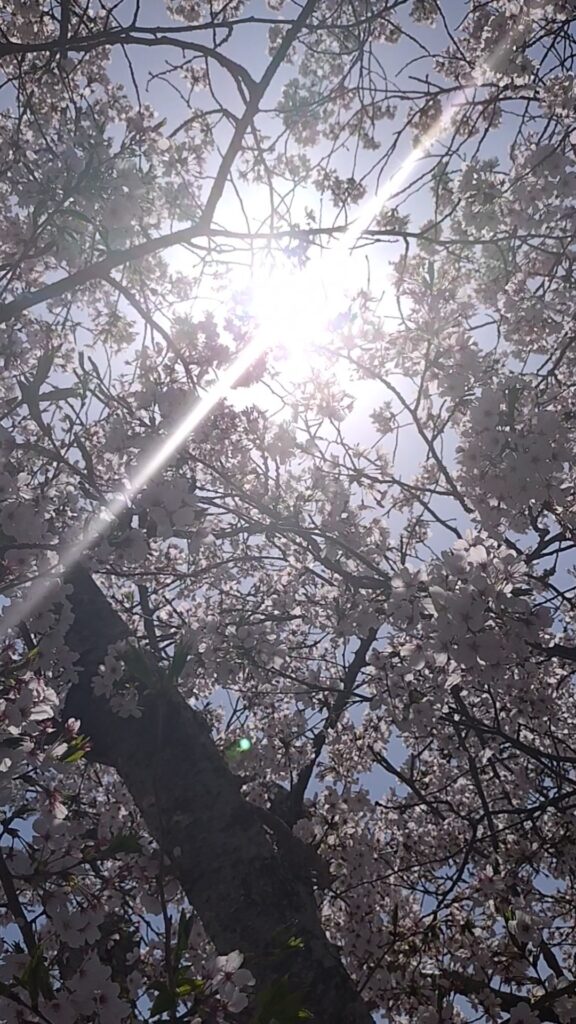
Cherry Blossoms with lightーnear a bus stop in my hometown. That light still lingers, even after the season has passed.
🔚 Back to Home
Want to explore more places and stories in Japan?
👉 Return to the main page


コメント