

🌊 Lead-in
In Japan, there are said to be over 12,000 shrines and temples dedicated to Benzaiten, the goddess of water, music, eloquence, wisdom, and flow.
Among them, the Three Great Benzaiten Shrines—Itsukushima (Hiroshima), Chikubu Island (Shiga), and Enoshima (Kanagawa)—are especially revered. Some also recognize a broader set known as the Five Great Benzaiten Shrines, which includes places like Tenkawa (Nara) and Daikannonji (Miyagi).
I had already visited two of these sacred places: Itsukushima Shrine in Hiroshima, and Tenkawa Benzaiten Shrine in the mountains of Nara, which holds a particularly sacred place in my heart.
👉If you’d like to explore that journey, see: Divine Thread #1 — Benzaiten: The Hidden Water Face of Saraswati.
As the Year of the Snake came to a close—a year rich in spiritual symbolism—I felt a growing call to visit the island.
There was no logical reason. Just a quiet certainty.
Something sacred was waiting.
🌧️ Before we begin, take a quiet moment to feel the atmosphere of the island in rain.
Watch this short scene from the ferry —
👉 A glimpse of Chikubu Island in mist and rain
🌿 The Sacred Origins of Chikubu Island
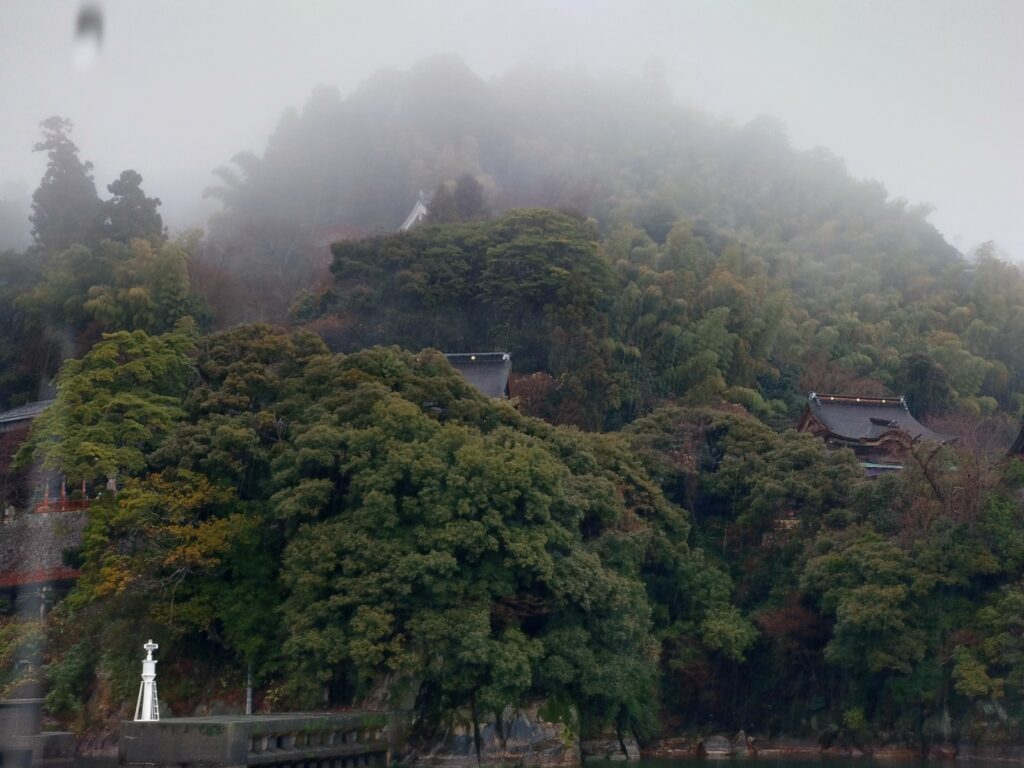
Chikubu Island wrapped in mist — a sacred sanctuary drifting between lake and sky.
Chikubu Island, a small, lush island in the middle of Lake Biwa, has long been revered as a place where heaven and earth meet. Its origins as a sacred site stretch back to the 8th century, rooted in imperial dreams, divine messages, and the merging of Buddhist and Shinto traditions.
According to temple legend, in the year 724 CE, Emperor Shōmu—a deeply spiritual ruler during the Nara period—received a divine vision in a dream from Amaterasu Ōmikami, the sun goddess and the spiritual matriarch of Japan’s imperial lineage.
In the vision, Amaterasu instructed him to enshrine Benzaiten—the Japanese form of the goddess Saraswati—on an island in Lake Biwa. The place, she said, was sacred and imbued with the power of flowing water and ancient spirits.
She declared:
“If Benzaiten is enshrined here, the land shall know peace, the harvest shall be abundant, and all people shall live in joy.”
Moved by the vision, Emperor Shōmu commissioned the monk Gyōki—renowned for his compassion, spiritual vision, and temple-building skills—to carry out the divine task. Gyōki traveled to the island, carved an image of Benzaiten, and established what would become Hōgon‑ji Temple, beginning Chikubu’s role as a sacred gateway to the divine feminine.
On Chikubu Island, the borders between shrine and temple, kami and buddha, dissolve—leaving behind a sacred tapestry where centuries of belief continue to breathe in stone, wood, and prayer.
The island is home not only to Hōgon‑ji Temple but also to Tsukubusuma Shrine, dedicated to Ichikishimahime-no-Mikoto, a goddess of water and one of the Munakata Three Goddesses, who is often equated with Benzaiten in syncretic belief.
This co-existence is a perfect expression of shinbutsu shūgō, the blending of Buddhist and Shinto spirituality that once shaped much of Japanese religious life. Here, the goddess is both kami and bodhisattva, appearing to those who listen closely, often in whispers of water and wind.
🔒 A Hidden Goddess: The 60-Year Secret
While the divine image of Benzaiten was lovingly carved and enshrined by the monk Gyōki nearly thirteen centuries ago, few in the world have ever seen it.
At Hōgon‑ji Temple on Chikubu Island, the principal statue of Benzaiten is what’s known as a hibutsu—a “hidden Buddha.”
Unlike many religious icons displayed for daily worship, this statue is kept hidden from view, revealed only once every sixty years.
The tradition, rooted in reverence and mystery, is meant to protect the sacred energy of the goddess, and to remind worshippers that true connection is not always visible.
To stand before her is considered a once-in-a-lifetime experience—a moment that resonates deep within the heart.
The next scheduled unveiling of this hidden goddess is set for the year 2037.
In a rare exception, the statue was made visible in 2024 to commemorate the 1300th anniversary of Hōgon‑ji’s founding. Those who were present described the encounter as radiant, silent, and deeply moving.
In a world filled with noise and constant exposure, Benzaiten remains quiet and hidden—
revealing herself not on demand, but when the time is right.
🐉 The Island’s Hidden Protectors: Black Dragons and Rain
One of the most well-known customs on Chikubu Island is the quiet ritual of kawarake-nage—a form of “wish-casting” using small clay discs.
Visitors climb to a special viewpoint on the island, write their wish on a lightweight disc, and throw it through a stone torii gate perched above the lake.
If the disc passes cleanly through the gate, the wish is said to be carried into the divine realm.

A prayer site for the Eight Great Dragon Kings (Hachidai Ryūō), open to both the sky above and the waters of Lake Biwa below — where offerings flow between heaven and the deep.
While these deities are traditionally worshipped as a collective, one stands out in particular here—the Black Drago, venerated as Kokuryū Daijin and Kokuryū-hime Daijin.
In many traditions, the Eight Dragon Kings are guardians of water, rain, and spiritual power.
But on Chikubu Island, the Black Dragon is deeply felt—a protector said to rise from the depths of Lake Biwa, climb up the sacred tree by the lake and watch over the island in quiet strength.
On the day I visited, the island was wrapped in mist.
Rain had begun in the early morning and continued gently, cloaking everything in a soft, luminous veil.
The air was damp, heavy, and filled with a strange clarity.
And the wind—yes, the wind moved quietly through the branches, brushing past the tree, the stones, and my skin.
It wasn’t cold. It wasn’t loud.
But it was present—like a breath.
Some say the Black Dragon rises through the lake, unseen.
That day, I believed it.
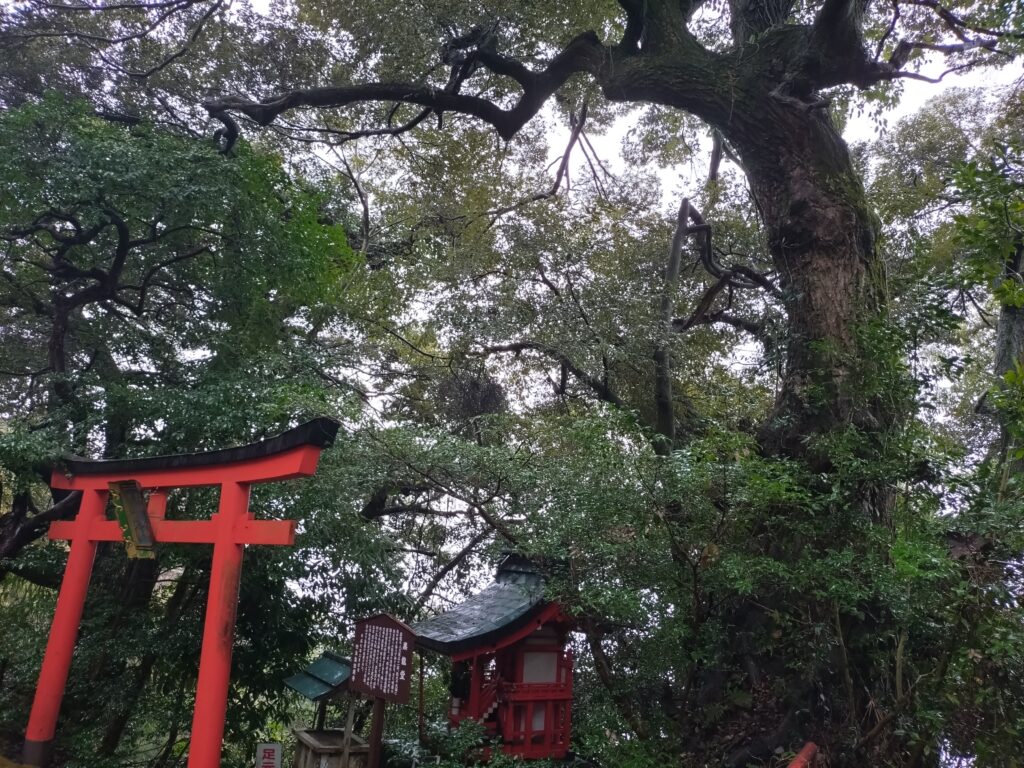
The sacred tree of the Black Dragon rises behind a quiet red torii, where whispers of rain and spirit meet in silence.
Do you want to see the tree?
🌿 Click here to watch the short clip from Chikubu Island — where the sacred tree stands near the Black Dragon’s waters.
🌳 A Tree of Silent Prayers
Near one of the quieter paths on Chikubu Island stands an ancient Mochi tree (Ilex integra)—
so old and strong that it seems to hold the island’s whispered prayers within its branches.
This tree is known as the “Mochi Tree,” and it has stood here for centuries.
It is believed to have been planted by Katagiri Katsumoto,
a high-ranking samurai commander who served Toyotomi Hideyoshi
during Japan’s Azuchi–Momoyama period (1573–1603)
and later Tokugawa Ieyasu in the early Edo period (early 1600s).
At a time when Japan was moving from constant warfare toward stability,
Katagiri Katsumoto played an important role
in shaping the political landscape of the country.
He came to Chikubu Island as part of his official duty,
overseeing construction work (fushin)
for the National Treasure Kannon Hall.
It is said that during this visit,
he personally planted this tree as a commemorative gesture—
an offering of intention and devotion.
When I stood beside it,
mist curled softly around each leaf and branch,
like a veil drawn across time.
The rain that morning had not stopped,
and droplets clung to every surface,
as if the tree itself were breathing with the island.
There was no sound—
only the quiet rustling of leaves
and the distant murmur of water.
It wasn’t just any old tree.
It felt like a living record of time, prayer, and presence.
As if the tree was still listening—
still holding that ancient wish,
and the many that followed.

This Mochi tree is believed to be around 400 years old.
It has quietly watched over this island for centuries.
🌊The Heart of Hōgon‑ji: Where the Goddess Dwells
Inside Hōgon‑ji’s main hall, the sacred atmosphere deepens even further.
Two striking statues of Benzaiten are enshrined separately on the left and right sides of the hall, each facing inward—as if holding the space between them. Their forms are serene yet powerful—silent guardians of the temple’s spiritual heart.
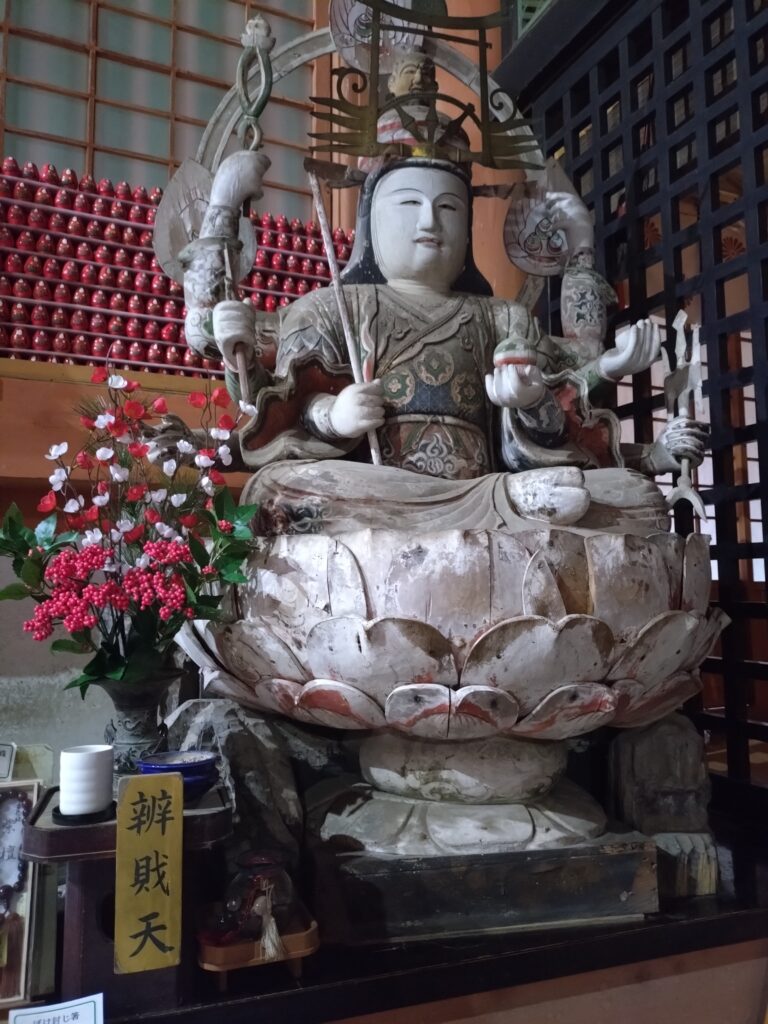
One of the two Benzaiten statues inside the main hall — serene, powerful, and surrounded by prayers.

The other Benzaiten statue — holding sacred instruments, watching over the space with quiet strength.
Above, the ceiling was adorned with soft shapes and colors, though I couldn’t make out the details clearly—my eyesight isn’t perfect. But there was something ethereal about the way the misty air played with the space above, as if something sacred was just barely visible.
Later, I received a beautifully crafted paper cutout as a kind of goshuin (shrine seal). It showed a delicate, flowing figure that looked like a celestial maiden—a tennyo, perhaps. When I saw it, something in me whispered, “That’s what I saw in the ceiling, even if I couldn’t see it clearly.”
Maybe I didn’t see with my eyes, but something in me remembered it anyway.
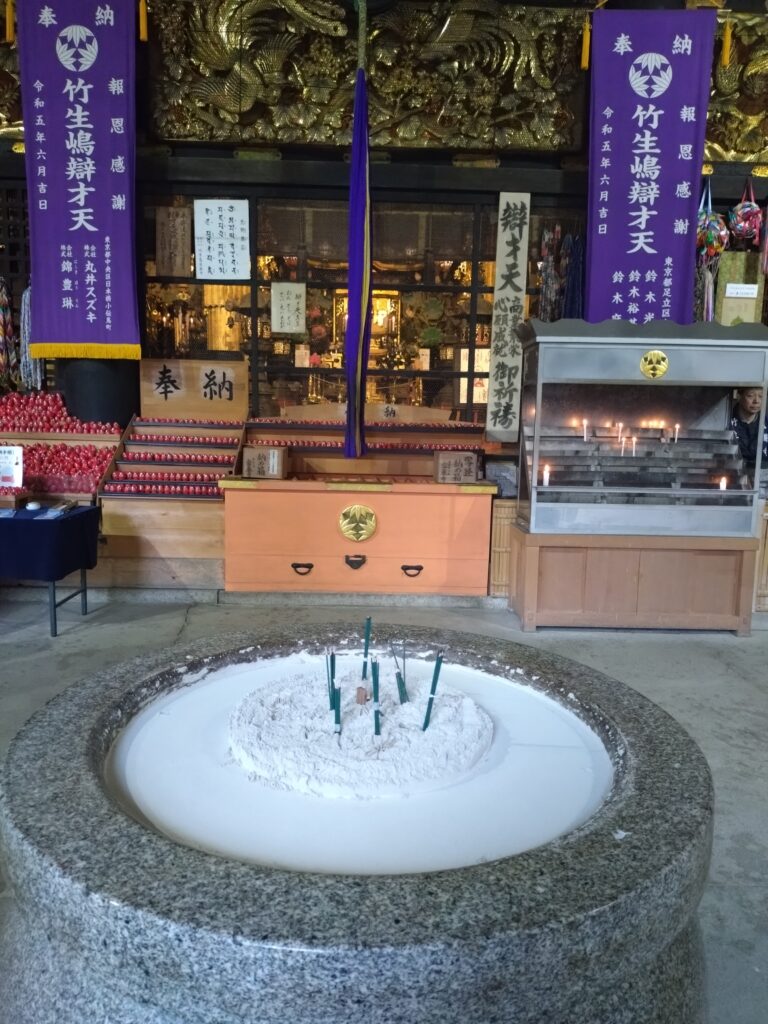
The heart of the temple — incense rising like prayers, framed by golden blessings and quiet reverence.
🛕Guardians, Maidens, and a Thousand Prayers
Inside the main hall of Hōgon‑ji, in front of the altar, hundreds—perhaps thousands—of small red daruma dolls filled the space like a gentle sea of wishes.
Each one, a prayer.
Each one, a hope entrusted to the goddess.
Benzaiten, revered across Japan as a deity of beauty, music, wisdom, fortune, and flowing abundance, draws deep devotion.
You could feel it here—not only in the formal statues, but in these small, heartfelt offerings.
The air was soft with incense.
The hush was deep but welcoming.
And as I stood there among so many unspoken prayers,
I offered my own—not with words, but with feeling.
And in return, I felt heard.
That moment created a thread—between me, the goddess, and all those who had prayed here before.
It wasn’t dramatic. It was quiet.
But it was real.
Benzaiten doesn’t ask for perfection.
Only sincerity.
And in that space, surrounded by red wishes and silent guardians,
I felt closer to her than ever before.

Rows of red daruma line the temple wall — a thousand prayers offered, held, and remembered.

A Benzaiten “wish daruma” — its gentle face carrying the silent hopes of many.
🕊 Kaha’s Note
I didn’t yet know how the journey would unfold—only that I was drawn to her, and something in me was ready to listen.
Maybe it was the dragon.
Maybe it was the goddess.
Maybe it was a part of myself I had forgotten.
On Chikubu Island, everything felt softened—by rain, by distance, by time.
The stone path, the ancient tree, the gentle ritual of casting wishes into the air.
There was no rush. No noise.
Only presence.
I didn’t have a grand epiphany.
But I did leave with something.
Something small.
Something real.
Another thread was tied.
Between me and the island.
Between me and her.
Between silence and the soul.
You don’t always recognize a sacred place the moment you arrive.
But when you leave, your heart carries a difference you didn’t arrive with.
Then you understand.
The blessing had already begun.

As the island faded into mist behind me, I didn’t feel like I was leaving something behind.
I felt like something had quietly come with me.
🌈Explore More
Curious about other sacred places and spiritual threads?
Discover more journeys woven with myth, mist, and meaning.


コメント