

🎐Lead-in
Every summer, Ofusa Kannon becomes known for its beautiful Wind Chime Festival, where hundreds of glass bells sway gently through the temple grounds.
I arrived hoping to enjoy the sound of the wind chimes on a rainy July morning. Instead, I found a temple filled with unexpected discoveries—from seasonal flowers and quiet corners to special exhibitions, local stories, and even a charming “school” of baby turtles.
Though relatively small in size, Ofusa Kannon offered far more than I had imagined, making it one of the most memorable temple visits of my summer.
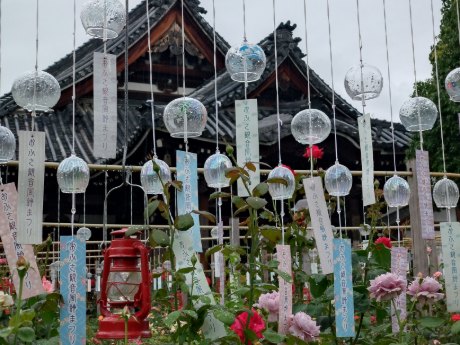
The main temple building framed by hundreds of wind chimes and blooming roses during the Ofusa Kannon Wind Chime Festival.

Rows of colorful glass wind chimes welcome visitors to the Ofusa Kannon Wind Chime Festival, creating one of the temple’s most beloved summer traditions.
At certain times during the festival, hundreds of soap bubbles drift through the temple grounds, adding a playful touch to the gentle sound of the wind chimes. Against the backdrop of the historic temple buildings, the floating bubbles created a magical moment that delighted visitors of all ages.
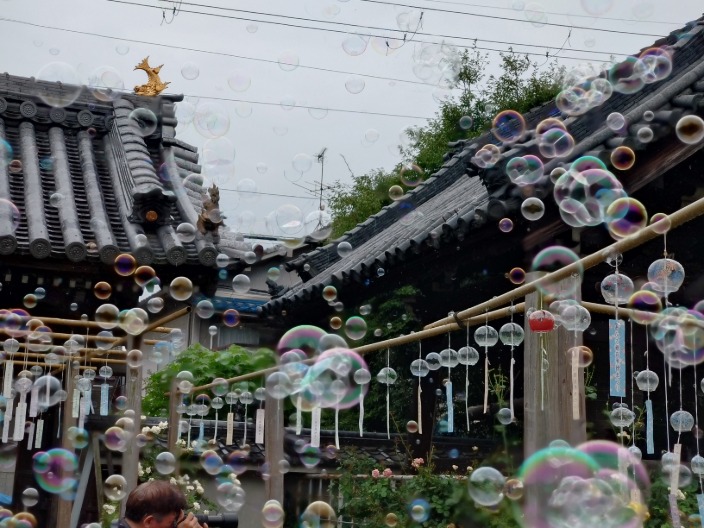
Floating soap bubbles transformed the temple grounds into a dreamlike summer scene.
As I was walking through the temple, I overheard one of the temple staff telling visitors that the wind chimes are even more beautiful beneath a clear blue summer sky.
I’m sure they are. Yet I found a different kind of beauty on this rainy day. The rain came and went throughout the morning, but just as the soap bubbles began to float through the temple grounds, it eased into a gentle drizzle. Watching the colorful soap bubbles drifting among the wind chimes and flowers became one of the most memorable moments of my visit.
Sometimes, the beauty of a place comes not from perfect weather, but from the unexpected moments it offers.
🌿 Beyond the Wind Chimes
While the Wind Chime Festival may be what first attracts many visitors, Ofusa Kannon offers far more than its summer decorations.
As I wandered through the temple grounds, I found peaceful statues, fragrant incense, seasonal flowers, and quiet corners that invited me to slow down. Every turn revealed another small discovery, making the visit feel less like sightseeing and more like a gentle walk through a living temple.
Despite its relatively modest size, Ofusa Kannon is a place where history, faith, and everyday life quietly come together.

Koyasu Kannon, the Bodhisattva traditionally associated with safe childbirth, motherhood, and the protection of children.

Fudō Myōō, a powerful Buddhist guardian known for protecting people and removing obstacles on the spiritual path.

Visitors gently waft the fragrant incense smoke toward themselves, believing it brings purification, healing, and blessings.

According to the sign, visitors are invited to pray for healthy legs and feet. A Bussokuseki is a stone carved with the footprints of Shakyamuni Buddha. Before Buddha statues became widely worshipped, these sacred footprints were already revered.
As I continued exploring, I discovered many small shrines and statues tucked throughout the temple grounds. Dedicated to Benzaiten, Jizō, Yama-no-Kami, and other deities, they quietly reveal how generations of visitors have come here to offer prayers for different aspects of life.
🐢The Legend Behind Ofusa Kannon
One of the most memorable parts of my visit came unexpectedly. As I explored the temple grounds, I happened to overhear a temple guide explaining the origins of Ofusa Kannon to a small group of visitors.
According to the temple’s tradition, the story began with a young woman named Ofusa. One day, she noticed a white turtle, believing it to be a sacred messenger. As she offered her prayers, she saw a small image of Kannon resting on the turtle’s shell.
Word of this miraculous event soon spread, and more people began gathering to pray. A small 20-centimeter statue of Kannon was later carved, and a Buddhist priest from Kyoto was invited to formally enshrine and worship it. Over time, this simple act of devotion gradually led to the founding of the temple.
Today, the temple’s principal image, the Eleven-Headed Kannon (Jūichimen Kannon), is a hibutsu (hidden Buddhist image) and is normally kept out of public view. It is unveiled only during a special public opening held each year on April 17 and 18.
After hearing this story, I found myself hoping to return one spring to experience this rare occasion and offer my own prayers before the hidden image.
🙏 A Temple of Living Faith
Beyond its seasonal beauty and centuries-old traditions, Ofusa Kannon continues to be a place of living faith for the local community.
During my visit, I learned that this Kannon is traditionally believed to help those suffering from shaku (癪)—an old Japanese term referring to stomach pain and digestive ailments.
The temple guide explained that many local people visit Ofusa Kannon to pray before seeking medical treatment. If their symptoms persist, they then visit a hospital. According to the guide, it is not unusual for local patients to pray at Ofusa Kannon before seeing a doctor and to seek medical care only if their symptoms do not improve.
Listening to these stories reminded me that Ofusa Kannon is much more than a historical temple or a seasonal destination. It remains a place where faith continues to be quietly woven into everyday life.
🖼️ A Rare Opportunity
During my visit, I was fortunate to encounter two special exhibitions.
One featured a sacred hanging scroll that is displayed to the public only once every thirty years, making it an exceptionally rare opportunity to see.
The other showcased iki-ningyō (“living dolls”), traditional Japanese figures crafted with such extraordinary detail that even their veins appear visible beneath the skin, giving them an astonishing lifelike presence. I later learned that only a small number of these remarkable works remain in Japan today.
Discovering both exhibitions purely by chance made my visit even more memorable.
🐢The Little “School” of Baby Turtles
One of the most charming discoveries at Ofusa Kannon was a small area affectionately known as the “School of Baby Turtles.”
Watching the tiny turtles swim side by side was a gentle and heartwarming moment. Although they are not the legendary white turtle connected with the temple’s origins, their presence felt like a playful echo of that story.
After learning about the white turtle and the founding of Ofusa Kannon, seeing these little turtles made the temple’s history feel unexpectedly close and alive.

The temple’s adorable “School of Baby Turtles,” a small and joyful reminder of the white turtle in Ofusa Kannon’s founding legend.
🌟Some moments are best experienced in motion. If you’d like to hear the gentle sound of the wind chimes or watch the baby turtles swimming together, I’ve also shared short videos from Ofusa Kannon on Instagram. 📷 Instagram: @8rainbowawakening.jp
🕊️ Kaha’s Note
Of all the stories I heard that day, the one that stayed with me most was how everything began with a single woman.
According to the temple’s tradition, Ofusa was the first person to witness a white turtle carrying the image of Kannon. Yet little by little, more people came to believe, to pray, and to gather. From one person’s experience, a temple was eventually born.
As I listened to this story, I couldn’t help wondering if I, too, had been quietly guided here by Kannon.
Although Ofusa Kannon is a relatively small temple, tucked away from the nearest station, I found a warmth here that is difficult to describe. Between the gentle sounds of the wind chimes, the stories passed down through generations, the smiles of the temple staff, and even the tiny turtles swimming peacefully together, it felt like a place where faith and everyday life still quietly meet.
Perhaps that is what I will remember most—not just the Wind Chime Festival, but the gentle spirit that continues to live here.

The entrance to Ofusa Kannon, where peaceful moments quietly begin.
🌈 Explore More
Discover more sacred places, seasonal beauty, and everyday moments from Japan throughout Rainbow Awakening.


コメント