
🌠Lead-In
From June onward, colorful bamboo branches decorated with handwritten wishes begin to appear across Japan.
You can find them not only at shrines and temples, but also in schools, shopping centers, railway stations, and local community spaces. For a few short weeks, handwritten wishes quietly become part of everyday life.
Known as Tanabata, or Japan’s Star Festival, this beloved seasonal tradition is inspired by an ancient legend of two lovers separated by the Milky Way, who are allowed to meet only once a year.
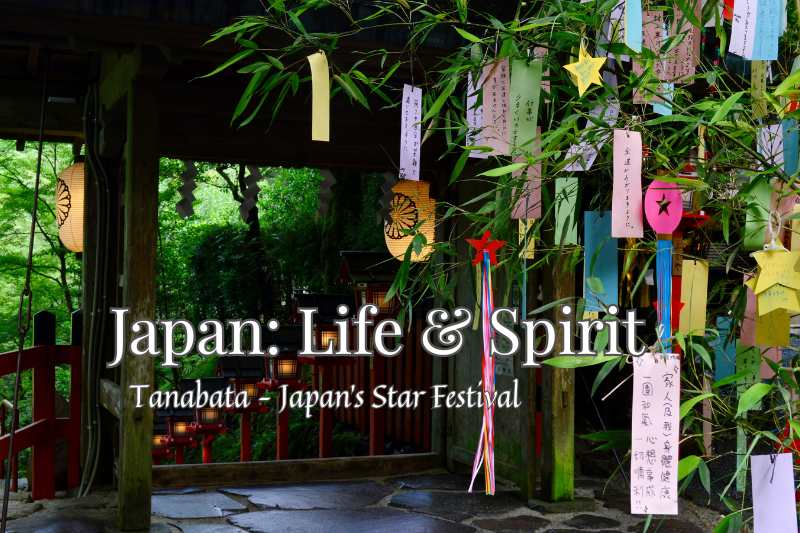
This year, I came across Tanabata decorations in several different places—from the peaceful grounds of Ryūsenji Temple to a small display in a local shopping mall. Although the settings were different, they shared the same quiet invitation: to pause for a moment, write down a wish, and look toward the summer sky.


Tanabata bamboo decorated with colorful tanzaku at Ryūsenji Temple.
To understand why this tradition continues to touch people’s hearts today, we first need to look at the legend that gave birth to Tanabata.
🌌 The Legend of Tanabata
The story of Tanabata comes from an ancient Chinese legend that was introduced to Japan more than a thousand years ago. Over time, it became intertwined with Japanese customs and developed into the seasonal celebration we know today.
According to the legend, Orihime, a talented weaver, spent her days weaving beautiful cloth beside the Heavenly River, known as the Milky Way. Her father, the Sky King, introduced her to Hikoboshi, a hardworking cowherd who lived on the opposite side of the river.
The two quickly fell in love and married. However, they became so absorbed in their happiness that they neglected their work. As a result, they were separated by the Milky Way and allowed to meet only once a year, on the seventh day of the seventh month.
It is said that on this special night, a flock of magpies forms a bridge across the Milky Way so the two lovers can reunite.

An artistic interpretation of Orihime and Hikoboshi reuniting on the night of Tanabata.
Today, their story continues to inspire Tanabata celebrations throughout Japan. Every handwritten wish placed on a bamboo branch carries a small echo of this timeless legend.
🎋 Writing Wishes on Tanzaku
The story of Orihime and Hikoboshi has been passed down for centuries, but Tanabata is much more than an ancient legend. Today, it continues to live on through a simple tradition that brings people of all ages together.
One of the most familiar Tanabata customs is writing wishes on tanzaku—small strips of colored paper—and hanging them on bamboo branches.
People write wishes for good health, success in school or work, happiness, peace, and hopes for the future. During the Tanabata season, bamboo decorated with colorful tanzaku can be found throughout Japan, inviting everyone to pause for a moment and add their own wish.
Traditionally, the five colors of the tanzaku are associated with the ancient Chinese philosophy of the Five Elements and have come to represent different virtues in Japan.
- 🔵 Blue (or Green) – Personal growth and self-improvement
- 🔴 Red – Gratitude and respect for parents and others
- 🟡 Yellow – Trust, friendship, and sincerity
- ⚪ White – Integrity, discipline, and keeping promises
- ⚫ Black (often replaced by Purple in Japan) – Wisdom and learning
Today, however, many people simply choose their favorite color and write a heartfelt wish. Whether following tradition or simply expressing a personal hope, Tanabata continues to bring people together through this simple and meaningful custom.
From quiet temple grounds to lively shopping malls, this tradition continues to remind people that even the smallest wish is worth writing down.

Hanging a handwritten wish on a bamboo branch during Tanabata.
🎐Tanabata in Everyday Life
What I find most beautiful about Tanabata is the way it quietly becomes part of everyday life in Japan.
As Tanabata season unfolds, different communities celebrate it in their own ways. While July 7 is the date most commonly associated with Tanabata today, some regions, shrines, temples, and local communities celebrate it according to the traditional lunar calendar, often in August.
Some places hold lively festivals with spectacular decorations and traditional events, while others celebrate more quietly by inviting visitors to write a wish and hang it on a bamboo branch.
One of the most famous celebrations is the Sendai Tanabata Festival, held each August. Although I haven’t had the opportunity to visit yet, it’s a festival I hope to experience someday.

The vibrant streamers of the Sendai Tanabata Festival, one of Japan’s largest and most famous Tanabata celebrations.
At the same time, Tanabata is also found in much smaller, everyday places. This year, even a flower shop inside a local shopping mall had prepared a small Tanabata corner where visitors could write their wishes and add them to a bamboo branch.

A Tanabata wishing corner at a local flower shop.
🌈 Kaha’s Note
Years ago, I was given a bamboo branch that had been cut from a mountain for the Tanabata season.
Since I had never celebrated Tanabata at home before, I decided to make my own decorations using origami paper, write a few wishes, and hang them from the bamboo.
By the time I returned home, however, the bamboo had already begun to wilt.
Remembering the sacred spring water I had received from Ōmiwa Shrine, I placed the bamboo in the water overnight.
The next morning, it looked remarkably fresh again.
A friend of mine, who works with flowers, was surprised. She told me that once bamboo begins to lose its freshness, it is usually very difficult to revive.
For me, it became one of those quiet moments that deepened my appreciation for the sacred spring water of Ōmiwa Shrine.
On the night of Tanabata, I also wrote wishes on behalf of a few friends who lived far away. Later that evening, we spoke on the phone and spent a few quiet moments looking up at the same night sky together.
Although we were far apart, it felt as though Tanabata had gently connected us.
So this year, let’s hope for a clear night so that Orihime and Hikoboshi can meet across the Milky Way. And perhaps, as you look up at the summer sky, take a quiet moment to reconnect with yourself—and with those who are far away, yet always close to your heart.
🌈 Explore More
If you enjoy discovering Japan’s seasonal traditions, sacred places, and quiet moments of everyday life, I invite you to explore more stories at Rainbow Awakening.
Whether you’re interested in Japanese culture, spiritual journeys, or the changing beauty of the seasons, I hope you’ll find something that inspires your own journey.
🌈 Explore More
If you enjoyed this journey through Tanabata, I invite you to explore more stories about Japan’s sacred places, seasonal traditions, and everyday moments at Rainbow Awakening.
コメント