

- 🌸 Lead-in
- 🌾 From Myth to Mandate: The Sacred Origins of Sake
- 🧴 Purification and Unity: Sake in Traditional Rituals
- 🎎 Rituals Today: San-san-kudo, Kagami Biraki & Beyond
- 🌐 Sake in the Modern Era: UNESCO & Global Reverence
- 🏞️ Local Culture and Symbols: Izumo Myths, Festivals, and Sugidama
- ✨Sacred in the Everyday: Sake’s Role in Modern Life
- 🕊️Kaha’s Note
- ✅Now available&Coming up Next
- 🔗Explore more
🌸 Lead-in
Sake (酒)is more than Japan’s iconic rice wine. Born from sacred rice and ancient reverence, it has long been used not just for drinking, but for purification, prayer, and connection with the divine. In this guide, we explore how sake serves both traditional ritual and modern soul care.
🌾 From Myth to Mandate: The Sacred Origins of Sake
Before sake became a drink served at celebrations, it was something far more sacred—a bridge between heaven and earth. In Japanese mythology, sake’s roots trace back to rice, a divine gift from the heaven.
According to Shinto cosmology, the sun goddess Amaterasu-Ōmikami(天照大御神), the highest deity in the Shinto pantheon, entrusted her grandson Ninigi-no-Mikoto with the Three Sacred Treasures(三種の神器)—a mirror, a sword, and a jewel—alongside a sacred bundle of rice when he descended to earth to rule over Japan.
This rice, known as the “Sacred Ear of Rice” (Yuniwa no Inaho), was not simply food—it was spiritual sustenance, a symbol of abundance, purity, and divine presence.

“Yuniwa no Inaho” 斎庭の稲穂 (“Sacred Ear of Rice from the Purified Garden”), painted by Konno Kakei, in the collection of the Jingu Agricultural Museum, Ise Jingu.
As rice became central to daily life, so too did its transformation into sake. Ancient Japanese people believed that fermentation itself was a sacred act, guided by the spirits. Early records from the Nara period (8th century) show that sake was brewed in the imperial court and offered in ritual ceremonies. It was not drunk casually, but presented to the kami (deities) in acts of devotion.
This offering is known as “omiki”(お神酒)—a sacred sake offering made during Shinto ceremonies. You’ll often see small saucers or cups of sake placed before a shrine or home altar, alongside salt and water. These are not just for human consumption; they are gifts for the deities, acts of respect and connection.
Even today, barrels of sake line the entrances of major Shinto shrines—such as Ise Jingu(伊勢神宮) in Mie, Meiji Jingu(明治神宮) in Tokyo, and many others across Japan. They are beautiful, yes—but more than decoration, they represent the prayers and offerings of people and sake brewers alike. Each barrel is a silent wish for harmony, prosperity, and sacred union.
To understand sake is to understand that it was never about intoxication. It was—and is—about intention.

Sake Barrels in Ise Jingu:
Each time I see those towering barrels of sake at a shrine, I feel a quiet awe. Not because of what’s inside—but because of what it represents: gratitude, presence, and a timeless offering to the unseen.
🧴 Purification and Unity: Sake in Traditional Rituals
Sake has always been more than a celebratory drink—it is a tool of purification, connection, and spiritual presence. Across centuries, it has played a central role in Shinto rituals that cleanse, unify, and honor both the visible and invisible worlds.
One of the most essential uses of sake is in harai or harae—Shinto purification rituals. In these ceremonies, sake may be poured on the ground, offered to the kami, or even sprinkled around sacred spaces to dispel impurities. Just as salt clears stagnant energy, sake acts as a liquid prayer, restoring harmony.
You’ll often see sake offered in small dishes at shrines, placed beside salt and water. This isn’t just tradition—it’s a spiritual transaction. The sake symbolizes gratitude, respect, and a desire for connection with the divine. In this act, the line between everyday life and sacred space dissolves.
In traditional wedding ceremonies, the custom of san-san-kudo (“three-three-nine times”) involves the couple sharing three sips from three sake cups. This ritual represents the union not just of two people, but of their families, ancestors, and divine witnesses. It’s a sacred vow sealed with sake.
Then there’s kagami biraki, the opening of a sake barrel at the start of the New Year or other festive occasions. The lid is broken with wooden mallets—a joyful, communal act that marks a fresh beginning. It’s not only symbolic of celebration but of breaking open divine blessings.
Throughout Japan’s history, sake has served as a vessel of unity—between people, between generations, and between the mortal and the sacred. Its role in ritual reminds us that spiritual connection isn’t just found in temples, but in shared gestures, cups, and intention.
🎎 Rituals Today: San-san-kudo, Kagami Biraki & Beyond
Sake rituals are not relics of the past. They are still very much alive—woven into modern ceremonies that blend reverence and renewal. Whether in traditional weddings or festive openings, sake continues to connect people to each other, and to something deeper.
One of the most iconic rituals is San-san-kudo—the “Three-Three-Nine” ceremony performed at Shinto weddings. During this solemn yet tender moment, the couple takes three sips from three cups, forming nine symbolic acts of union. The number nine represents harmony and completeness in Japanese culture. Through sake, they aren’t just joining hands—they’re joining souls.

San-san-kudo(三々九度) at a Shinto Wedding
A Shinto priest pours sacred sake for the bride during the San-san-kudo ritual. This time-honored ceremony symbolizes unity—between partners, families, and the divine.
The ritual is typically guided by a Shinto priest (kannushi), who pours the sake with care into lacquered cups. The bride and groom sip in turn, surrounded by family, kami, and centuries of tradition. Though the cups are small, the act is vast: a spiritual contract wrapped in silence and grace.
Another joyful expression of sake ritual is Kagami Biraki—the ceremonial breaking open of a sake barrel. This is often seen at weddings, New Year’s parties, or company events. With wooden mallets in hand, participants crack open the lid of the barrel, not just to drink, but to invite divine blessings and a fresh start.
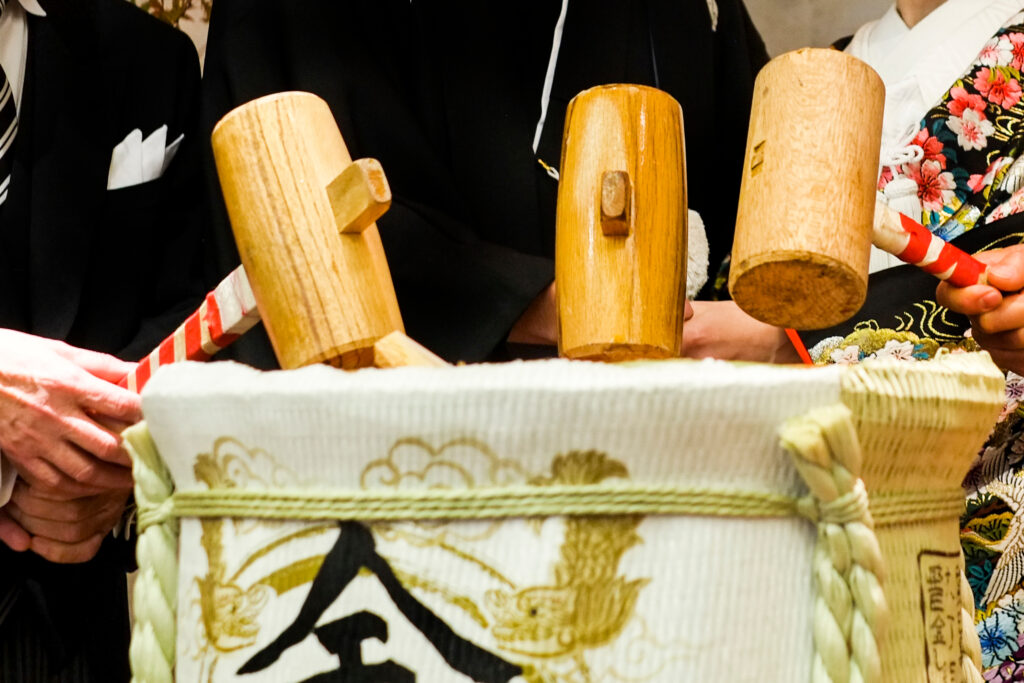
Kagami Biraki(鏡開き): Breaking Open the Sacred Sake Barrel
A celebratory moment during a Japanese wedding or New Year ritual, where guests break open a sake barrel to invite blessings and new beginnings.
These rituals may vary in form, but their essence remains unchanged: sake is sacred when shared with intention. In a world that moves fast, these ceremonial pauses offer a return—to presence, to prayer, to connection.
Even today, many young couples in Japan choose to marry at Shinto shrines, not just for tradition’s sake, but because of the quiet power these rituals carry. In a moment of stillness, with sacred sake between them, they honor the past, celebrate the present, and invite the future.
🌐 Sake in the Modern Era: UNESCO & Global Reverence
Though deeply traditional, sake is not frozen in time. In recent years, it has gained renewed attention and respect—not just in Japan, but across the world. Its recognition as a cultural treasure continues to grow, affirming that sake is not only a drink, but a living tradition.
In 2024, Japanese sake-making was officially added to the UNESCO list of Intangible Cultural Heritage(無形文化遺産). This global recognition was not merely about technique—it was about the spiritual and social role of sake throughout history. It acknowledged the heart behind the brewing: reverence, craft, and community.
This honor came at a time when domestic sake consumption in Japan was declining. Yet, paradoxically, international interest has soared. Exports to countries like the U.K., the U.S., and France have dramatically increased. Sake is being served in Michelin-starred restaurants, paired with international cuisines, and studied by sommeliers.
Still, the soul of sake hasn’t changed. Brewers—especially in smaller regional communities—continue to craft it with care, often in harmony with the natural seasons, water, and rice grown nearby. Many consider it a sacred duty rather than a commercial venture.
The sake industry has also become a point of cultural diplomacy. It connects Japan to the world not only through taste but through values: mindfulness, seasonal awareness, and spiritual intention.
And yet, even with international accolades and booming exports, the essence remains quiet and close: a clear liquid offered to the gods, poured with intention, and received with humility.
🏞️ Local Culture and Symbols: Izumo Myths, Festivals, and Sugidama
Sake is not only a national tradition—it is deeply local, seasonal, and symbolic. Across Japan, each region carries its own mythology, festivals, and rituals tied to sake, enriching its sacred character.
Take Izumo(出雲), one of Japan’s most ancient spiritual centers. This region is home to Izumo Taisha, a shrine dedicated to the deity Ookuninushino-Mikoto(See Divine Thread Pre-#4), and steeped in myths of creation, harmony, and divine gathering. In nearby legends, sake even plays a mythic role: the storm god Susanoo-no-Mikoto (See Divine Thread Pre-#1&2, Japan:Life&Spirit#2) famously defeats the serpent Yamata-no-Orochi by intoxicating it with strong sake. This tale shows how sake can act as both offering and divine strategy—a tool that bridges worlds.
Sake also flows through the rhythms of the year. In towns like Saijō(西条) in Hiroshima Prefecture, the Sake Matsuri 酒まつり(Sake Festival) draws thousands each autumn. Here, sake is not just tasted—it is celebrated with parades, prayers, and community. These festivals revive ancient gratitude for rice, water, and spirit, uniting locals and visitors alike in joyful reverence.
Another powerful symbol is the Sugidama(杉玉)—a large sphere made of cedar branches, hung outside sake breweries. When the new sake of the season is ready, a fresh green sugidama is displayed. As it dries and turns brown over time, it reflects the aging of the sake inside. But more than that, it’s a sign to the community: the sacred cycle has begun again.
Sake is not confined to ritual halls or formal ceremonies. It lives in the rhythms of villages, the myths of mountains, the scent of cedar and rice. In these local customs, sake continues to teach us: spirituality is seasonal, tangible, and shared.
🟢Fresh Sugidama: A New Beginning 緑の杉玉(新酒のしるし)
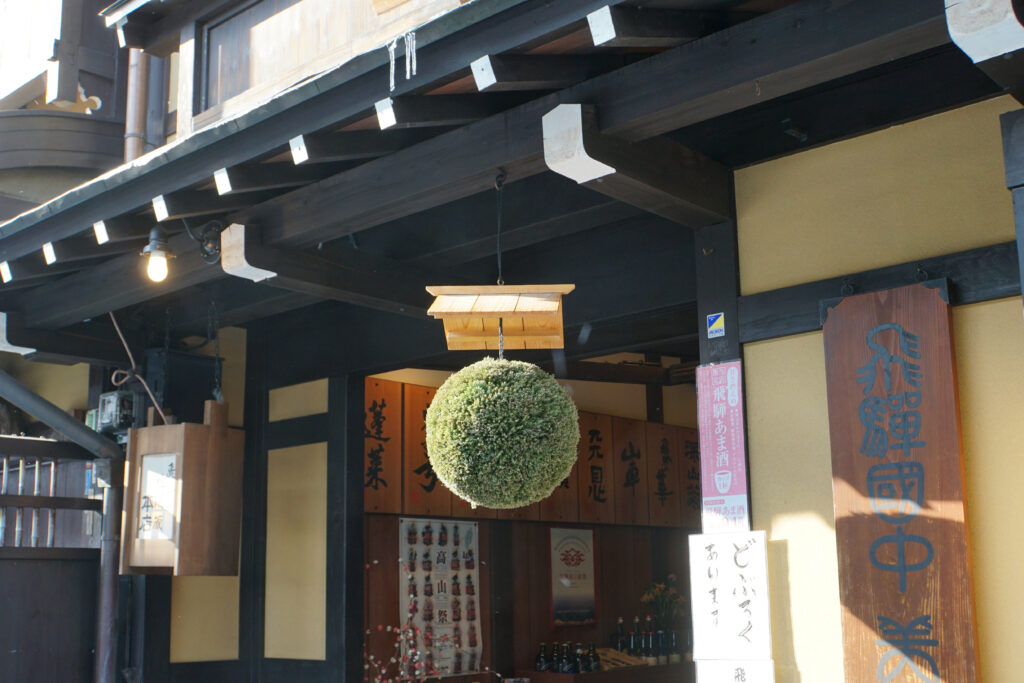
Fresh Sugidama: A New Beginning
A vibrant green cedar ball is hung outside the brewery to mark the release of the season’s freshly brewed sake—an invitation to celebrate the start of a sacred cycle.
🟤Aged Sugidama: Time and Maturity 茶色の杉玉(時と共に熟す)

Aged Sugidama: Time and Maturity As the sugidama dries and turns brown over time, it reflects the aging of the sake inside. A quiet symbol of time’s passing and spirit deepening.
✨Sacred in the Everyday: Sake’s Role in Modern Life
Not everyone drinks sake—but everyone can work with its spirit. In modern life, sake still holds its ancient role: to cleanse, to bless, to ground, and to connect. You don’t have to be in Japan to experience its sacred potential.
In daily Shinto practice, a small offering of sake is often placed on the kamidana (home altar) alongside water, salt, and rice. It is not immediately consumed—but later shared or used with care as a sacred “osagari” (blessing returned from the gods). Nothing is wasted; the intention continues.
For those who do not drink alcohol, ritual bathing with sake is a beautiful alternative. Add a small cup (I use 1–2 tablespoons) to warm bathwater to purify the body and spirit. I personally add salt and sake to my bath every night, but you can do it only when you feel called—when your body, energy, or mood asks for a reset.
Sake is also said to benefit the skin—leaving it soft, smooth, and refreshed. It is gentle on the skin and believed to energetically cleanse, making it a soothing companion for both body and soul.
You can also use sake for space clearing. Pour a small amount into the sink, at the entrance of your home, or even onto the earth before a new project or full moon. The intention is not to waste—but to offer, to make room for new energy.
I don’t drink alcohol, but I always keep a bottle of sake at home—not for drinking, but for spiritual use. I add it to my bath, offer it at my altar, or pour a few drops into the sink when I feel the need to cleanse a space. It doesn’t have to be expensive—what matters is the intention.
In this way, sake becomes not just a traditional drink, but a modern spiritual companion—one that helps us mark transitions, honor the unseen, and return to the sacred in everyday life.
🕊️Kaha’s Note
Sake is not just something we pour into a glass—it’s something we pour into our lives. From its mythic birth through the hands of a sun goddess, to cedar-scented breweries, wedding altars, and quiet baths, sake has always carried more than flavor. It carries meaning.
In a world that moves too fast, sake reminds us to slow down. To offer before we take. To notice what is unseen. Whether placed on an altar, poured in a cleansing bath, or shared between two souls in ceremony, sake helps us reconnect—not only with tradition, but with ourselves.
You don’t need to speak Japanese or visit a shrine to feel its presence. Just a simple ritual, a mindful gesture, a moment of quiet reverence is enough. In these small acts, sake becomes more than rice and water. It becomes invitation. Presence. Blessing.
So whether you sip it, pour it, or simply keep it as a sacred tool—let sake remind you that spirit lives in stillness. And that the divine often arrives, not with thunder, but with a whisper.
✅Now available&Coming up Next
If you missed it, yesterday’s post Salt & the New Moon explores the sacred role of salt—from ancient myths to practical modern-day purification rituals. It’s the perfect start to this ritual series.
Today, sake grounds your presence. From sacred offerings to silent rituals, it reminds us that spirit lives in the details—in the way we pour, offer, and receive.
Tomorrow, we turn our gaze to the stars.
New Moon energy is rising, and with it comes a chance to align with the sky’s deeper rhythm.
🌑✨ Stay tuned for: “Moon Moves & Star Signs: Reading the Sky on a New Moon”(Working Title)
🔗Explore more
🌈 Curious to explore more?
This post is part of a wider journey.
🔗 Return HOME to revisit the sacred flow.
✨ Don’t miss other categories on the site—there’s more waiting for you.
The Rainbow Map will guide your way 🌈


コメント