
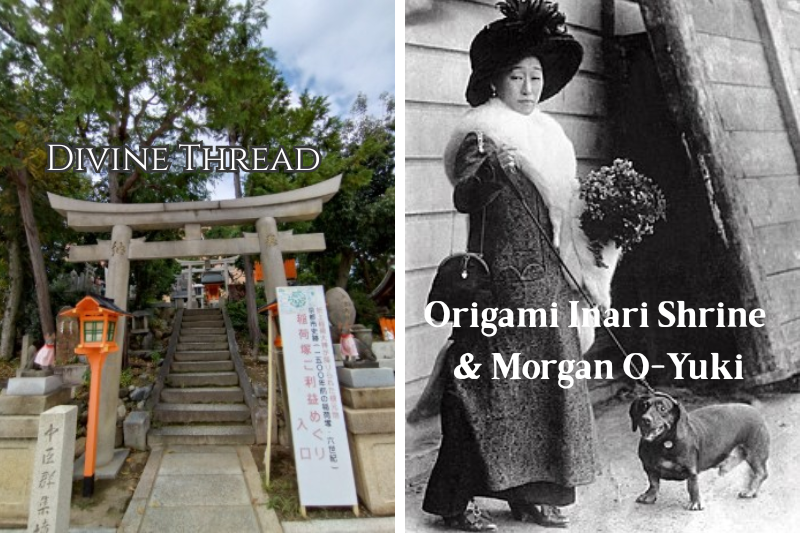
- 🌠 Lead-in
- ⛩️ Origami Inari Shrine — Guardian of Working Women
- 👘 Morgan O-Yuki — From Gion to “Japan’s Cinderella”
- ⛩️ A Torii Bearing O-Yuki’s Hidden Name
- 🎐 Hyotan Okami — The Gourd of Good Fortune
- 🦊 The Ancient Inari-zuka — A Hillside of Many Prayers
- 🔥 Festivals Honoring Women, Life, and Renewal
- 🧵 A Thread Continuing to Dōjū-in
- 🌿 Kaha’s Note
- 🌈Explore More
🌠 Lead-in
Hidden in a quiet corner of Yamashina, Kyoto, Origami Inari Shrine (折上稲荷神社) has long been revered as a guardian of women—especially those working, building their own lives, and moving through important turning points.
Across its hillside grounds is an ancient Inari-zuka (稲荷塚)—a sacred mound containing numerous small shrines and places of prayer associated with health, relationships, financial fortune, success in work, and relief from the everyday difficulties of life.
Yet one of the shrine’s most fascinating stories belongs to Morgan O-Yuki (モルガンお雪), a geiko from Kyoto’s Gion district who married George Denison Morgan, a member of the wealthy American Morgan family, and became widely known as “Japan’s Cinderella.”
O-Yuki is said to have been deeply devoted to both Origami Inari Shrine and Dōjū-in Temple (同聚院) near Tofukuji (東福寺), where Fudō Myōō (不動明王) is enshrined and part of her remains are preserved. I hope to introduce Dōjū-in and its connection with her more fully in a future journey.
Here at Origami Inari, traces of her faith remain—a stone torii bearing a hidden reference to her, the Hyotan Okami she visited devotedly, and a special charm made in the same form as the one she is believed to have carried inside her obi.
In this journey, we explore a shrine where women’s prayers, unusual Inari deities, and the extraordinary life of Morgan O-Yuki come together—revealing a sacred place filled with stories of protection, perseverance, and unexpected changes of fortune.
⛩️ Origami Inari Shrine — Guardian of Working Women
Origami Inari Shrine stands in Yamashina, on the eastern side of Kyoto.

The vermilion worship hall of Origami Inari Shrine, long revered as a guardian of working women.
Its grounds are believed to preserve a sacred site of remarkable age. According to the shrine, the ancient Inari mound within the grounds dates back approximately 1,500 years, to a time when ancestral agricultural deities were worshipped here before the later development of Inari belief.
The shrine enshrines three deities connected with food, growth, and the life-giving powers of nature:
Ukanomitama no Kami,
Ukemochi no Kami, and
Wakumusubi no Kami.
Origami Inari is also known as Yamashina Inari and is traditionally described as an inner or further sanctuary connected with Fushimi Inari.
Yet its best-known identity today is that of a guardian of women—particularly women who work.
According to shrine tradition, near the end of the Edo period, many court ladies serving Emperor Kōmei became ill around the time of his enthronement. Prayers for their recovery were offered at Origami Inari Shrine, and the women are said to have regained their health.
Among the court ladies, the shrine’s blessings came to be described as “origami-tsuki”—a Japanese expression meaning something is guaranteed or certified. The words also echoed the name Origami Inari.
Wishing for the women to remain healthy and continue their service, Emperor Kōmei presented the shrine with chōmei-bashi, or “chopsticks of long life.”
From this tradition, Origami Inari became widely revered as a protector of working women.
Today, women visit to pray not only for health and longevity, but also for success in business, professional growth, good relationships, and the strength to move through important changes in life.
Among the women said to have placed deep faith in this shrine was Morgan O-Yuki—a Kyoto geiko whose life would eventually carry her far beyond Japan and make her one of the most talked-about women of her time.
👘 Morgan O-Yuki — From Gion to “Japan’s Cinderella”
Morgan O-Yuki was born Katō Yuki in Kyoto in 1881.
Through her elder sister, who managed a teahouse and geiko house in Gion, Yuki entered the flower-and-willow world at the age of fourteen. As a geiko, she used the professional name 雪香 and became known for her skill in the traditional arts, particularly the kokyū, a bowed Japanese string instrument.
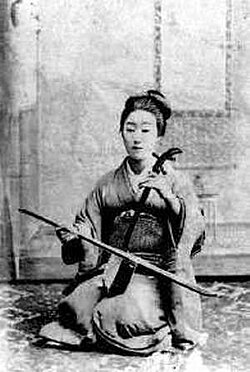
Morgan O-Yuki playing the kokyū during her years as a geiko in Kyoto.
In 1901, she met George Denison Morgan, an American traveler and a member of the prominent Morgan family. He was a nephew of the financier J. P. Morgan.
George was captivated by Yuki and proposed marriage. She did not immediately accept, and he is said to have returned to Japan several times over the following years before she finally agreed.
Their relationship attracted enormous public attention.
In 1904, Yuki and George married in Yokohama. Newspapers sensationalized the large sum reportedly paid to release her from her obligations as a geiko, although the precise amount and circumstances remain disputed.
Some celebrated the marriage as a modern Cinderella story. Others judged Yuki harshly, portraying her as a woman who had chosen wealth over love.
Behind the headlines, however, was a young Japanese woman entering an unfamiliar international world at a time when marriages across nationality and race were still unusual and often viewed with suspicion.
After their marriage, Yuki traveled abroad with George and later became known in European society as Madame Morgan. Her journey from the streets of Gion to the world of the Morgan family led newspapers to call her “Japan’s Cinderella.”
Yet her life was far more complex than that romantic title suggests. It would later carry her through public scrutiny, life across continents, bereavement, war, faith, and an eventual return to Kyoto.
Her full story deserves a journey of its own. Here, we follow the part of her life that remains closely connected with Origami Inari Shrine—a place she is said to have visited with deep devotion, and where traces of her prayers can still be found today.
⛩️ A Torii Bearing O-Yuki’s Hidden Name
Within the shrine grounds stands a stone torii closely connected with Morgan O-Yuki and the women of her family.
The torii is said to have been dedicated by O-Yuki’s elder sister, who managed the Gion teahouse and geiko house known as Katōrō. The names of the four Katō sisters were inscribed upon it—yet the name “Yuki” does not appear openly.
In its place are the characters “Katōrō Inakichi”「加藤楼稲吉」.
Katōrō was the name of her sister’s establishment, while Ina refers to Inari. Kichi means good fortune or an auspicious blessing. Together, the name is understood to express the idea that Katōrō—and O-Yuki herself—had received good fortune from Origami Inari.
According to the explanation at the shrine, O-Yuki’s identity was concealed to protect her from further public criticism and to avoid drawing attention during a period when relations between Japan and the United States were becoming increasingly strained.
The inscription is easy to overlook.
Yet once its meaning is known, the torii becomes more than an entrance to the sacred mound. It is a quiet record of O-Yuki’s connection with the shrine—and of a woman whose name was recognized around the world, yet was hidden here within a private expression of faith.
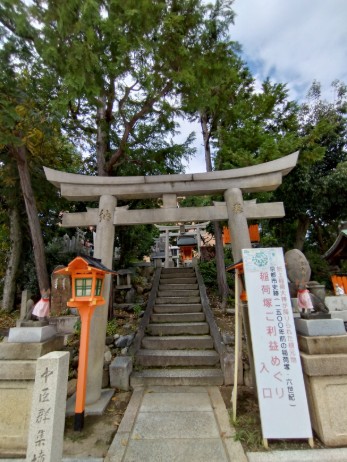
The stone torii connected with Morgan O-Yuki, marking the entrance to the shrine’s sacred Inari mound.
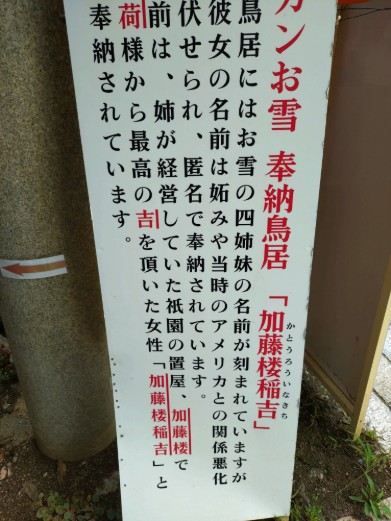
The shrine’s explanation of the stone torii connected with Morgan O-Yuki.
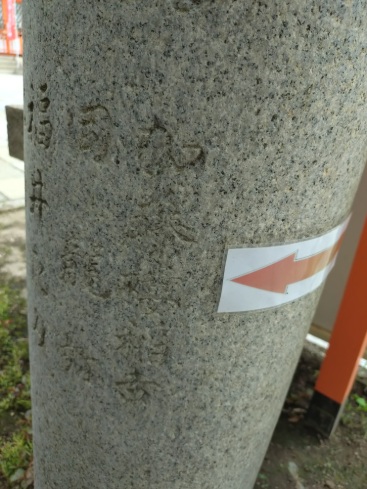
The weathered inscription “Katōrō Inakichi,” the name used to represent O-Yuki without revealing her identity.
🎐 Hyotan Okami — The Gourd of Good Fortune
Beyond the stone torii, another place closely associated with Morgan O-Yuki is Hyotan Okami, a deity represented by the shape of a gourd.
The gourd has long been regarded in Japan as a symbol of good fortune, prosperity, and protection.
Here, it is especially connected with prayers for women’s success, advancement, and a fortunate marriage.
O-Yuki is said to have prayed devotedly at this sacred place.
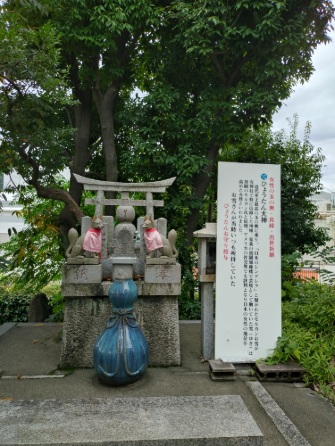
The large blue gourd associated with Hyotan Okami and the story of Morgan O-Yuki.
Today, Origami Inari Shrine offers the Morgan O-Yuki Hyotan Charm, created in the same distinctive form and blessed for women seeking advancement and a fortunate change in life.
According to shrine tradition, O-Yuki carried a gourd-shaped amulet tucked inside her obi.
A Hyotan Charm is still offered at Origami Inari Shrine today, carrying prayers for women’s advancement and a fortunate change in life.
When I asked how it should be carried today, a member of the shrine told me that it may simply be kept inside a handbag—allowing this small tradition once carried in O-Yuki’s obi to continue within modern life.
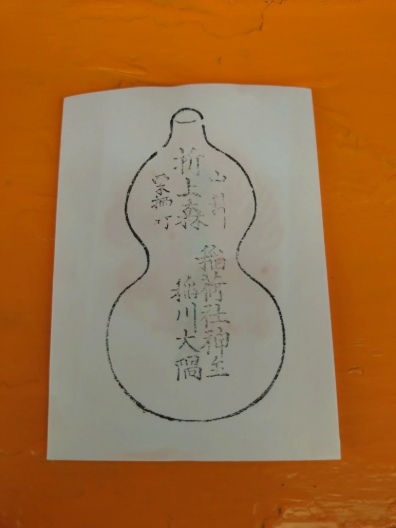
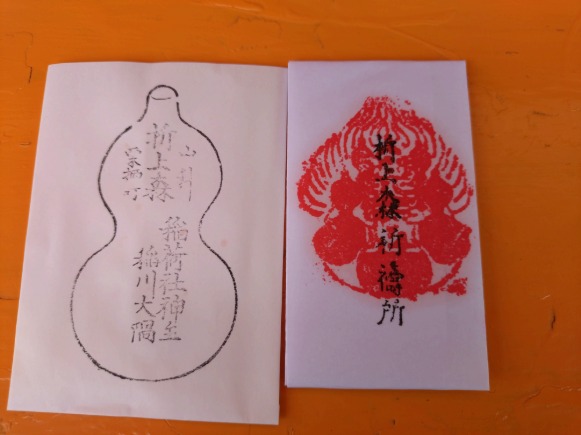
The Hyotan Charm, traditionally carried inside an obi and now often kept inside its paper covering and carried safely in a handbag.
The gourd may look playful, but its meaning reaches beyond the familiar idea of tama-no-koshi—marrying into wealth or status.
It can also be seen as a prayer for a woman’s own path to open: through work, relationships, courage, and the unexpected turns that reshape a life.
🦊 The Ancient Inari-zuka — A Hillside of Many Prayers
Beyond the main worship hall, stone steps lead upward into one of the shrine’s most distinctive sacred spaces: the Inari-zuka, or Inari mound.
According to the shrine, this sacred site preserves a form of worship dating back approximately 1,500 years, when ancestral agricultural deities were honored here even before the widespread establishment of Inari worship.
Small shrines, stone monuments, fox guardians, sacred trees, and places of prayer are gathered closely across the hillside.
Rather than offering only one blessing, the Inari-zuka invites visitors to move slowly from one sacred place to another, bringing prayers for the many concerns that shape human life.
🦊 Sankurō Inari — Relief from Three Great Hardships
One of the most memorable sacred places here is Sankurō Inari Shrine.
According to shrine tradition, three white foxes served and protected Origami Inari Okami when the deity descended upon this land.
Because the three foxes endured many hardships before finally reaching this place, the shrine became known as Sankurō Inari—a name associated with “three hardships.”
Today, Sankurō Inari is revered for helping people overcome three great difficulties of human life:
relationships, health, and money.
Its spring festival is held on March 9, while its autumn festival takes place on September 3—dates that playfully echo the name Sankurō through the numbers three and nine.
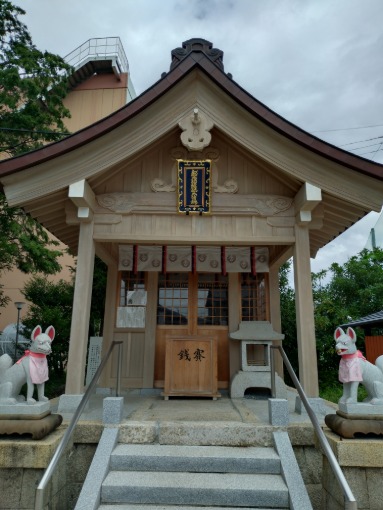
Sankurō Inari Shrine, where visitors pray for relief from difficulties involving relationships, health, and money.
🌳 The Sacred Kashi Tree — A Tree of Renewal and Guidance
Along the path stands the remains of a sacred kashi, or evergreen oak tree.
Although much of the ancient tree has been lost, its weathered trunk remains enshrined as a sacred presence.
The shrine’s guide describes it as both a tree of renewal and a tree of divine guidance.
Visitors are invited to place a hand upon it and quietly notice what arises within the heart, receiving that thought or feeling as a possible message.
Its aged form offers a powerful image of endurance—the life of the tree continuing through memory, prayer, and the reverence of those who visit.
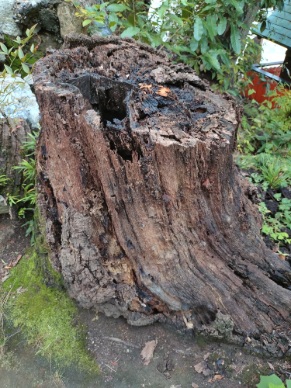
The remains of the sacred kashi tree, revered as a symbol of renewal and a source of inner guidance.
🌿 Hyōkichi Okami — The Deity Who Needed No Doctor
Another unusual presence is Hyōkichi Okami, affectionately described as the deity of isha-irazu—“needing no doctor.”
The shrine’s guide tells of an elderly man named Hyōkichi who lived energetically to the age of ninety-eight without once requiring a doctor.
After completing such a long and healthy life, he came to be enshrined here as Hyōkichi Okami.
Visitors now offer prayers for health, vitality, and a life lived with strength.

Hyōkichi Okami, known as the “doctorless” deity and revered for health, vitality, and longevity.
🙏 Isshin Daimyojin — A Prayer Carried Through the Years
On the left side of the path, after passing through the torii and beginning the ascent, visitors encounter Isshin Daimyojin.
This deity is associated with granting a wish that has been held in the heart for many years.
Its quiet position beside the ascending path feels especially fitting—a place to pause, gather one’s thoughts, and entrust a long-cherished hope before continuing farther into the Inari-zuka.
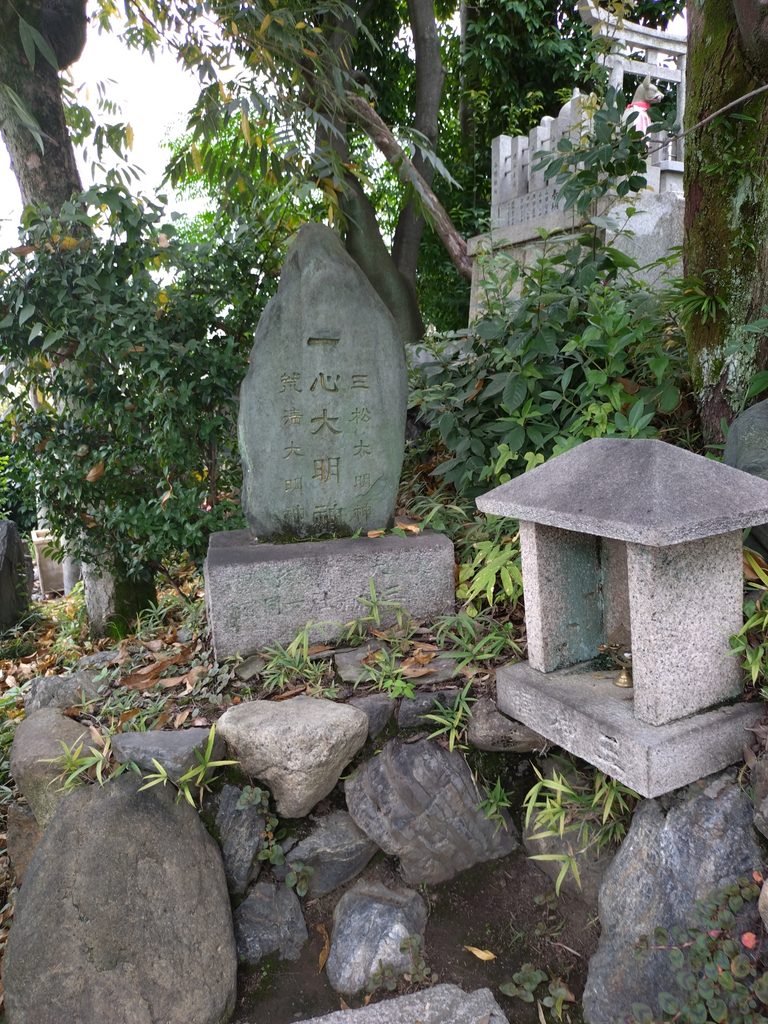
Isshin Daimyojin, where visitors entrust wishes they have carried for many years.
🔄 Uramairi no Goza — Praying from Behind the Sacred Mound
The Uramairi no Goza is found after following the path around to the rear of the Inari-zuka.
Uramairi means offering prayers from behind.
Rather than ending the visit at the front of the mound, worshippers continue around it and pray once more from the reverse side.
According to the shrine’s guide, this sacred place is associated with prayers for a life free from financial hardship and for the removal of misfortune.
The shrine also preserves a tradition that many people who completed this rear prayer during the Edo period later found success.

The Uramairi no Goza behind the Inari-zuka, associated with protection from financial hardship and misfortune.
These are only a few of the many sacred places found across the Inari-zuka.
Other deities receive prayers for business success, attracting customers, breaking harmful ties, good fortune in stocks and lotteries, healthy eyes and ears, relief from pain in the legs and lower back, mental clarity, freedom from stress, success in examinations, safe childbirth, and the blessing of children.
A historic sitting stone associated with both a court lady of the late Edo period and Morgan O-Yuki is also said to bring happiness and good fortune to women.
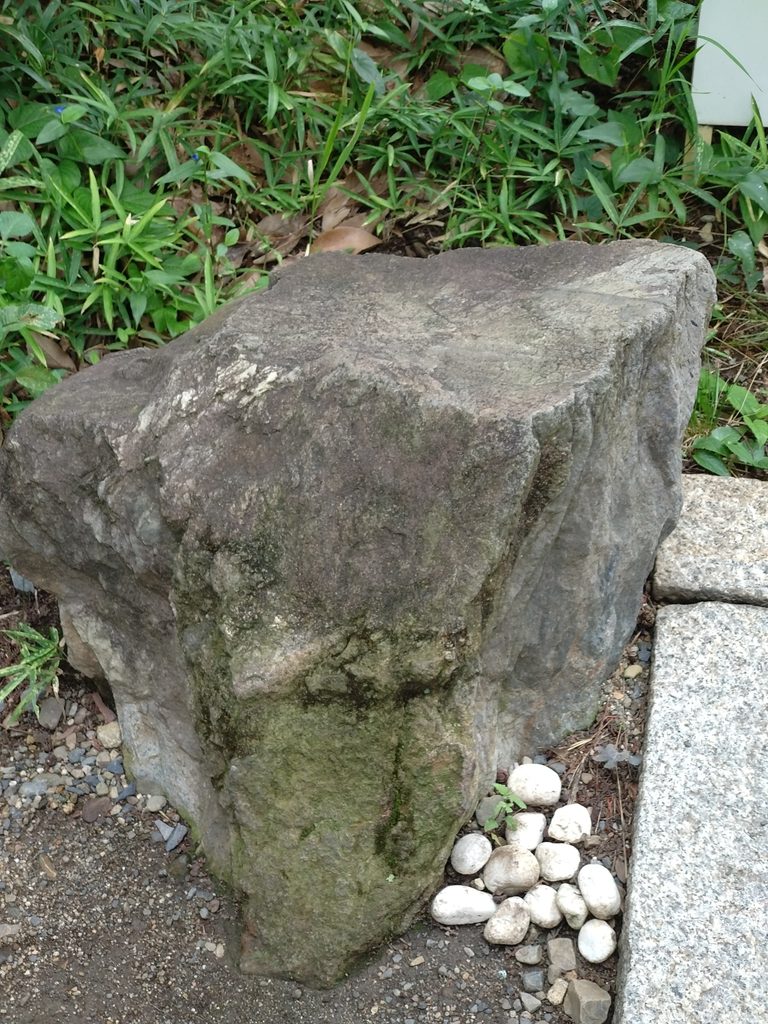
The historic sitting stone where the court lady Nagahashi no Tsubone is said to have rested. Morgan O-Yuki later sat here and is believed to have received its blessing.
The remarkable range of these blessings makes the Inari-zuka feel like a small pilgrimage within the shrine—each step revealing another story, another concern, and another place to pause.
A beautifully illustrated guide available at the shrine introduces the sacred places and their particular blessings. Carrying it while walking around the mound makes it easier to recognize each deity and follow the prayer route.

The shrine’s illustrated guide to the Inari-zuka, showing the many deities and blessings found along its paths.
🔥 Festivals Honoring Women, Life, and Renewal
Origami Inari Shrine’s annual festivals continue its long connection with women, work, health, and the changing rhythms of life.
The shrine’s principal Inari Festival is usually held in early June.
During this celebration, Origami Inari Okami is carried through the neighborhood in a mikoshi, or portable shrine, to share the deity’s blessings with the community.
While women have traditionally been excluded from carrying mikoshi at some Japanese festivals, women participate alongside men here—a meaningful reflection of Origami Inari’s identity as a guardian of working women.
Children also join the procession wearing fox masks and accompanying the mikoshi of Sankurō Inari.
In November, the shrine holds its Ohitaki Festival, also known as the Festival of Longevity.
Connected with the shrine’s tradition concerning Emperor Kōmei and the women of the Imperial Court, this ceremony expresses gratitude for women who work—and for those who have worked throughout their lives—while offering prayers for health and longevity.
Wishes are written upon wooden prayer sticks and offered to the sacred fire, through which misfortune is symbolically burned away.
Together, these festivals reveal that Origami Inari is not simply a place where individual wishes are offered.
It is also a living shrine where women’s efforts, health, endurance, and continuing journeys are honored through the seasons.
🧵 A Thread Continuing to Dōjū-in
Morgan O-Yuki’s life of faith was connected not only with Origami Inari Shrine.
She is also said to have been deeply devoted to Dōjū-in, a small temple near Tofukuji in Kyoto, where Fudō Myōō is enshrined.
Origami Inari and Dōjū-in are now visited as two sacred places associated with O-Yuki and the protection of women—one through the blessings of Inari, and the other through the powerful presence of Fudō Myōō.
Her grave is also located at Dōjū-in, bringing the long and remarkable journey of her life back to Kyoto.
Her story reached far beyond the romantic image of “Japan’s Cinderella.”
It was a life shaped by art, love, public scrutiny, travel across continents, loss, faith, and return.
In a future journey, I hope to revisit Dōjū-in and follow this other sacred thread—exploring the temple she cherished and more of the extraordinary life that lay behind the name Morgan O-Yuki.
🌿 Kaha’s Note
Origami Inari Shrine is not a large or grand destination.
Yet within its quiet grounds are layers of prayers for work, health, relationships, prosperity, and the many turning points that shape a woman’s life.
What stayed with me most was how specific some of the blessings felt.
There are prayers for overcoming human relationships, health concerns, and financial hardship; for attracting customers or releasing harmful ties; and for wishes carried quietly over many years.
These are not distant or abstract hopes.
They are the concerns of everyday life—the things people worry about, work through, and continue carrying in their hearts.
Morgan O-Yuki’s story adds another thread to this place.
Behind the image of “Japan’s Cinderella” was a woman who crossed cultures and continents, faced both admiration and criticism, and continued seeking places of faith throughout a life of dramatic change.
Perhaps that is why her connection with this shrine feels so fitting.
Origami Inari does not promise a life without difficulty.
Instead, it offers many small places where we can pause, name what we are carrying, and ask for the strength and good fortune to take the next step.
🌈Explore More
Explore more stories of Japan’s sacred places, remarkable women, spiritual traditions, and hidden histories throughout this blog.


コメント