
🍀 Lead-in
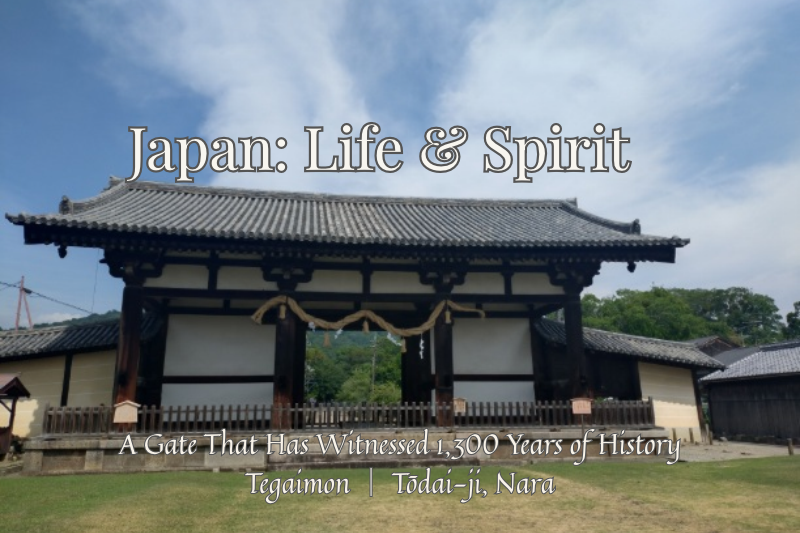
At the northwestern edge of Tōdai-ji in Nara stands Tegai-mon, an ancient gate I came to see with fresh eyes after listening to a local guide.
What first appeared to be simply an old wooden structure became a place where the past felt unexpectedly close. The encounter reminded me how much we can miss when we look without pausing—and how many stories a single surviving gate can hold.
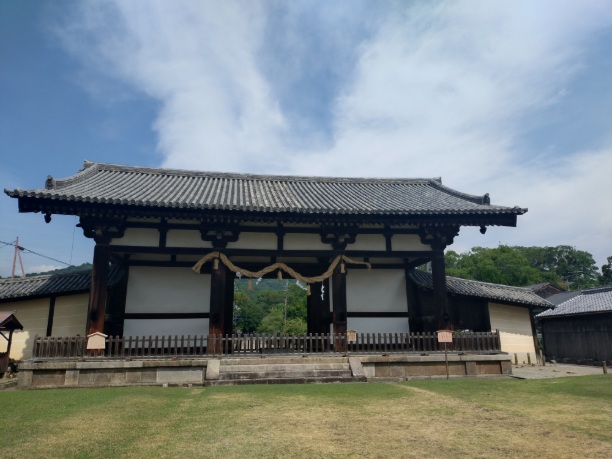
Tegai-mon Gate — a quiet encounter with Nara’s past.
🏯 A Gate That Survived the Centuries
Tegai-mon dates from the Nara period, with its construction generally placed between 756 and 762, although the precise date is uncertain. It stands at what was once the northwestern entrance to Tōdai-ji, facing a street of the ancient capital of Heijō-kyō.
In 1180, a devastating attack burned much of the temple complex. Tegai-mon was among the few buildings that escaped the flames. Centuries later, fighting again reached the area: in 1567, Matsunaga Hisahide’s forces used the gate as a military position during their conflict with the Miyoshi faction, according to the visitor leaflet.
Its survival does not mean that it has remained untouched. Major repairs took place in 1194–1195, and during restoration in 1931–1932, three deteriorated pillars were replaced. Yet the gate retains the character of its early architecture—a broad tiled roof resting on substantial wooden pillars, with a single central passage.
Today, Tegai-mon is designated a National Treasure. Its history is one of both survival and care: an ancient structure passed down through generations, with repairs becoming part of its long story.
🌳 Stories Written in the Wood
Looking closely at the pillars, I noticed prominent knots and grain swirling around them. Their surfaces carried the irregular character of the trees from which they had been made.
The guide explained that retaining these natural features, rather than working the wood into a perfectly smooth finish, was believed to help the pillars remain strong and last longer. Hearing this changed the way I looked at them: the knots became traces of the living tree, preserved within the structure of the gate.
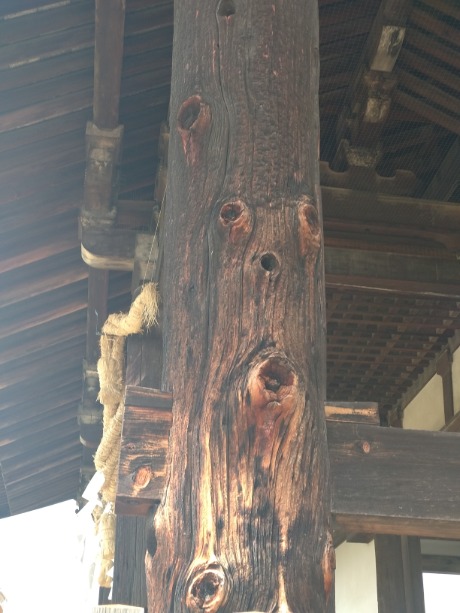
Natural knots and weathered grain — details that invite a closer look at the gate’s wooden pillars.
The wood also bears traces of a more turbulent past. According to the visitor leaflet, marks left by arrowheads and bullets remain on the pillars. These are thought to date from the fighting in 1567, when Matsunaga Hisahide’s forces occupied the gate.
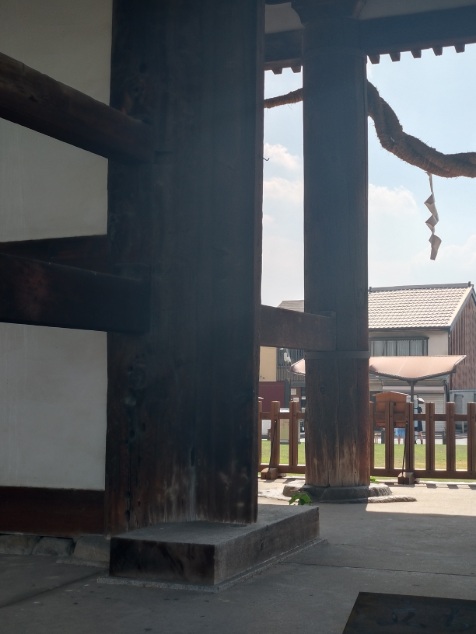
One of the pillars the guide pointed out when explaining the traces of past battles.
Although the marks are difficult to make out in this photograph, seeing the pillar in person and hearing its story made the history feel unusually close. The conflict was no longer only a date in a historical account; it had left traces on the building standing before me.
Together, the natural features of the wood and the traces of human events gave the pillars a depth I had not noticed at first. Within this seemingly quiet gate, stories of craftsmanship and conflict were still there to be discovered.
⛩️ A Temple Gate with a Sacred Rope
Looking up beneath the eaves, I was struck by the great shimenawa, or sacred straw rope, stretched across the gate. Its hanging tassels and white paper streamers stood out against the dark wooden beams.
Although Tegai-mon belongs to a Buddhist temple, it also has a longstanding connection with Hachiman, the deity revered as Tōdai-ji’s guardian. The information board explains that the gate serves as a ceremonial resting place for Hachiman during the festival associated with Tamukeyama Hachimangū Shrine.
The visitor leaflet lists this festival, known as Tegai-e, on October 5, and notes that the gate’s shimenawa is renewed once every four years.
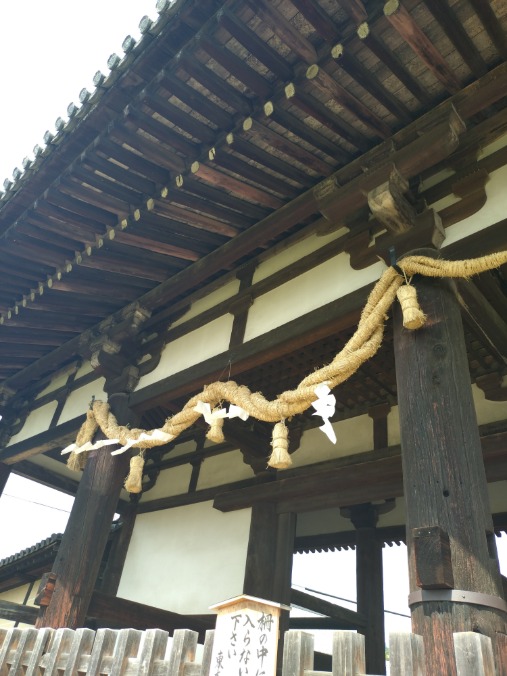
A great shimenawa beneath the wooden eaves — a glimpse of the gate’s continuing sacred role.
Seen this way, the rope adds another layer to the gate’s story. Alongside the old timber and traces of conflict, it speaks of worship carried forward through generations. Tegai-mon remains a place where the histories of the temple and its guardian deity meet.
🦌 A Quiet Moment in Nara
Nearby, deer rested in the shade while others wandered across the grass. After looking closely at the gate’s pillars and listening to their stories, I enjoyed this simple, peaceful scene.
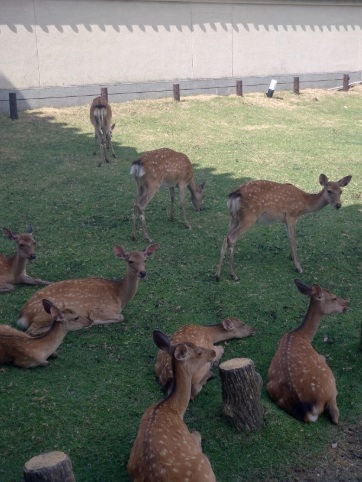
A quiet afternoon near Tegai-mon — deer resting in the shade.
What stayed with me was the feeling of encountering history in something I could easily have passed by. A knot in the wood, a mark on a pillar, a rope beneath the eaves—each detail opened a different part of the gate’s story.
I left with a little more curiosity about the familiar-looking places around me, and the stories waiting there when we pause to look.
⭐Kaha’s Note
Listening to the guide helped me notice details in the pillars that I might otherwise have overlooked. Hearing the stories behind them made my visit a little more memorable.
Sometimes, a brief conversation with local people gives me a fresh perspective on what I see.
🌈 Explore More
Continue exploring Nara and the stories woven into everyday life in Japan.
🎦 Nara Deer │ Featured Video Collection
Little moments with Nara’s deer—from peaceful encounters to scenes of everyday life.

🦌 Japan: Life & Spirit #1 │ Nara Park — Where Stories Walk Beside You
Explore Nara Park, where deer, sacred places, and everyday life share the same landscape.


コメント