

💧 Lead-in
The beginning of the Inner Shrine lies not in the sanctuary itself,
but in the act of approaching it.
This land did not wait for buildings to become sacred.
Long before the Inner Shrine took its present form, people lived, moved, and prayed according to the presence of water, forest, and land.
Tradition tells that Yamatohime-no-mikoto, serving as the sacred attendant of the Sun Goddess, traveled for many years in search of a place where the divine could dwell.
Her journey unfolded through landscapes shaped by water—places where local deities were respected rather than replaced, and where harmony was sought rather than imposed.
Today, the approach to Naikū still follows this spirit.
The crossing comes first.
By stepping onto Uji Bridge, visitors leave the ordinary world behind and enter the sacred precinct of the Inner Shrine.
From there, the path leads gently inward—through forest and silence—until it reaches water.
Within the precinct, the Isuzu River continues to flow.
Here, visitors pause to cleanse their hands before proceeding further.
Purification is not about being flawless.
It is about stopping, washing one’s hands, and moving forward with care.
After this quiet preparation, the path continues toward the heart of the shrine.
🌉 Uji Bridge — Entering the Sacred Precinct
The approach to the Inner Shrine begins with a crossing.
Uji Bridge stands at the threshold between the ordinary world and the sacred precinct of Naikū.
Before stepping onto the bridge, visitors pause and bow.
It is a small gesture, but one that quietly marks the moment of transition.
Crossing the bridge is not merely a matter of distance.
It is the first conscious step away from everyday life.
Once across, the sounds, pace, and atmosphere begin to change.
Uji Bridge has been rebuilt many times, yet it has never been treated as a permanent structure.
Its renewal follows the rhythm of the Shikinen Sengū, taking place every twenty years, four years before the shrine buildings themselves are renewed.
This practice traces back to a difficult period after the war, when the rebuilding of the shrine had to be postponed.
Even then, people felt that the act of approaching the sacred must not be allowed to disappear.
If nothing else could be renewed, the bridge would be.
Since that time, the bridge has continued to be renewed—not simply to maintain a structure,
but to preserve the act of crossing itself.
By stepping onto Uji Bridge, visitors leave the ordinary behind.
What lies ahead is not yet prayer,
but the quiet beginning of it.
From here, the path leads inward—
through forest and time—
toward water.
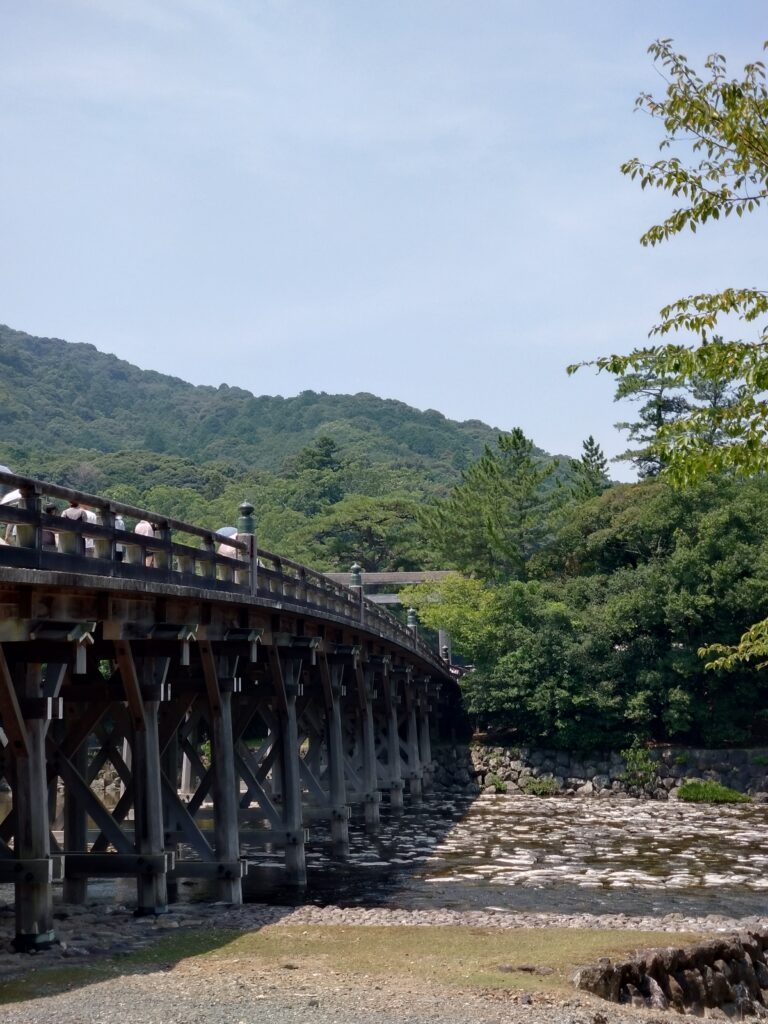
Crossing Uji Bridge today,
following a path renewed again and again.
🌅 Isuzu River — Water Within the Sacred Precinct
After crossing Uji Bridge and walking deeper into the sacred precinct,
the path reaches water.
The Isuzu River flows quietly within the grounds of the Inner Shrine.
It is not placed here as scenery, nor treated as something secondary to the buildings.
The river is part of the shrine itself.
Here, visitors pause.
They bend down, wash their hands, and allow the water to pass over them.
No words are required.
No instruction is given beyond the act itself.
Purification at the Inner Shrine is not about being flawless.
It is about stopping, touching the water, and continuing with care.
The movement is simple, and because of that, it has endured.
The Isuzu River does not always appear the same.
On clear days, its surface reflects the surrounding forest.
After rain, the water becomes clouded and moves with greater force.
Both states are accepted.
Here, purity has never meant stillness or clarity alone.
It has always meant flow.
From the bridge, the river is first encountered as a quiet boundary,
running alongside the path of approach.
Farther along, at designated points along the riverbank,
visitors may step closer to the water and cleanse their hands
before continuing toward the heart of the shrine.
Long before reaching the Inner Shrine,
purification had already begun at the sea.
Different from the sea, yet serving the same purpose,
the river marks a transition—
from movement to stillness,
from approach to presence.
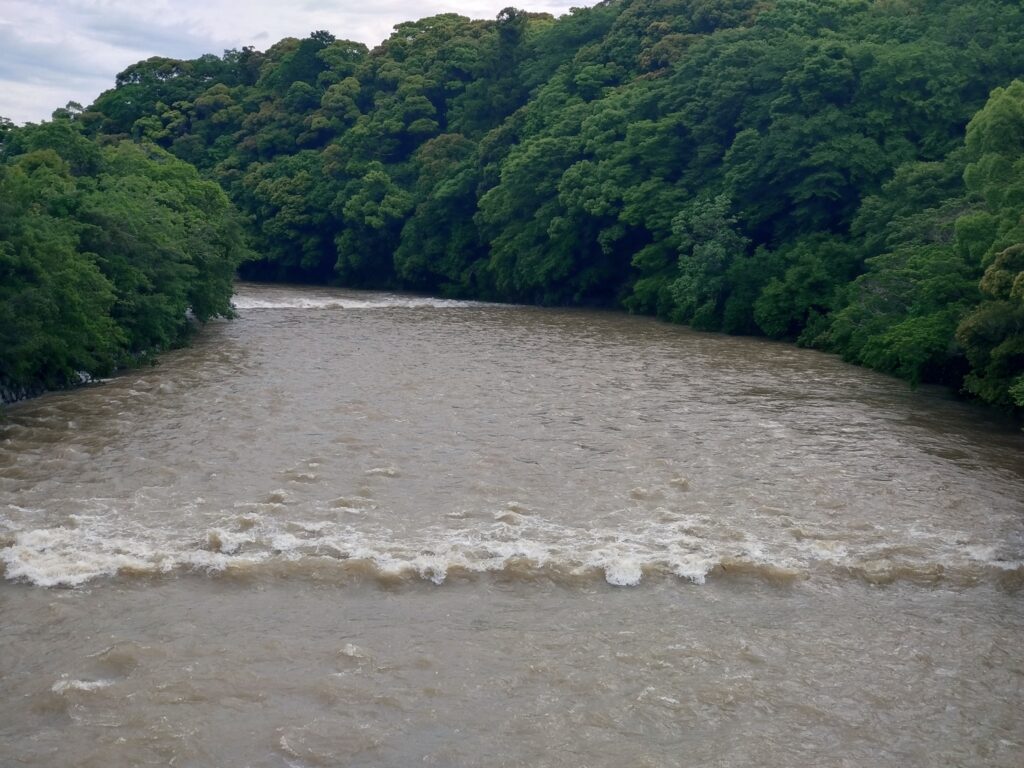
The Isuzu River after rain.
The water runs thick and heavy, carrying soil from the mountains.
Here, purity has never meant stillness or clarity—
it has always meant flow.
🎥 The Isuzu River in motion
👉 https://youtube.com/shorts/3CEveGPodGY
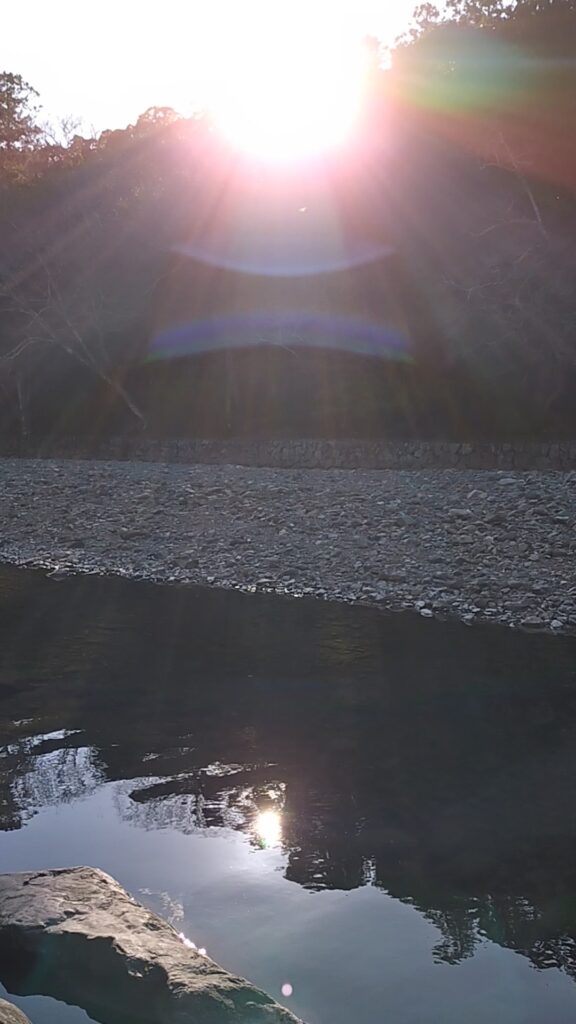
Light lingers on the surface of the river. The water receives it fully, becoming a mirror for what arrives.
The role of water in this approach has deep roots.
In the Edo period (around the 17th–19th century), pilgrimage to Ise became widespread among ordinary people.
At that time, many pilgrims did not begin their visit at the Inner Shrine itself.
Instead, they first traveled to Futamiura, where they performed ritual purification in the sea.
This practice was known as Hama-sangu, or “shore pilgrimage.”
By cleansing themselves with seawater, pilgrims prepared their bodies before proceeding inland toward Naikū.
Purification was not symbolic or optional;
it was physical, deliberate, and essential.
🎥 Futamiura shore
👉 https://youtube.com/shorts/0JA7HZo1U_U
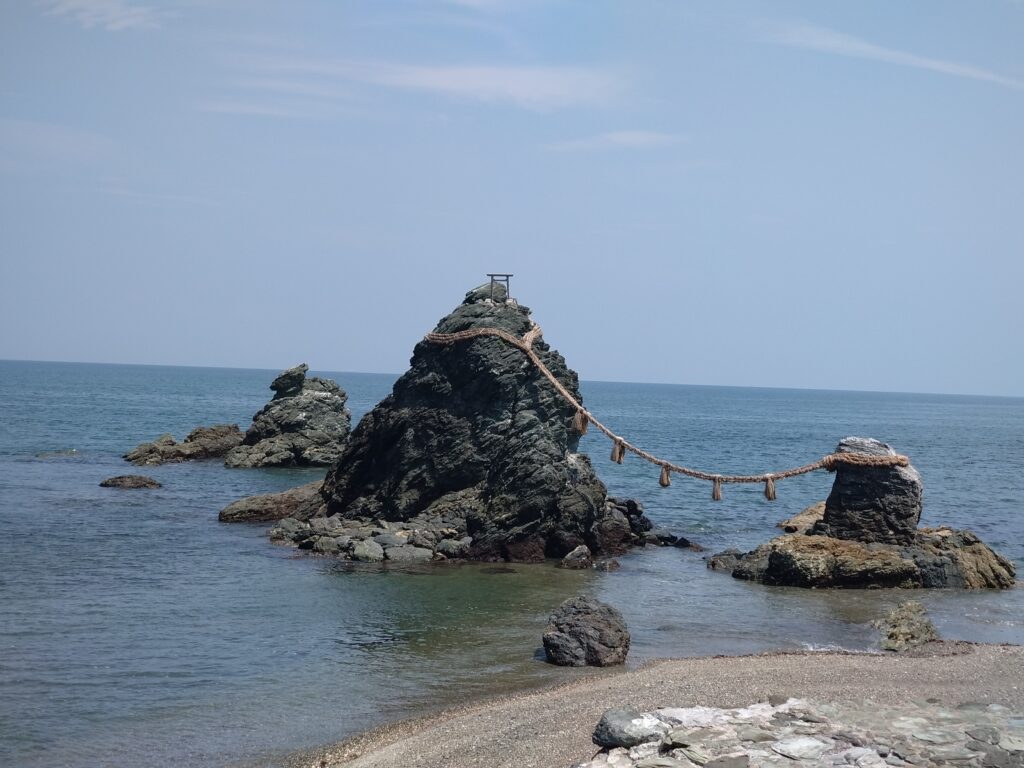
Wedded Rocks, Futamiura — where purification once began at the sea.
🌿Takimatsuri-no-Kami — Greeting the Land at the Water’s Edge
Close to the Isuzu River, just beyond the place of purification,
a small sacred space stands quietly by the water.
This is Takimatsuri-no-Kami.
There is no shrine building here in the usual sense.
Instead, a sacred stone is enclosed by a simple fence near the riverbank.
Its form is modest, almost easy to pass by,
yet it has long been regarded as an essential presence within the Inner Shrine precinct.
Takimatsuri-no-Kami is understood as a deity of water
and as the guardian of the Isuzu River.
Although officially designated as a subordinate shrine,
the rites performed here are treated with special care—
reflecting the importance placed on water as a sustaining force of life and purification.
This place is also known as that of an intermediary deity.
Prayers offered here are understood as a greeting,
announcing to Amaterasu that a visitor has arrived
and is about to proceed further into the sacred heart of the shrine.
Many visitors pass by without noticing.
Others stop briefly, bow, and offer a quiet acknowledgment.
There is no obligation—only an opportunity
to recognize the land and the water that have long protected this place.
In pausing here, one does not move closer to the shrine buildings,
but deeper into relationship—
with the river, the land, and the unseen presence that precedes all structures.
Only after this greeting do many continue onward toward the Inner Shrine.
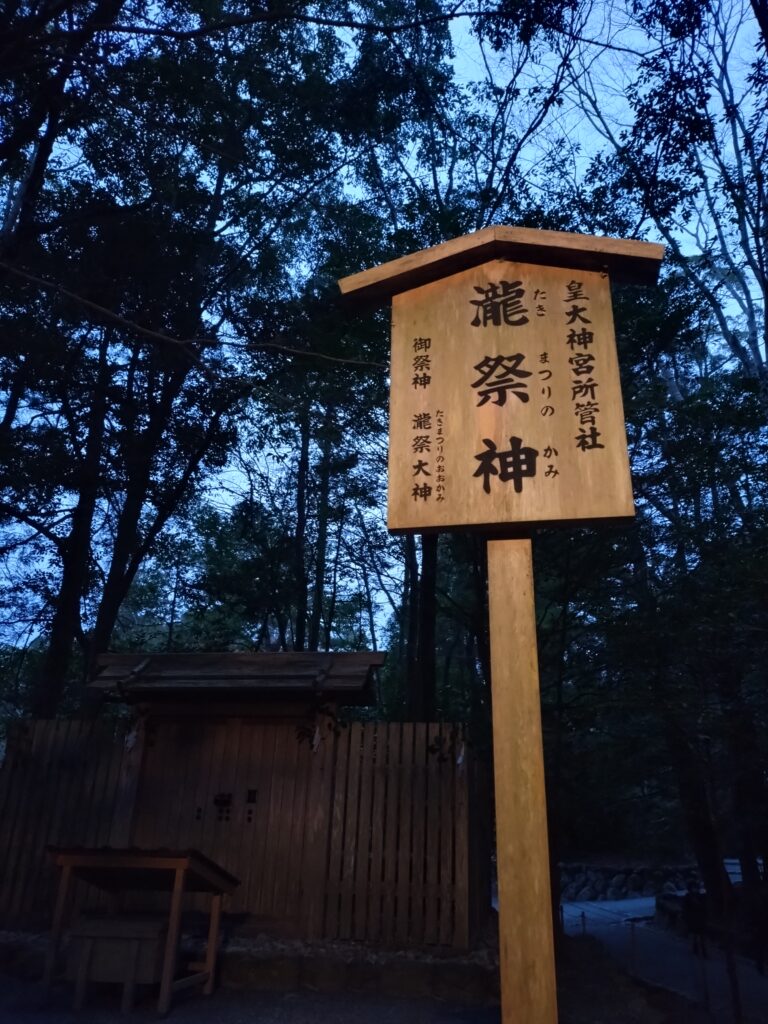
A small sacred space by the river—
where the land is greeted before moving on.
🌉 Uji Bridge — Holding Wishes, Returning to the World
Uji Bridge is crossed twice—
once when entering the sacred precinct,
and again when returning to everyday life.
On the way back, the bridge reveals another layer of meaning.
Along its railings are sixteen bronze finials, known as gibōshi.
At first glance, they appear purely decorative.
Yet inside each one, a small paper talisman is placed.
A guide once explained that visitors are encouraged to gently touch one before leaving.
The wishes held within are simple and enduring:
that the bridge will remain safe for the next twenty years,
that peace will continue during that time,
and that one day, the traveler may return again to Ise.
These wishes are not displayed.
They are not spoken aloud.
They are held quietly—
within the bridge itself.
What a beautiful way of carrying each traveler’s hopes,
not only forward into the sacred,
but back into their own lives.
Uji Bridge does not belong only to arrival.
It belongs equally to departure—
holding the memory of what has been passed through,
and the quiet promise of return.
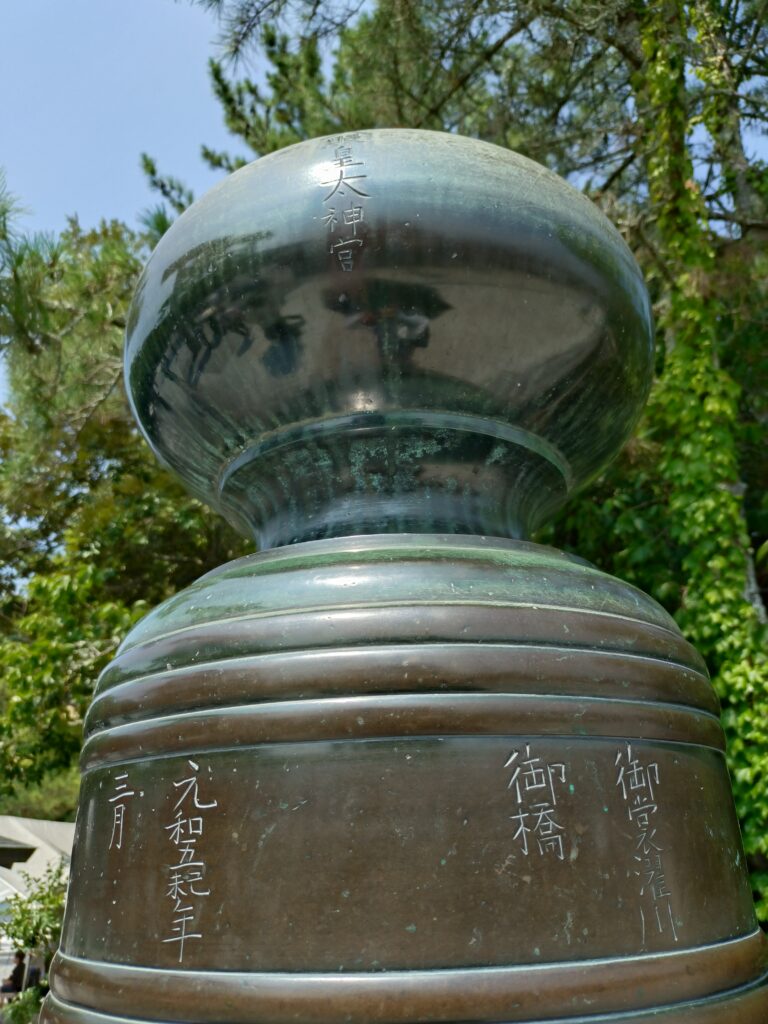
A bridge that holds wishes—
for peace, continuity, and returning once more.
🌸 Kaha’s Note — Harmony That Continues
Walking through the Inner Shrine,
one begins to notice small, quiet choices.
A tree stands in the middle of the stone steps.
Rather than removing it, the path bends around it.
Elsewhere, fences are built with trees growing gently between them.
Stone, wood, and living roots remain side by side—
none forced to yield.
At Ise, nature is not treated as something to be managed,
but as something to be listened to.
This attitude can be felt throughout the shrine grounds.
During the Shikinen Sengū, when the buildings are renewed,
the sacred structures are rebuilt with care and intention.
Yet the story does not end there.
The wood from the former shrine buildings is not discarded.
It is entrusted to shrines across the country,
where it continues to serve, carrying its memory forward.
Hinoki cypress, long treasured for its strength and fragrance,
is now carefully sourced and replanted.
New trees are grown with an understanding that they will not serve today,
but generations far into the future.
Such patience reflects a way of thinking that reaches far beyond one lifetime.
These choices echo the spirit attributed to Yamatohime-no-mikoto,
who is said to have sought not to claim the land,
but to find a place where harmony already existed—
where the divine could dwell without disruption.
Here, the sacred does not stand above nature.
It stands within it.
With gentle respect,
with care for all that is already here,
the land is not reshaped, but met with care and respect.
It is listened to.
It is cherished.
And through that, harmony endures.
In this way, the path to Naikū unfolds—
through water, air, and the living presence of the land—
quietly carrying tradition forward into tomorrow.
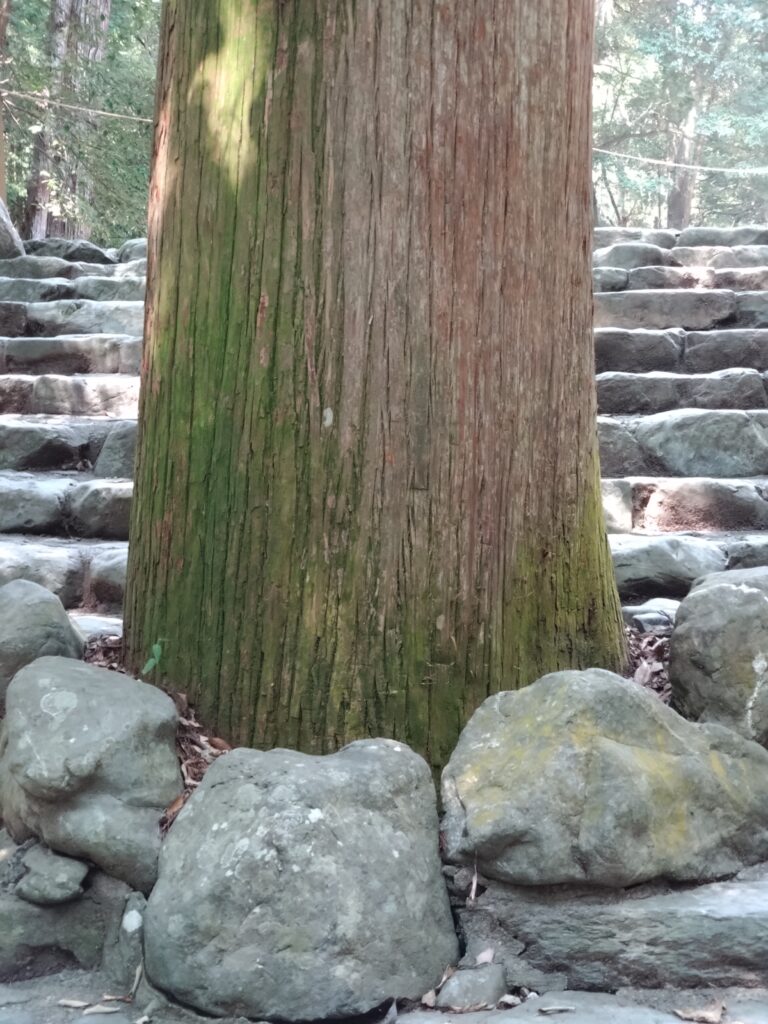
A tree left standing at the heart of the steps—
a path shaped not by removal, but by reverence.
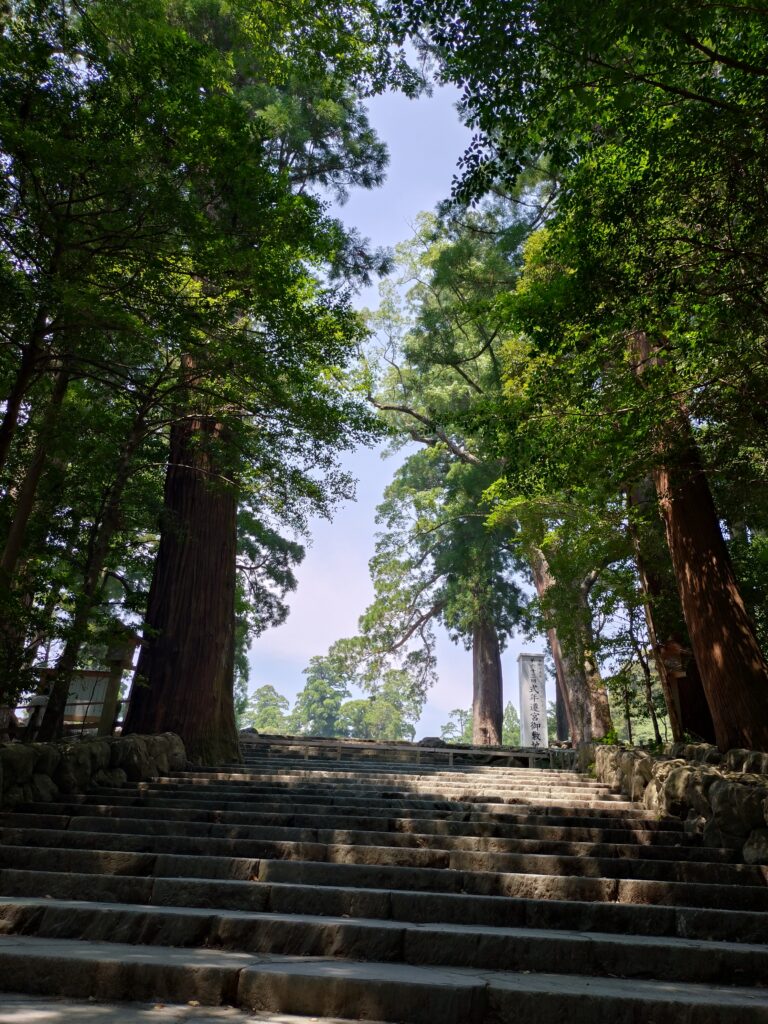
Looking up toward the future site of the Shikinen Sengu from the base of the steps. Tradition continues,
guided by reverence for nature and trust in the passage of time.
🌈Explore more
Morning light at Ise Jingu Naiku.
Footsteps moving gently through the prism of sunrise.
👉 https://youtube.com/shorts/X-olEsIh8rk
If you feel drawn to explore further reflections on sacred Japan, please visit the homepage.


コメント