
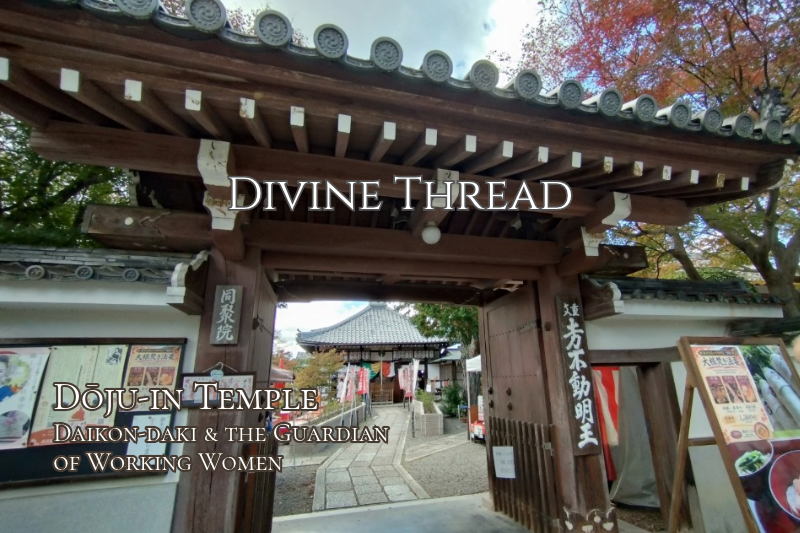
🍀 Lead-in
I visited Dōju-in Temple (同聚院) in Kyoto during its Daikon-daki Memorial Service (大根焚き法要), a traditional Buddhist observance in which eating specially prepared daikon radish is believed to help ward off misfortune and bring good health.
I enjoyed a bowl of simmered daikon with yuba (tofu skin), discovering a Kyoto tradition that was entirely new to me.
The temple was also holding a special opening, offering an opportunity to see its impressive Fudō Myōō (不動明王) statue.
Another fascinating connection was Morgan O-Yuki, a remarkable Japanese woman whose story I had previously explored at Origami Inari Shrine.
What began as a visit to discover a seasonal tradition became an opportunity to explore the faith, history, and stories preserved within this small Kyoto temple.
🥬 Daikon-daki — A Kyoto Winter Tradition
Daikon-daki (大根焚き) is a traditional Buddhist custom found at several temples in Kyoto, particularly during the colder months.
Although the details vary from temple to temple, the custom generally involves preparing simmered daikon radish and offering it to visitors with prayers for good health and protection from misfortune.
At Dōju-in Temple, the Daikon-daki Memorial Service (大根焚き法要) is associated with Shōsetsu (小雪), one of Japan’s 24 traditional seasonal divisions, marking the time when the weather grows colder and the first light snow may begin to fall.
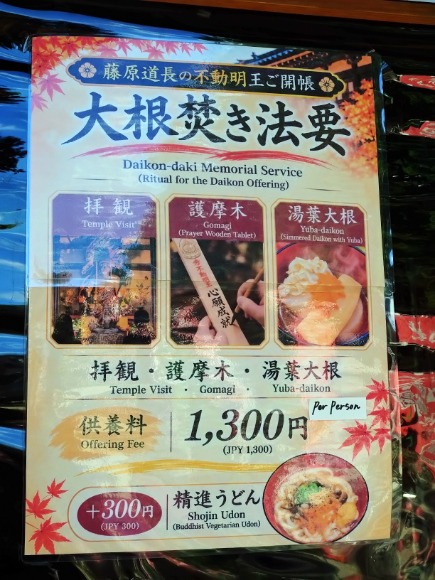
A sign introducing the Daikon-daki Memorial Service, including temple worship, gomagi (prayer wooden tablets), and yuba-daikon (simmered daikon with tofu skin).
The temple’s observance is connected to the anniversary traditionally associated with the consecration of its Fudō Myōō statue.
🍲 A Bowl of Yuba-Daikon
During my visit, I received a warm bowl of simmered daikon radish accompanied by yuba (tofu skin) and aburaage (fried tofu).
The daikon was generously seasoned, and the dish was decorated with small autumn-leaf-shaped garnishes, adding a lovely seasonal touch.
I was also given two candies as a small gift.
What might appear to be a simple bowl of vegetables carries a deeper meaning here. Eating the daikon is traditionally associated with prayers for protection from misfortune and continued good health.
Through this modest offering, an old Buddhist tradition becomes something visitors can experience in everyday life.
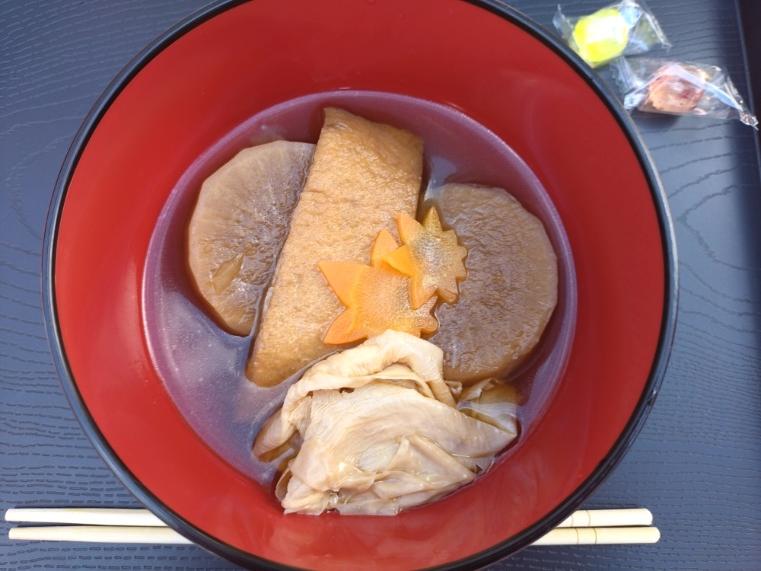
Simmered daikon radish with yuba (tofu skin) and fried tofu, served during the Daikon-daki Memorial Service at Dōju-in Temple in Kyoto. Two candies were also given as a small gift.
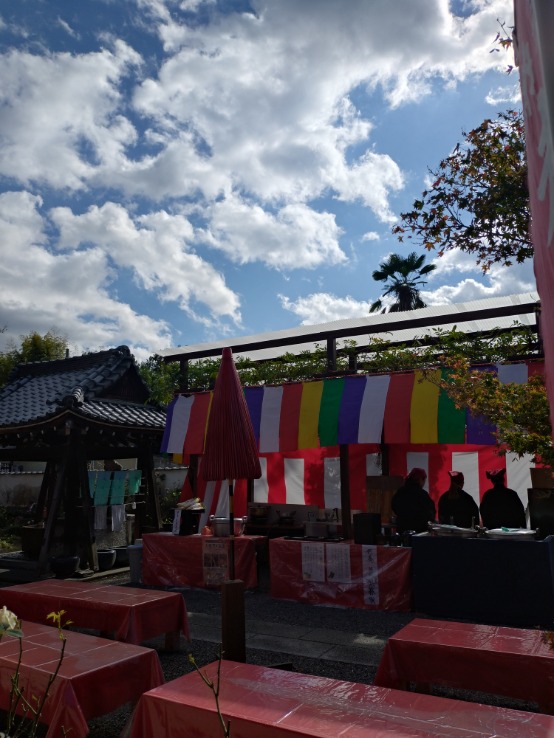
The temple courtyard during the Daikon-daki Memorial Service, decorated with colorful Buddhist banners and red-and-white curtains.
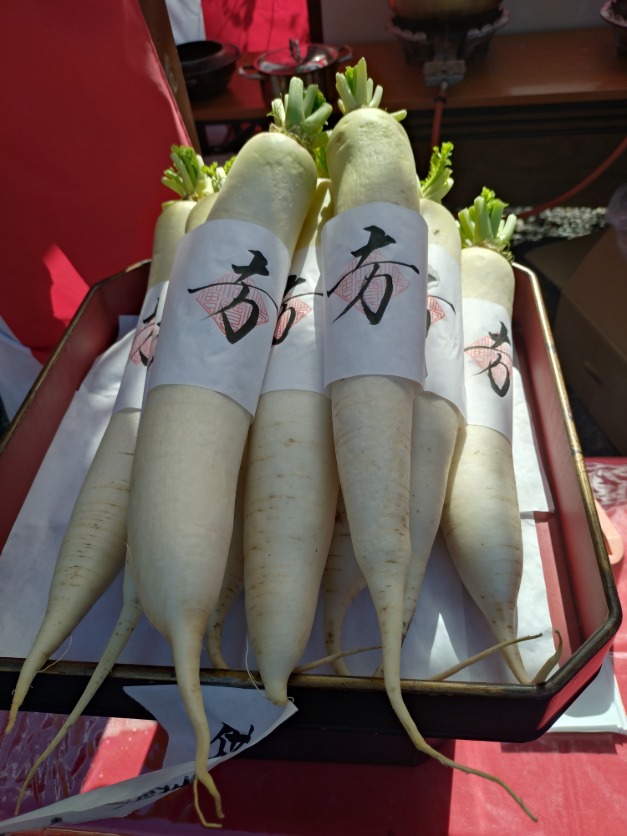
Daikon radishes wrapped in paper bearing the distinctive sacred symbol associated with Dōju-in Temple’s Fudō Myōō, during the Daikon-daki Memorial Service in Kyoto.
🔥 Fudō Myōō — A Thousand Years of Faith
⛩️ From Hōshō-ji to Dōju-in Temple
Dōju-in Temple is a subtemple of Tōfuku-ji, belonging to the Rinzai school of Zen Buddhism.
Its history is closely connected with Hōshō-ji Temple (法性寺), established in this area by Fujiwara no Tadahira (藤原忠平) during the Heian period.
In 1006, Fujiwara no Michinaga (藤原道長) commissioned the construction of the Godai-dō (五大堂), a hall dedicated to the Five Great Wisdom Kings of Buddhism, to commemorate his 40th year.
Hōshō-ji later declined, and Tōfuku-ji was established on its former grounds.
Of the original five Wisdom King statues, the seated image of Fudō Myōō (不動明王) survived.
The Godai-dō was rebuilt in 1280 to house the surviving statue. Dōju-in itself was founded in 1444, and the present hall dates from a later reconstruction in 1714.
Today, this remarkable Buddhist image remains the principal object of worship at Dōju-in.
🔥 The Great Fudō Myōō
The temple’s principal statue of Fudō Myōō was created by Kōshō (康尚), an important Buddhist sculptor of the Heian period, at the request of Fujiwara no Michinaga.
Measuring approximately 2.65 meters in height, this monumental wooden seated statue is designated an Important Cultural Property of Japan.
According to the temple’s official history, it is the largest wooden seated statue of Fudō Myōō in Japan.
Its fierce expression represents the powerful protective nature of Fudō Myōō, while the sculpture also retains the refined elegance characteristic of Heian-period Buddhist art.
The statue is normally housed within the temple’s hall, but special openings offer visitors an opportunity to see this extraordinary work of Buddhist sculpture.
💧 Fudō Myōō at the Chōzuya
Another interesting feature of Dōju-in Temple is its chōzuya (手水舎), where a statue of Fudō Myōō stands beside the purification water.
It was an unusual and memorable sight, revealing another aspect of the temple’s devotion to Fudō Myōō.
🎥 Watch on YouTube
Fudō Myōō at the chōzuya — Dōju-in Temple, Kyoto.
🎐 Watch on Instagram
Discover Dōju-in Temple in summer, with the gentle sounds of wind chimes.
👉 https://www.instagram.com/8rainbowawakening.jp/
✨ The Mysterious Symbol of Fudō Myōō
One of Dōju-in’s most distinctive traditions concerns a mysterious sacred symbol.
According to temple tradition, Fujiwara no Michinaga received this symbol from Fudō Myōō in a dream.
The symbol combines elements associated with several interpretations of the deity’s protective power.
- Doriki Fudō (土力不動) — protection of the land and protection against disasters, including fire.
- Jūman Fudō (十万不動) — Fudō Myōō accompanied by 100,000 spiritual attendants who help protect and save living beings.
- Jippō Fudō (十方不動) — the protective power of Fudō Myōō extending throughout the ten directions.
The symbol is also associated with protective talismans (屋守護札), traditionally connected with prayers for protection against fire and other misfortunes.
The story of this mysterious symbol reflects the enduring faith in Fudō Myōō as a protector against danger and adversity.
🌸 A Guardian of Working Women
Dōju-in’s Fudō Myōō is also revered as a Guardian of Working Women.
According to a temple legend, a noblewoman once lost a precious koto plectrum while visiting Hōshō-ji. Fujiwara no Michinaga prayed to Fudō Myōō for its recovery and vowed to build a hall in gratitude if it was found.
The plectrum was recovered, and the story became associated with the founding of the Godai-dō.
The temple relates that Fudō Myōō was deeply revered by women of the imperial court, including those praying for improvement in traditional arts.
Centuries later, this faith became closely associated with Morgan O-Yuki (モルガンお雪), a celebrated Kyoto geisha who married into the American Morgan family.
According to Dōju-in’s official account, O-Yuki spent time in prayer and reflection at the temple during a difficult period in her life. Her devotion helped strengthen its reputation as a place of prayer for women.
Having previously encountered her story at Origami Inari Shrine, I found this connection particularly interesting — another chapter in the remarkable life of Morgan O-Yuki.
💗 Kaha’s Note
Before this visit, I knew very little about Kyoto’s Daikon-daki tradition.
What initially caught my interest as an unusual seasonal custom turned out to be a fascinating encounter with centuries of Buddhist faith and history.
Dōju-in is located in an area rich in temples and historic sites, not far from the famous Tōfuku-ji Temple. During the autumn foliage season, the surrounding area has a lively atmosphere, with visitors enjoying the colorful leaves, special temple openings, and even a few small stalls along the way.
I think the Daikon-daki observance is worth experiencing, even for those who are not particularly interested in Buddhism. It offers a chance to discover a different side of Japanese culture while enjoying an autumn walk through Kyoto.
For those planning a visit in 2026, the Daikon-daki observance and special autumn opening continue through December 6.
Sometimes, a simple curiosity leads us to places and stories we might otherwise have overlooked.
And that, for me, is one of the pleasures of exploring Japan.
🌈 Explore More
Discover more stories of Kyoto’s seasonal beauty, sacred places, and the remarkable women connected to Japan’s history.
🍁 Seasonal Gallery #3 — Autumn Colors & Floral Beauty at Shōrin-ji Temple
⛩️ Divine Thread #24 — Origami Inari Shrine: Guardian of Women & Morgan O-Yuki
コメント