
🍀 Lead-in
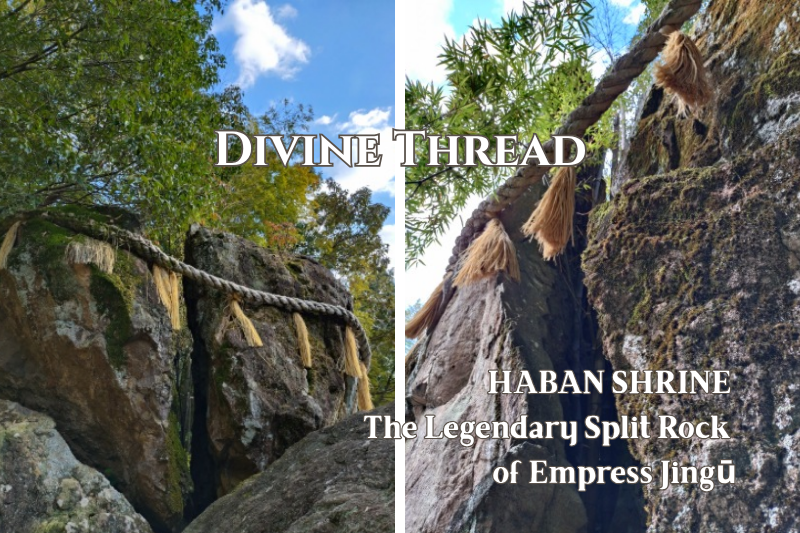
In a quiet corner of Himeji, Hyōgo Prefecture, stands Ware-iwa (われ岩), an enormous sacred rock associated with Haban Shrine (破磐神社).
According to local legend, the rock was split by an arrow shot by Empress Jingū (神功皇后).
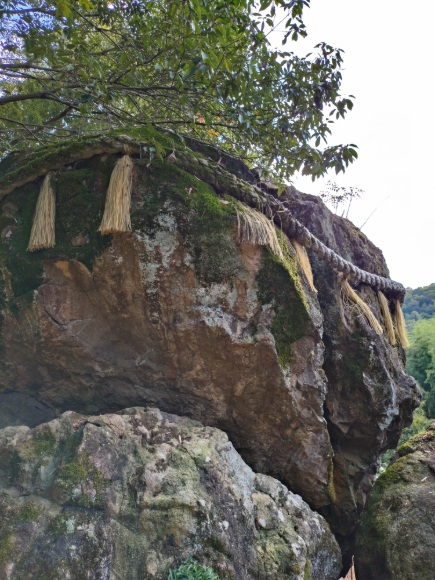
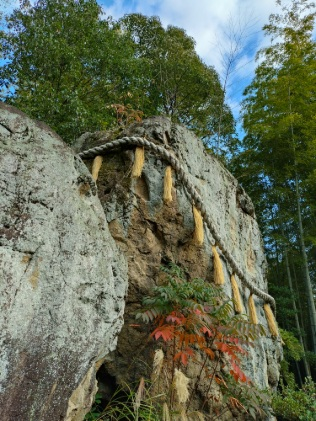
When I visited, I was struck by the remarkable sight of the massive rock, divided by a deep, clean split and adorned with a sacred shimenawa rope.
Surrounded by trees, this ancient stone preserves a fascinating connection between Japanese legend, history, and the natural landscape.
👑 Who Was Empress Jingū?
Empress Jingū (神功皇后) is a legendary figure in ancient Japanese history, traditionally believed to have lived in the 3rd century.
According to the Kojiki and Nihon Shoki, Japan’s early historical chronicles, she was the consort of Emperor Chūai and the mother of Emperor Ōjin.
Following her husband’s death, she is said to have led a military expedition to the Korean Peninsula and later ruled as regent for her young son.
Although the historical details of her life remain uncertain, legends associated with Empress Jingū have been preserved at shrines and sacred sites throughout Japan.
One such story is found at Haban Shrine in Hyōgo Prefecture.
🏹 The Legend of the Three Arrows
According to the tradition of Haban Shrine, Empress Jingū stopped in the Harima region on her return from a military expedition to the Korean Peninsula.
At the time, she was facing opposition from Prince Oshikuma (忍熊王), who challenged the succession of her son, the future Emperor Ōjin.
With an uncertain path ahead, the empress prayed to the heavenly and earthly deities at Mount Asō (麻生山), seeking a sign of divine guidance.
She then released three arrows.
The first arrow brought no sign.
Neither did the second.
But the third arrow was different.
Flying toward the mountains of Nishiwaki, it struck an enormous rock — and split the massive stone into three pieces.
What an extraordinary sight it must have been, if the event unfolded as the legend describes.
For Empress Jingū, this was no ordinary occurrence. She took it as a favorable omen, a sign that the deities had heard her prayers.
The arrowhead was subsequently enshrined at the site, which became associated with the origins of Haban Shrine.
Centuries later, the enormous split rock remains in the wooded hills, preserving a remarkable story of faith, divine guidance, and the legendary empress.
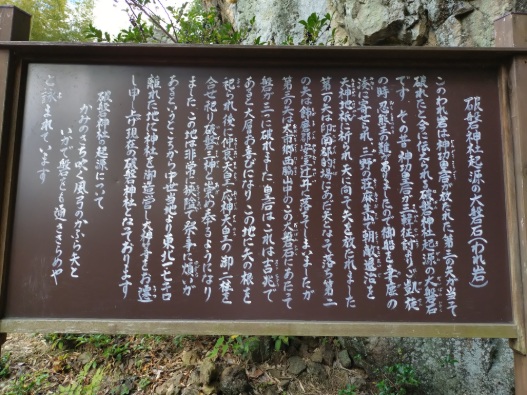
An information board at Ware-iwa explaining the legend associated with Empress Jingū and Haban Shrine.
🪨 Ware-iwa — The Sacred Split Rock
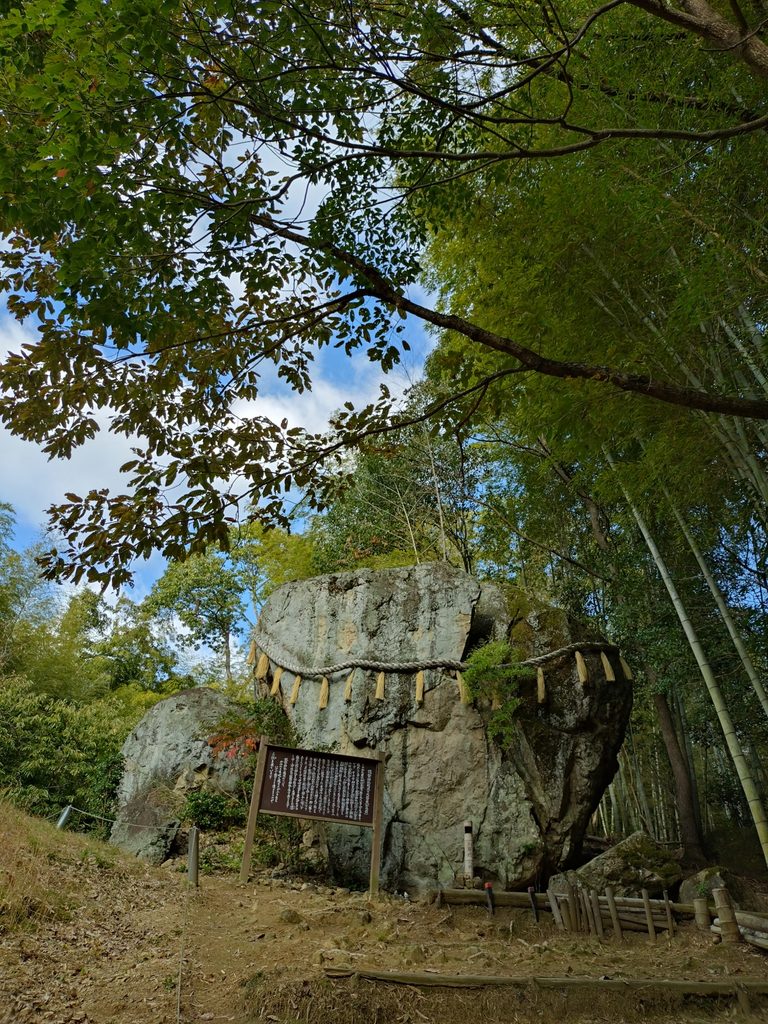
Located in the wooded hills of Miyagadani, approximately 1.7 kilometers southwest of Haban Shrine, Ware-iwa (われ岩) is an enormous rock formation associated with the legend of Empress Jingū.
The rock measures approximately 6.5 meters in height, 5.5–6 meters in width, and 7.5 meters in depth.
A thick sacred shimenawa rope stretches across its rugged surface, marking it as a place of reverence.
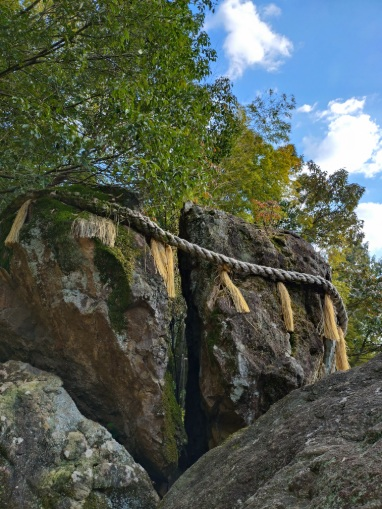
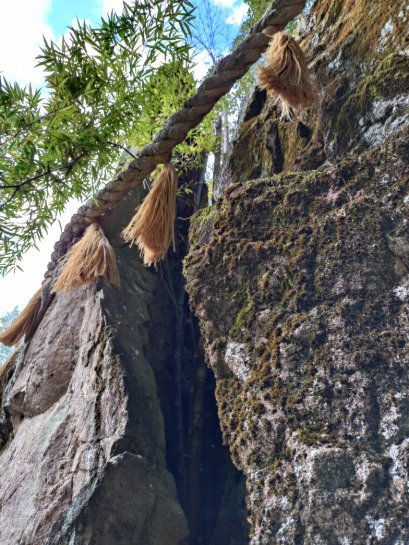
What makes Ware-iwa particularly remarkable is the deep, clearly defined split running through the massive stone.
When I visited, I was struck by how sharply the rock appeared to have been divided. From different angles, the opening revealed dark, narrow spaces between the towering sections.
Moss covered parts of the weathered rock, while trees and patches of blue sky framed the scene.
Walking around Ware-iwa offered a different perspective at every turn, revealing both the impressive scale of the formation and the quiet beauty of its natural surroundings.
Long revered as a sacred rock, Ware-iwa remains a tangible connection between the landscape and the ancient legend preserved at Haban Shrine.
🎥 Watch on YouTube — Ware-iwa, Part 1
Follow the path toward Ware-iwa and watch as the legendary split rock gradually comes into view.
🎥 Watch on YouTube — Part 2
Ware-iwa — A Closer Look at the Legendary Split Rock
In Part 2, we walk around the enormous rock, taking a closer look at its remarkable split and natural formation.
📷 Explore Ware-iwa on Instagram
Discover Ware-iwa from another angle on Instagram.
⛩️ Haban Shrine — Deities and History
Haban Shrine (破磐神社) is located in Nishiwaki, Himeji, Hyōgo Prefecture.
The shrine is dedicated to four deities:
- Empress Jingū (神功皇后) — Okinagatarashihime no Mikoto
- Emperor Chūai (仲哀天皇) — the husband of Empress Jingū
- Emperor Ōjin (応神天皇) — their son
- Susanoo no Mikoto (素戔嗚尊) — a powerful deity associated with storms and the slaying of the eight-headed serpent Yamata no Orochi
According to the shrine’s history, the original place of worship was situated near Ware-iwa, deep in the mountains of Miyagadani.
However, the narrow and rugged terrain made it difficult to conduct religious ceremonies. In the early Edo period, the shrine was relocated to its present, more accessible location.
During the centuries when Shinto and Buddhism were closely intertwined, it was known as Sansho Daigongen (三所大権現).
Following the separation of Shinto and Buddhism in the Meiji period, the shrine came to be known once again as Haban Shrine.
Today, the shrine continues to preserve its connection with Ware-iwa and the ancient traditions of the region.
🌾 A Quiet Journey Through the Countryside
The journey to Haban Shrine also offered a glimpse of the peaceful countryside of Himeji.
Along the way, open rice fields stretched across the rural landscape, adding a quiet charm to the visit.
A peaceful rural landscape with rice fields near Haban Shrine in Himeji, Hyōgo Prefecture.
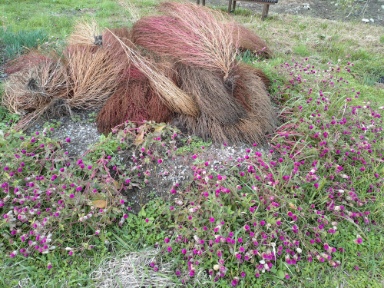
At the shrine, a traditional tea gathering was taking place, with beautiful red Japanese umbrellas adding a warm touch of color to the grounds.
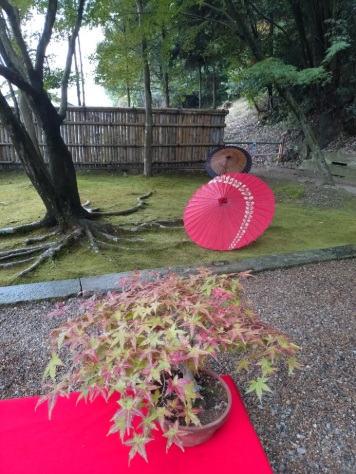
Red Japanese umbrellas beside a tea gathering at Haban Shrine, Himeji, Hyōgo Prefecture.
The peaceful shrine grounds and the surrounding countryside revealed another side of this visit, beyond the ancient legend of Ware-iwa.
These simple scenes were a lovely reminder that Japan’s sacred places are not only connected to ancient legends, but also remain part of everyday life and local traditions.
🌸 Kaha’s Note
Of the two places I visited, Ware-iwa left the strongest impression on me.
The enormous rock was split so cleanly that it was almost unbelievable. Standing beside it, I felt a powerful energy around the stone.
I couldn’t help wondering how many people had stood before this same rock over the centuries, listening to the legend of Empress Jingū and feeling something beyond its remarkable appearance.
Haban Shrine itself had a much gentler atmosphere, with a traditional tea gathering taking place during my visit.
Yet it was Ware-iwa that stayed with me most deeply.
There was something extraordinary about standing before a place where an ancient legend and the physical landscape seem to meet — as though the story had never entirely faded into the past.
🌈 Explore More
Explore the world of Japanese kami, sacred landscapes, and ancient traditions.



コメント