
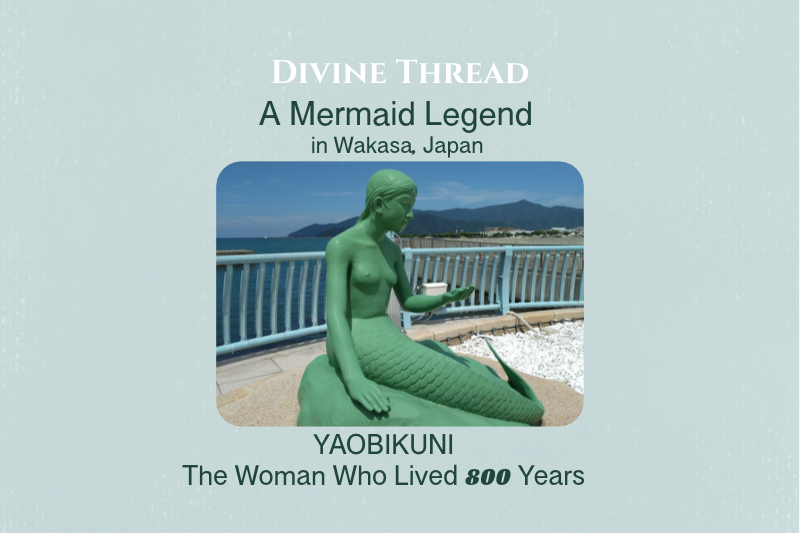
- 🍀 Lead-in
- 🧜♀️ The Legend of Yaobikuni — A Girl Who Never Grew Old
- 🌿 A Long Journey Across Japan
- 🌸 The White Camellia and the Cave at Kūinji Temple
- 📜 A Mysterious Nun in Medieval Records
- 🐚 What Did Mermaids Look Like in Old Japan?
- 🌊 Mermaid Terrace — The Legend in Present-Day Wakasa
- 💭 Kaha’s Note
- 🌈 Explore More
🍀 Lead-in
During my visit to Ongamijima Island in Wakasa Bay, Fukui Prefecture, I learned about a fascinating Japanese legend involving a mermaid.
Today, many of us imagine mermaids as beautiful women with long hair and fish tails, an image familiar from Western fairy tales and films. But Japan has its own mermaid traditions, and the creatures depicted in old Japanese illustrations sometimes look very different.
Curious about these stories, I began looking into the legend of Yaobikuni (八百比丘尼), a woman said to have lived for 800 years after eating the flesh of a mermaid.
Her story has been passed down in different forms throughout Japan, but one of its best-known versions comes from Wakasa, in present-day Fukui Prefecture.
It is a remarkable tale of eternal youth, loneliness, compassion, and a journey that eventually leads back home.
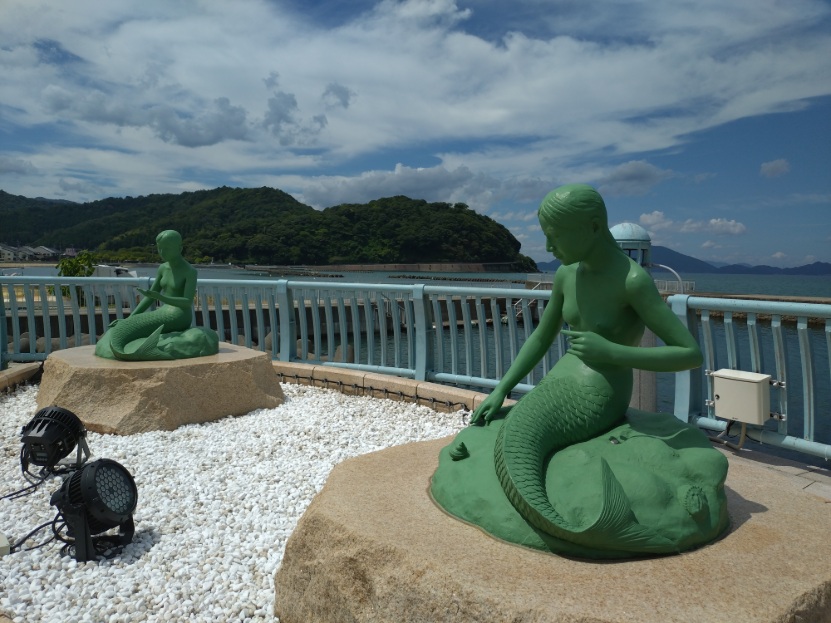
Mermaid statues at Mermaid Terrace, Obama City, Fukui Prefecture.
🧜♀️ The Legend of Yaobikuni — A Girl Who Never Grew Old
According to a version of the legend preserved in Obama City, long ago, a wealthy man named Takahashi Gondayū lived in Wakasa.
One day, he attended a gathering where an unusual delicacy was served: the flesh of a mermaid.
He brought some home, but his family found it so strange that no one wished to eat it. Only his beautiful sixteen-year-old daughter unknowingly tasted a piece.
From that day onward, something extraordinary happened.
The girl stopped aging.
Years passed, then decades. Her family and friends grew old and died, while she remained as young as ever.
At first, eternal youth might seem like a wonderful gift. Yet for the girl, it gradually became a source of sorrow. Those around her began to fear her unchanging appearance, leaving her increasingly alone.
When she reached the age of 120, she decided to become a Buddhist nun and devote her long life to helping others.
She became known as Yaobikuni, the nun who lived for 800 years.
🌿 A Long Journey Across Japan
According to the legend, Yaobikuni traveled throughout Japan, performing acts of kindness and service.
She is said to have helped build roads and bridges, and to have contributed to the construction and repair of temples and shrines.
Different regions preserve different versions of her travels, reflecting how widely her story spread over the centuries.
Her extraordinary lifespan was no longer simply a mystery. In the telling of the legend, it became an opportunity to serve others.
After many years of wandering, Yaobikuni eventually returned to her birthplace in Wakasa.
🌸 The White Camellia and the Cave at Kūinji Temple
In Obama City, a cave at Kūinji Temple (空印寺) is associated with the final chapter of Yaobikuni’s life.
According to local tradition, when she reached the age of 800, Yaobikuni planted a white camellia near the cave.
She is said to have told the people around her that when the camellia died, they would know her life had come to an end.
Then she entered the cave and disappeared.
Today, the site is known as Yaobikuni Nyūjō-dō (八百比丘尼入定洞), the cave where the legendary nun is believed to have entered her final spiritual retreat.
A stone statue depicting Yaobikuni stands beside the cave. She is shown wearing Buddhist robes and holding a flower and prayer beads.
The camellia remains an important symbol in the local telling of her story.
The legend ends not with a dramatic farewell, but with a woman returning to her homeland after centuries of travel.
After eight centuries of unchanging youth, she entrusted the end of her life to a living tree—a quiet symbol of the passing of time and the impermanence of all things.
📜 A Mysterious Nun in Medieval Records
Although Yaobikuni is known primarily through folklore, accounts of an extraordinarily long-lived nun from Wakasa also appear in historical writings.
In 1449, during Japan’s Muromachi period, a nun associated with Wakasa was reportedly seen in Kyoto.
The diary Yasutomiki (康富記) describes a nun said to be more than 200 years old, while another historical record, Gaun Nikkenroku (臥雲日件録), refers to an elderly nun said to be 800 years old.
These accounts do not prove that Yaobikuni lived for centuries, nor do they establish that the woman mentioned was the same person as the legendary figure.
Yet the differing ages recorded in these accounts suggest how extraordinary the stories surrounding this mysterious nun had already become. They also show that tales of a remarkably long-lived nun from Wakasa were circulating in medieval Japan, centuries before Toriyama Sekien’s mermaid illustration appeared in 1780.
🐚 What Did Mermaids Look Like in Old Japan?
The mermaids we see in modern films and illustrations are often graceful, beautiful figures with human upper bodies and fish tails.
But historical Japanese images of ningyo (人魚), literally meaning “human-fish,” reveal a much wider range of appearances.
Some look more like strange fish with human faces than the familiar mermaids of Western fairy tales.
One fascinating example appears in Toriyama Sekien’s Konjaku Hyakki Shūi (今昔百鬼拾遺), published in 1780.
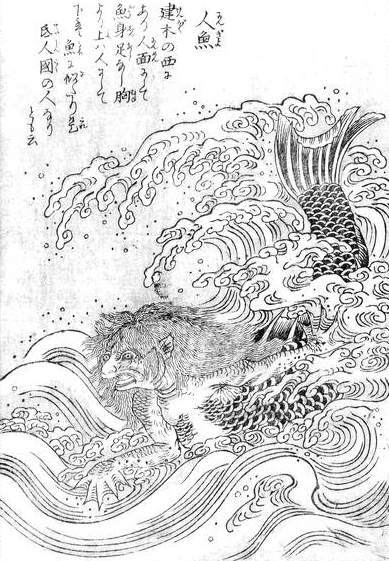
Ningyo, from Konjaku Hyakki Shūi (1780), by Toriyama Sekien. Via Wikimedia Commons. Public domain. This illustration represents a historical Japanese mermaid, not Yaobikuni herself.
A very different mermaid appears in Santō Kyōden’s Hakoiri Musume Menya Ningyō (1791), a work of popular fiction from the Edo period.
With her traditional Japanese hairstyle and fish-like body, she offers another fascinating glimpse into how mermaids were imagined in Japan.
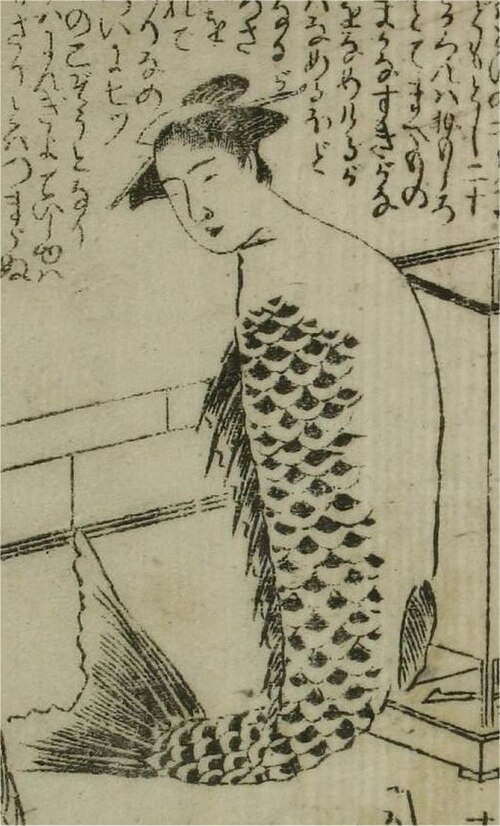
An Edo-period Japanese mermaid with a traditional nihongami hairstyle, illustrated in Santō Kyōden’s Hakoiri Musume Menya Ningyō (1791). This image does not depict Yaobikuni.
These images remind us that the appearance of a mermaid was never fixed.
And although Yaobikuni’s legend begins with mermaid flesh, the creature in her particular story cannot be identified with any certainty.
🌊 Mermaid Terrace — The Legend in Present-Day Wakasa
Today, visitors to Obama City can encounter a very different image of a mermaid.
At Mermaid Terrace, two green mermaid statues overlook the sea.
Their human faces and graceful fish tails are much closer to the familiar modern image of a mermaid.
The statues were installed in connection with the local mermaid tradition, keeping the story present in the coastal landscape.
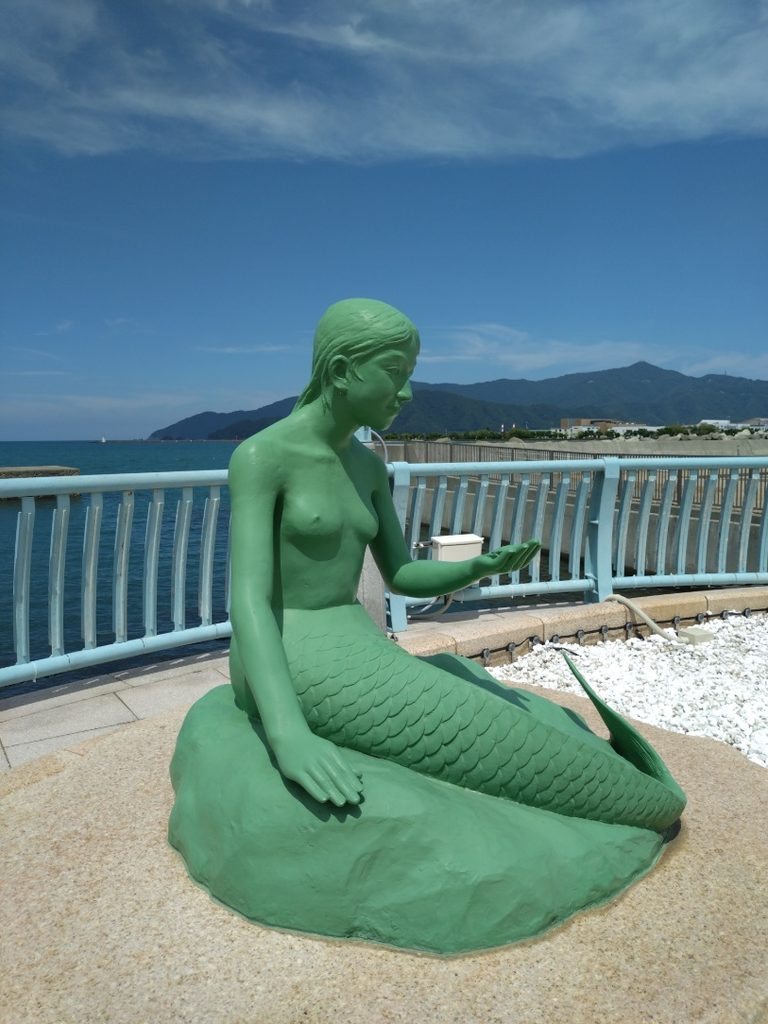
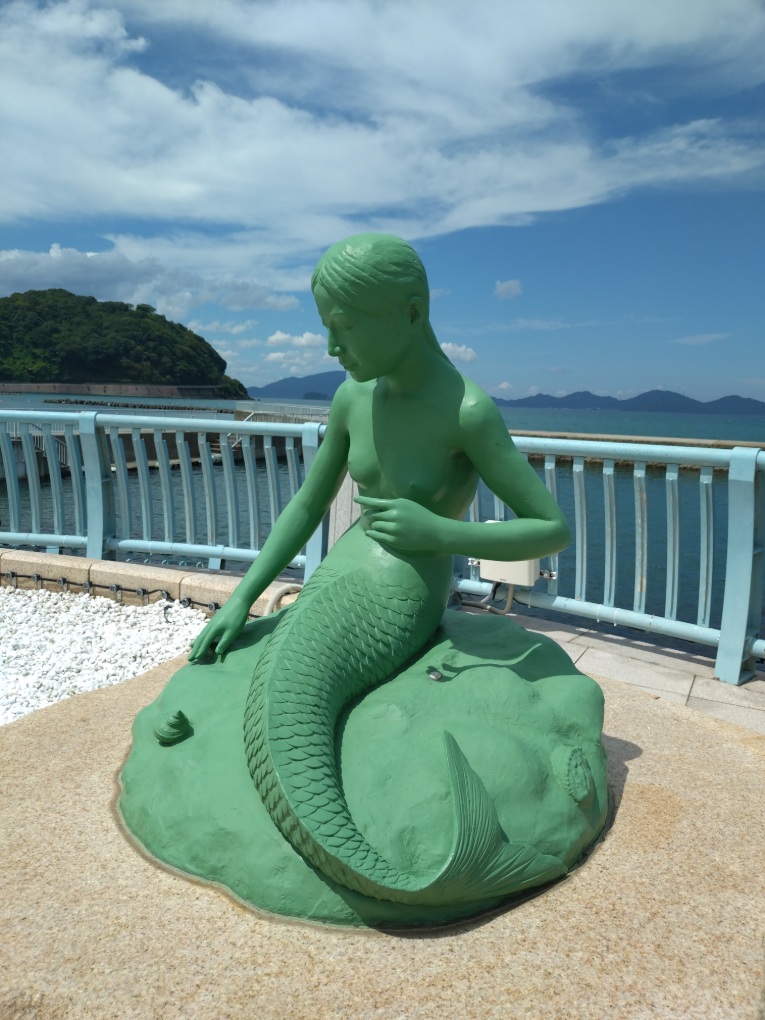
Closer views of the mermaid statues at Mermaid Terrace, Obama City.
Looking at these modern figures alongside the older Japanese illustrations reveals how differently mermaids have been imagined over time.
Yet the story of Yaobikuni is not really about what a mermaid looked like.
It is about what happened to a human being after an extraordinary encounter changed the course of her life.
💭 Kaha’s Note
What stayed with me most about Yaobikuni’s story was not the promise of eternal youth, but the loneliness that came with it.
To remain young while everyone around you grows old and disappears would be a very different kind of life from the one we usually imagine when we wish for longevity.
And yet, in the legend, Yaobikuni eventually turns her long years toward helping others.
I find the white camellia at the end of her journey especially memorable. Its presence brings a sense of peace to a story marked by centuries of separation and loss.
Perhaps the greatest gift is not to live forever, but to find meaning in the time we are given.
🌈 Explore More
🐉 Dragon Path #3 │ Ongamijima — Where Dragons Meet the Sea
Discover a mysterious island in Wakasa Bay, where ancient legends, sacred traditions, and the sea come together.
🌟 Earth Whispers #10 │ Where Water Holds the Memory of Time
Follow another thread into the natural world, exploring the quiet connection between water, time, and memory.

コメント