
🏝️Lead-in
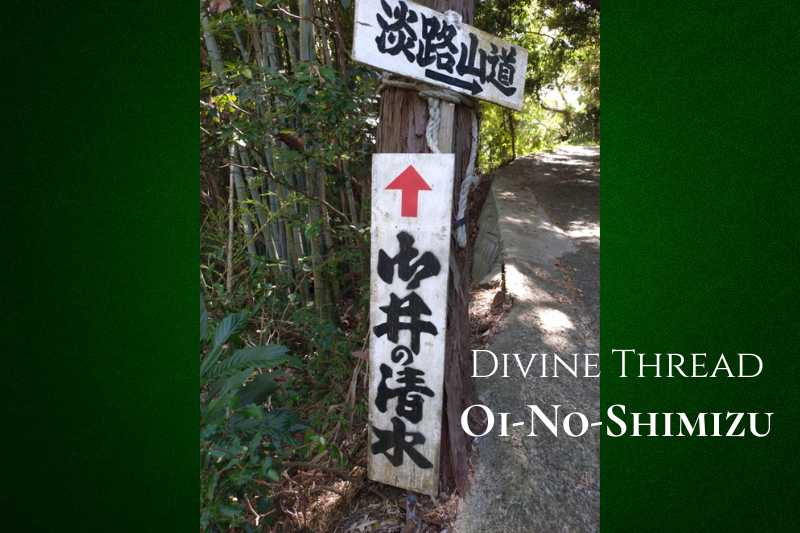
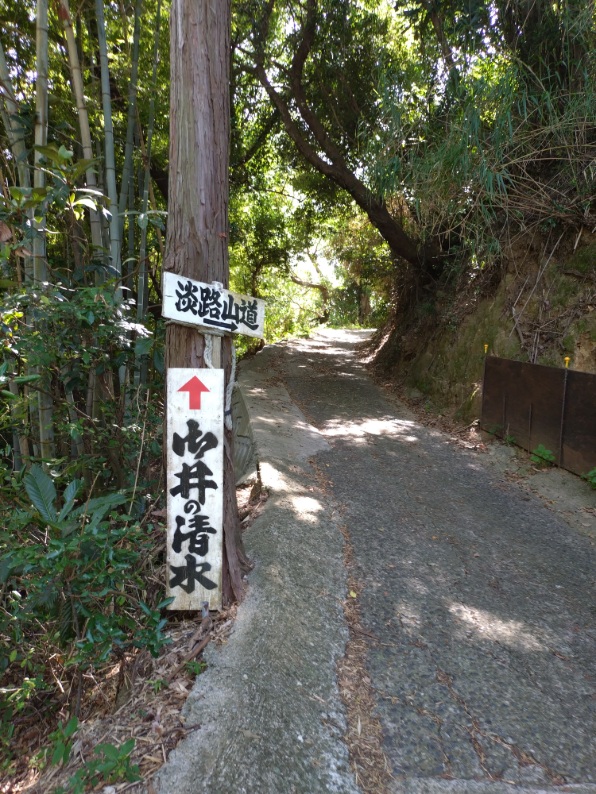
On the eastern side of Awaji Island, a weathered wooden sign points toward a quiet path surrounded by bamboo and summer greenery.
At the end of this path lies Oi-no-Shimizu, one of Awaji Island’s lesser-known sacred water sites. According to an ancient story recorded in the Kojiki, spring water from Awaji was once carried across the sea morning and evening for Emperor Nintoku.
Today, the spring remains hidden within the forest, preserving a quiet connection between Awaji Island, the ancient imperial court, and the maritime people who once crossed Osaka Bay.
Sano-Koi, Awaji City, Hyogo Prefecture
🌿Following the Signs to Oi-no-Shimizu
The route to Oi-no-Shimizu follows a single road, with a few simple wooden signs marking the way. Surrounded by bamboo and summer greenery, the path gradually leads toward the spring.
Along the way, both going to and returning from the spring, I encountered several dragonflies, three or four black butterflies, and one small lizard shimmering with rainbow-like colors.
Even before I reached Oi-no-Shimizu, what appeared to be an eagle flew low across the road directly in front of my taxi. After arriving, another bird swept remarkably close to me along the mountain road. Near the spring, I could no longer see any of the birds, but their calls continued to echo through the surrounding forest.
Together, these encounters made the journey feel filled with the vivid presence of life.
The way there is relatively straightforward if you continue following the signs. On the return journey, however, it is worth paying close attention to the route you came from. If you are not careful, you may accidentally follow a different road instead of retracing your original path.
In summer, the sound of cicadas fills the surrounding forest. The walk itself becomes part of the experience—a quiet journey through the green landscape of Awaji Island toward a spring connected with an ancient story.
📜 A Sacred Spring in the Kojiki
The story associated with Oi-no-Shimizu appears in the section of the Kojiki devoted to Emperor Nintoku.
The ancient chronicle tells of an extraordinarily tall tree whose shadow was said to reach Awaji Island in the morning and extend beyond Mount Takayasu in the evening. After the tree was cut down, its wood was used to build a remarkably swift boat called Karano.
Using this boat, people collected fresh spring water from Awaji Island every morning and evening and presented it as ōmimoi—water reserved for the emperor’s use.
The Kojiki does not identify the spring by its present-day name or provide its exact location. However, Oi-no-Shimizu in Sano-Koi has long been preserved as a traditional site associated with the “cold spring of Awaji” described in the story.
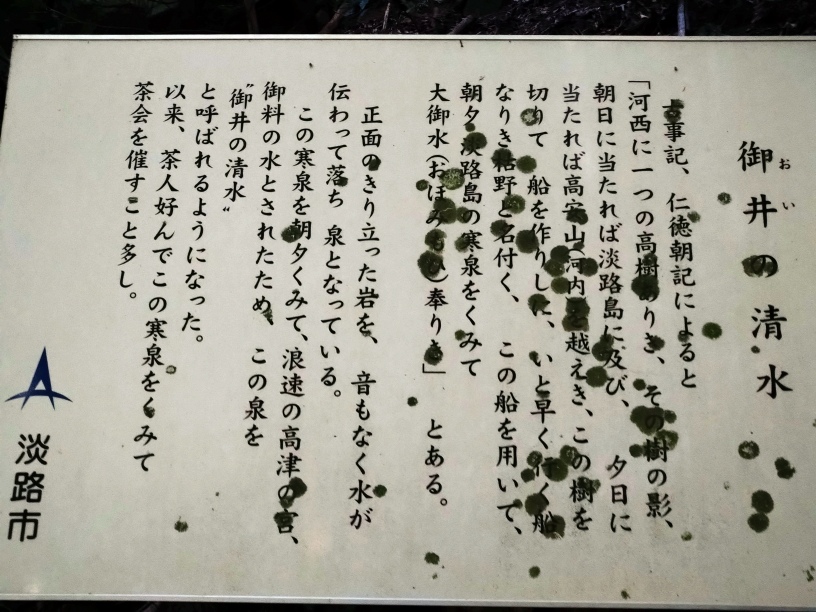
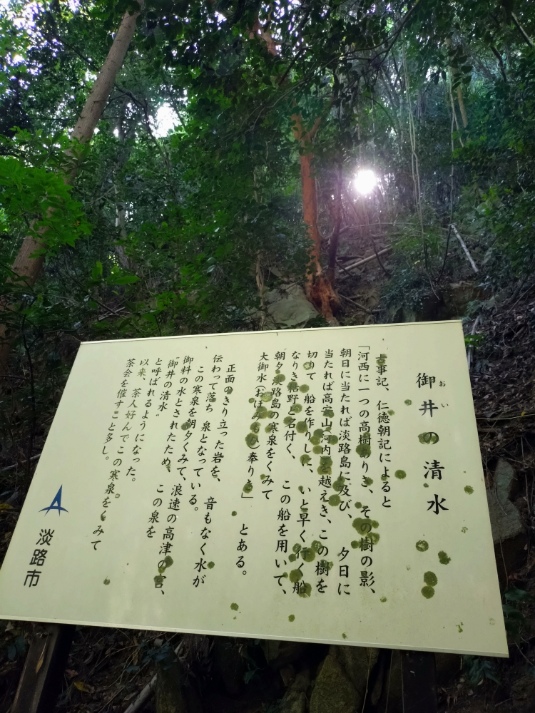
The local signboard recounts the ancient story of spring water carried from Awaji Island for Emperor Nintoku.
⛵ Water Carried Across the Sea
The story is remarkable not only because of the water itself, but also because of the journey it required.
Emperor Nintoku’s palace was located in Naniwa, in present-day Osaka. According to the tradition, carrying fresh water from Awaji Island for the emperor meant crossing Osaka Bay morning and evening, using a swift vessel and the exceptional navigational skills of the island’s maritime people.
Known as the Ama, these ancient seafarers played an important role in connecting Awaji Island with the imperial court. They navigated the surrounding seas and supplied the court with salt, seafood, and other valuable products from the island.
Awaji was also remembered as a Miketsukuni—a region that provided food and precious resources for the imperial table. The story of Oi-no-Shimizu reveals that fresh water, too, formed part of this deep relationship between the island, the sea, and the ancient court.
Today, Oi-no-Shimizu is included among the cultural properties that form Awaji Island’s Japan Heritage story, which explores the lives of the maritime people who helped support the ancient Japanese state.
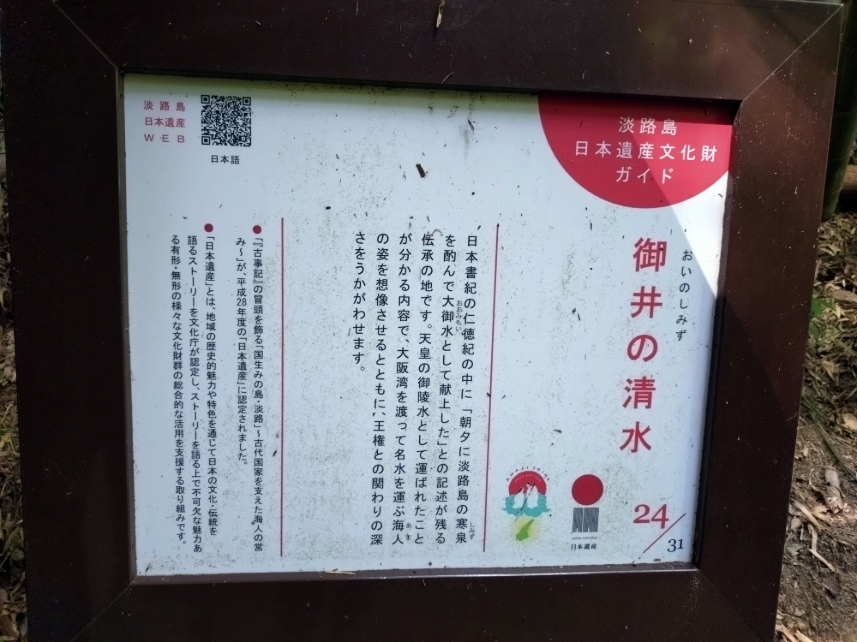
Oi-no-Shimizu is one of the cultural properties included in Awaji Island’s Japan Heritage story.
💧 Oi-no-Shimizu Today
According to the local signboard, water flows silently down the steep rock face and gathers below as a spring. Because it was traditionally regarded as water reserved for imperial use, the spring came to be known as Oi-no-Shimizu.
The signboard also explains that tea practitioners valued this cold, clear water and often collected it for tea gatherings.
When I visited in summer, the surrounding forest was filled with the sound of cicadas. The spring was modest and deeply secluded, with none of the grand architecture found at many famous sacred sites.
I collected some of the water and used it to gently cleanse crystals I had brought with me. In the shade of the trees, surrounded by flowing water and the sounds of the forest, it felt like a quiet encounter with a place where an ancient tradition remains part of the living landscape.
Oi-no-Shimizu rests quietly beneath the trees, surrounded by the sounds and greenery of the summer forest.
🎥 Watch on YouTube
Walk along the quiet summer path to Oi-no-Shimizu, listen to the cicadas, and discover the sacred spring hidden within the forest of Awaji Island.
【Spiritual Japan】Oi-no-Shimizu 💧│ Sacred Spring Linked to the Kojiki │ Sacred Portal │ Awaji Island
💗Kaha’s Note
Some sacred places reveal themselves through magnificent gates, ancient buildings, or dramatic landscapes. Others remain almost hidden within the everyday scenery.
Oi-no-Shimizu was one of those quieter places—a few wooden signs along a mountain road, clear water beneath the trees, and the sounds of the summer forest.
The dragonflies, black butterflies, a small lizard shimmering with rainbow-like colors, and the calls of a bird of prey made the surrounding landscape feel vividly alive. As I listened to the cicadas and flowing water, I imagined the ancient boats crossing Osaka Bay, carrying fresh water from Awaji Island toward the imperial palace.
Whether every detail of the tradition can still be traced today or not, the spring preserves a meaningful connection between the island, the sea, and Japan’s distant past.
🌈 Explore More
Explore more reflections, seasonal journeys, and gentle discoveries from Japan.


コメント