

Lotus flowers have been one of the symbols that awaken my soul, and following the Lotus flowers brings me wisdom, new insight, and connection.
- 🌿 Lead-in
- 📚The Story of the Oga Lotus: Discovery, Preservation, and Blooming Today
- 🌺What Sets Ancient Lotus Apart?
- 🍃 A Serendipitous Visit to Shōrenji Temple
- 🤩Lessons in Bloom at Saidaiji Temple
- 🌿 The Six Teachings of the Lotus (蓮の六徳)
- 🌱The Seeds We Carry
- 📷 Image Captions (Photo Selection Highlights)
- 🌸 When to Visit
- 🧭 Follow the Lotus: Where to Go & What to Know
- 🕊 Kaha’s Note
- 🟩 Next Topics
- 🟨 Inspiration Snapshots
- 🌈 Explore More
🌿 Lead-in
In the quiet waters of Gyōda, Saitama and Kumamoto’s Suizenji Park, a rare and sacred flower blooms each summer — the Oga Lotus, or “ancient lotus.” These blossoms are not just admired for their beauty. What makes them extraordinary is their origin: they sprouted from seeds over 2,000 years old, discovered in the 1950s by Japanese botanist Dr. Ichiro Oga. After careful excavation and preservation, one of the ancient seeds was successfully germinated, awakening a life that had slumbered for millennia.
Today, the blooming of the ancient lotus is a celebrated seasonal event across Japan. Its elegant pink petals rising from murky ponds symbolize purity, resilience, and spiritual rebirth — values deeply embedded in Buddhist philosophy. But beyond their sacred associations, ancient lotus flowers also offer a fascinating story of science, discovery, and cultural memory. This article explores the places where these flowers bloom, their spiritual meanings, and what they continue to teach us — not just about nature, but about life.
📚The Story of the Oga Lotus: Discovery, Preservation, and Blooming Today
The story of the ancient lotus begins in the 1950s, when Dr. Ichiro Oga, a Japanese botanist and expert in lotus biology, unearthed lotus seeds from the Kemigawa shell mound in Chiba Prefecture. Radiocarbon dating later confirmed these seeds were about 2,000 years old — from the Yayoi period.
In 1951, one of the seeds germinated, blooming into what would become known as the Oga Lotus. Since then, it has been cultivated across Japan, most notably in Gyōda, Saitama, at the Ancient Lotus Village, and in Kumamoto’s Suizenji Park.
The Oga Lotus serves not just as a living relic of the past, but also as a symbol of dormant potential, resilience, and rebirth — a reminder that life can awaken even after centuries of silence.
🌺What Sets Ancient Lotus Apart?
While lotus flowers bloom all over Japan, the ancient lotus holds special significance. Here’s what sets it apart:
- Age of Seeds: Ancient lotus seeds can survive thousands of years; ordinary lotus are planted annually.
- Shape & Color: Ancient lotus often feature larger, fuller blossoms with soft pink hues.
- Spiritual & Scientific Value: Ancient lotus connects to Japan’s archaeological past and Buddhist symbolism, where the lotus represents enlightenment rising from the mud.
These blooms are not just seasonal beauty — they are storytellers of time, memory, and transformation.
🍃 A Serendipitous Visit to Shōrenji Temple
Last August, while exploring a historical site with a friend, we happened upon Shōrenji, a temple neither of us had planned to visit. It was a suggestion from a quick online search — a spontaneous decision that led to something memorable.
Shōrenji was founded over 1,200 years ago, during the Heian period, by order of Emperor Saga’s consort who prayed for a safe childbirth. A Jizō Bodhisattva statue over three meters tall watches over the grounds, radiating calm and reassurance.
According to legend, Kūkai (Kōbō Daishi) once stopped here to pray for clear skies. Since then, the temple has become known for sunshine prayers. During the rainy season through August, teru teru bōzu dolls— handmade charms believed to bring good weather — are lovingly displayed around the grounds.
That day, among the lotus in bloom, one stood out — a blue lotus. Rare and vivid, it shimmered under the sun, more like a vision than a flower. I later learned that the temple’s head priest holds a Ph.D. in life sciences and actively researches lotus growth. The mix of science and spirit felt just right.
We hadn’t intended to visit Shōrenji, but the lotus — as always — led the way.
🤩Lessons in Bloom at Saidaiji Temple
I visited Saidaiji Temple in mid-July, when lotus were blooming in clay pots around the temple grounds. Some were wide open, their petals radiant in the summer light; others were still closed, holding their energy within.
Saidaiji is part of the “Lotus Road” pilgrimage, connecting four Nara temples where lotus guide visitors through prayer and reflection.
At Saidaiji Temple, I walked among pots of blooming lotus, the air filled with sunlight and stillness.
Nearby, a small signboard caught my attention. It explained the Six Teachings of the Lotus—six ways in which the lotus embodies Buddhist wisdom.
I read it slowly. Here’s what I learned:
🌿 The Six Teachings of the Lotus (蓮の六徳)
Each part of the lotus tells a story—not only of the flower itself but of the spiritual path it symbolizes.
① Purity Amidst Mud – 汚泥不染の徳
The lotus blooms from thick mud, yet remains untouched by it.
(True wisdom and virtue can arise even in a troubled world.)
➡ Live with clarity and integrity, no matter your surroundings.
② One Stem, One Flower – 一茎一花の徳
Each stem produces only one flower, representing focus and uniqueness.
(Follow one path with sincerity, and awakening will come.)
➡ You are one of a kind. Walk your path with devotion.
③ Flower and Fruit Together – 華果同時の徳
The lotus bears fruit as it blooms, symbolizing inner potential.
(Buddha-nature exists within us from the beginning.)
➡ The journey and the goal are already within you.
④ One Flower, Many Seeds – 一花多果の徳
From one blossom, many seeds. One truth can nourish many lives.
(One act of good can ripple out into the world.)
➡ Small kindness can create infinite blessings.
⑤ Hollow but Upright – 中虚外直の徳
The lotus stem is empty yet stands tall.
(Let go of ego to live straight and strong.)
➡ A humble heart holds quiet strength.
⑥ Seeds That Never Die – 種子不失の徳
Lotus seeds can remain dormant for centuries, yet still bloom.
(The potential for enlightenment never fades.)
➡ What’s within you is timeless. Keep nurturing it.
Each teaching revealed more than metaphor — it mirrored life itself.
After reading those teachings, I spoke with a woman working at the temple. who told me about Aizen Myō-ō, one of several Buddhist deities honored at the temple. While fierce in appearance, Aizen is said to represent passion and love transformed — not destruction, but purification. I wasn’t allowed to photograph the statue, but I was shown a ballpoint pen drawing of the deity, which I was permitted to capture.
🕉️ Aizen Myō-ō: Love, Protection, and the Power of Prayer
In esoteric Buddhism, Aizen Myō-ō embodies the transformation of excessive human desire into righteous life energy. Rather than denying emotions, Aizen teaches us how to elevate passion into strength, clarity, and compassion.
At Saidaiji Temple, Aizen is also deeply connected to the 13th-century monk Eison, a central figure in Nara’s Buddhist revival. During the Mongol invasions of Japan, Eison performed a powerful esoteric rite known as the Aizen Sonshō-hō, with Aizen as its central deity.
According to temple tradition, on the final day of the ritual, the arrow in Aizen’s hand flew westward into the sky, calling forth divine winds—kamikaze—that repelled the invading forces without harming a single soul.
It is a story of fierce compassion and protective love, where power does not destroy but instead shelters and transforms.
Sometimes the most powerful experiences come not through sights or rituals, but through simple exchanges — a quiet moment, a kind gesture, a flower that opens at just the right time.
🌱The Seeds We Carry
During another summer in Nara, years before, a local man handed me a lotus seed. Fresh from the pod, it was something I had never seen. “Try it,” he said. I did — it was nutty and earthy, simple and good.
That moment returned to me as I stood again among the lotus.
A seed, passed hand to hand, held everything the lotus had taught me.
That growth is slow. That beauty comes in layers. That even in the most fleeting moments, something lasting can be planted.
📷 Image Captions (Photo Selection Highlights)

Blue lotus. Sacred to ancient Egypt.
Blooming here, in Japan.
A quiet bridge between worlds—between what was, and what still lives. (Shorenji)

Kwan Yin stands tall among lotus pots, offering quiet strength to those who pass.(Saidaiji)

Soft white petals with a faint blush, open in calm strength. (Saidaiji)
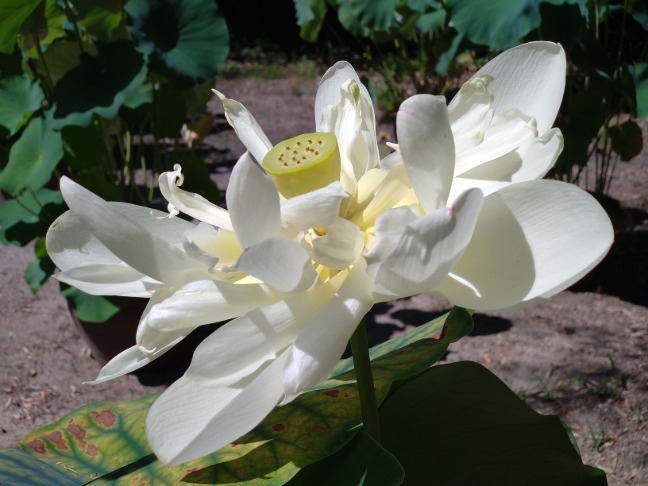
Its pale yellow center, firm and bright, marks a moment in time—soon to deepen into green, then darken as seeds ripen within. Even in stillness, the lotus moves forward. (Saidaiji)
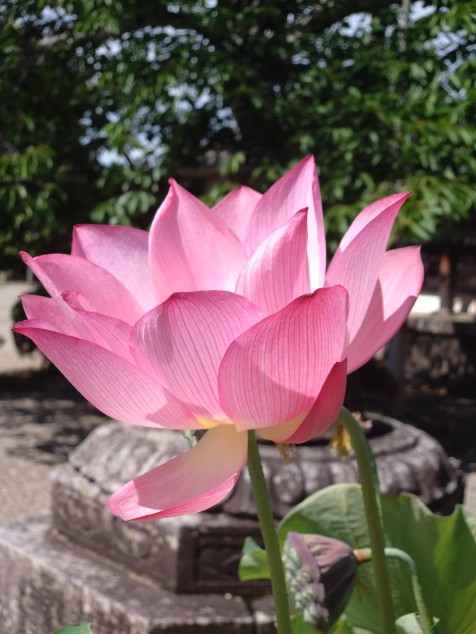
Pink lotus blooms, each petal catching the light like silk. (Saidaiji)

Each seed nestled in the pod holds the promise of tomorrow. The flower fades, but life prepares to begin again. (Saidaiji)

A ballpoint pen drawing of Aizen Myō-ō — fierce, focused, and compassionate.
Known as a “Cupid of Love,” this fiery guardian turns passion into a force of protection and balance. (Saidaiji)
🌸 When to Visit
Early July to early August is peak lotus season in most regions of Japan.
Early mornings offer the best light and open blooms — lotus flowers begin to close by midday.
Each bloom typically opens in the morning and closes in the afternoon for about three days.
After that, the petals fall away, revealing the green seed pod at the center,
which gradually darkens to brown or black as the seeds mature.
It’s a brief, beautiful cycle — and one reason why visiting in the early hours feels so precious.
🧭 Follow the Lotus: Where to Go & What to Know
📖 Further Reading & Resources
Suizenji Park (Kumamoto)
👉 https://www.kumamoto-guide.jp
Lotus Flower Symbolism in Buddhism
Explore the deeper meanings of the lotus as a symbol of purity, awakening, and spiritual growth.
👉 Lion’s Roar – Lotus: A Symbol of Enlightenment
Lotus Viewing Spots in Japan (Japanese)
Find the best summer lotus viewing locations.
👉 奈良県ビジターズビューロー – 生蓮寺 (Shōrenji) 奈良・佐紀のお寺さんぽ帖+2奈良観光モデルコース+2ヤギの京都観光案内/KYOTO GOAT BLOG+2奈良市観光協会+2奈良市観光協会+2ヤギの京都観光案内/KYOTO GOAT BLOG+2奈良県観光[公式サイト] あをによし なら旅ネット+1Gojo-City Tourist Association+1
👉 Visit Nara (Official) – Saidaiji Temple 奈良市観光協会+3奈良観光モデルコース+3トリップアドバイザー+3
🕊 Kaha’s Note
Some flowers are more than just beautiful.
They’re teachers, quiet companions, and living metaphors.
For me, lotus blossoms in Japan have become exactly that.
From the ancient seeds of the Oga Lotus, to a blue lotus blooming in a forgotten corner, to the gentle eyes of a Jizō and the fierce love of Aizen Myō-ō — each encounter offered more than beauty. It offered insight, stillness, and connection.
Following lotus flowers has become a personal ritual.
Not just to see where they bloom,
but to see what they awaken.
If you’ve ever felt something shift while looking at a flower,
you already know what I mean.🌙Now Available
👉 Divine Thread #1│Benzaiten:The Hidden Water Face of Saraswati
👉 Soulful Shares > Spirit Snippets #2: Katakamuna: Ancient sounds, New Steps
🟩 Next Topics
👉Empress Jingu’s Sacred Rock(Working title)
👉Divine Thread│Iwanaga-hime:Powerful Rock Goddess who brings stability and power(Working Title)
🟨 Inspiration Snapshots
Glimpses of wonder from everyday Japan. Updated weekly.
🌈 Explore More
Want to wander further along Earth Whispers’s paths of seasons and spirit?
Browse the Rainbow Map, where every color uncovers a gentle story waiting to be embraced.


コメント