

🍃Lead-in
In Japan, spring does not arrive all at once.
It begins quietly — often while the air still carries a trace of winter.
And sometimes, its first whisper comes not from plum blossoms, but from something even earlier.

Wintersweet in my mother’s backyard — the earliest light of the season.
In my mother’s backyard, the wintersweet had already begun to bloom.
Small yellow petals, gently lit against bare branches, did not announce the season — they simply glowed.

Wintersweet beginning to open — the first light of the season.
Soon after, in the front yard and along the familiar street nearby, I began noticing the plum trees.
Some branches were still tightly gathered — buds clustered close together, as if holding their breath before opening.
They felt full of quiet energy, patient and composed.

Plum buds gathered close, holding their quiet strength.
Then, slowly, a few blossoms began to unfold.
Round petals, soft in color yet firm in presence.
Plum blossoms do not overwhelm the landscape.
They appear with restraint — and with strength.
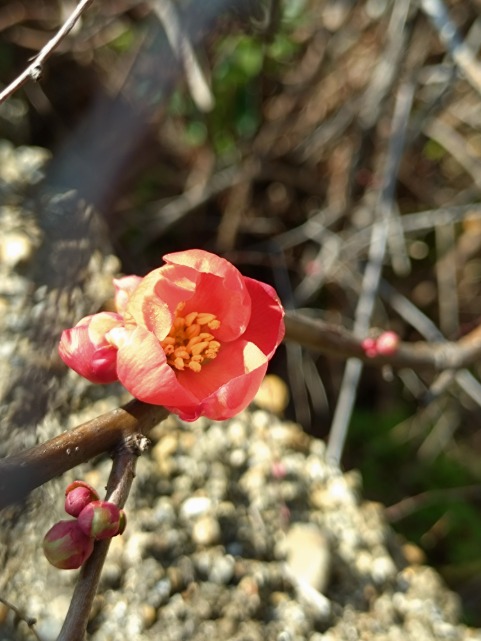
Blossoms beginning to open, quietly and without hurry.
Last spring in Kyoto, I stood beneath weeping plum branches glowing in backlight.
It feels recent — and yet, another year has gently passed.
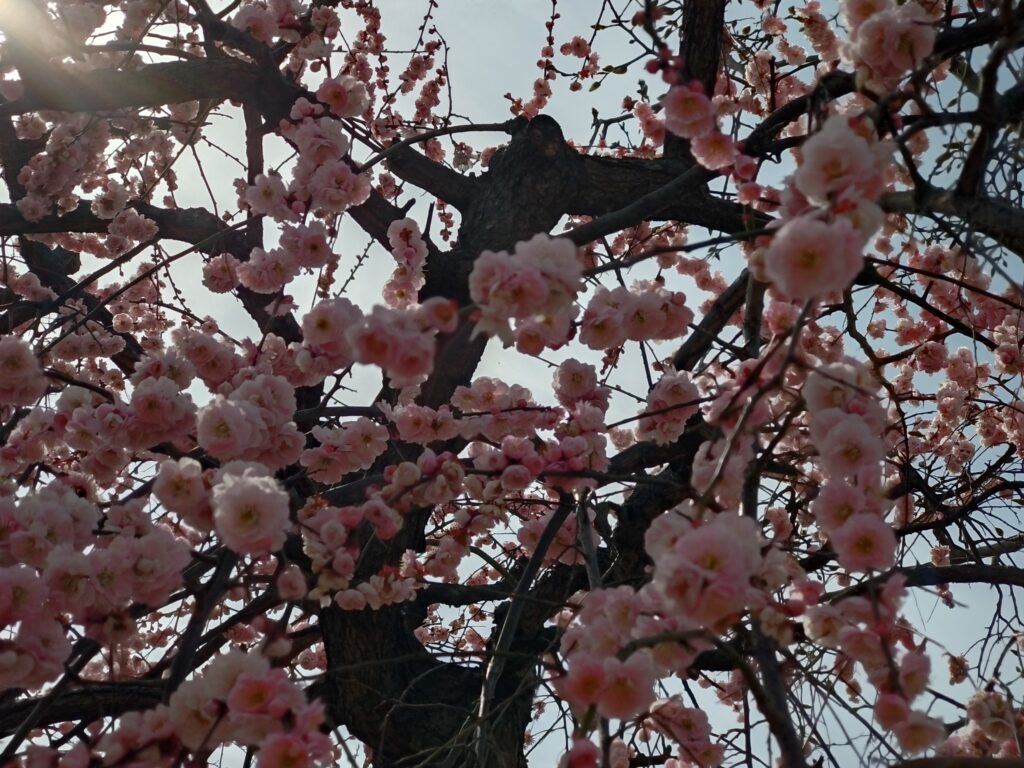
In Japan, plum blossoms have long been seen as symbols of endurance and renewal.
They bloom while the cold still lingers, reminding us that beauty does not wait for perfect conditions.
Spring rarely announces itself.
It begins with a whisper.
🌺 Colors and Forms — White, Crimson, and Layered Petals
Traditionally, plum blossoms appear most commonly in two colors — white and crimson.
White plum (shira-ume) carries a quiet clarity.
Its simplicity feels clean and serene.
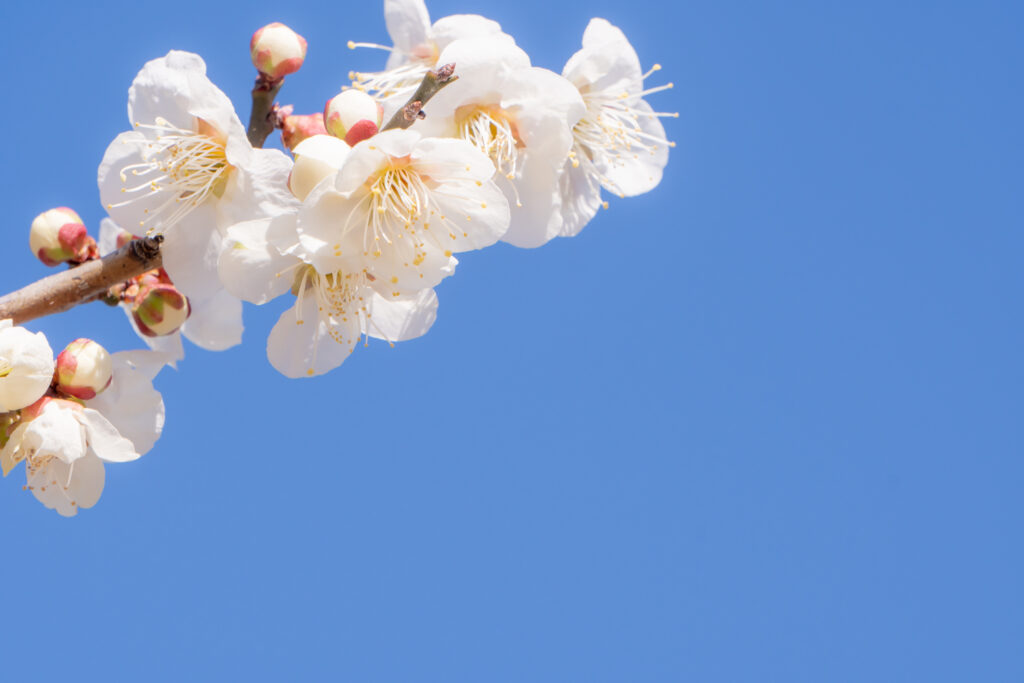
White plum blossoms in soft light.
Red plum (kōbai), on the other hand, glows vividly beneath the clear blue sky — a quiet pulse of life against the cool air.
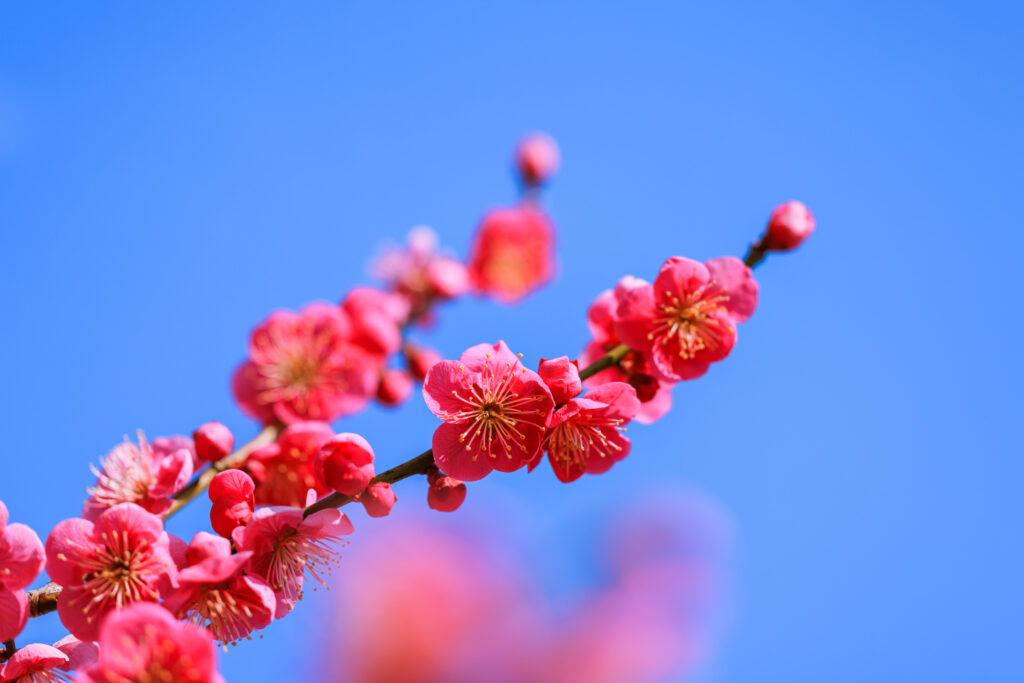
Crimson plum blossoms beneath a clear sky.
In recent years, cultivated varieties with softly layered petals — known as yae, or double blossoms — have also become beloved in gardens.
With their layered petals, they feel more elaborate — almost celebratory in spirit.
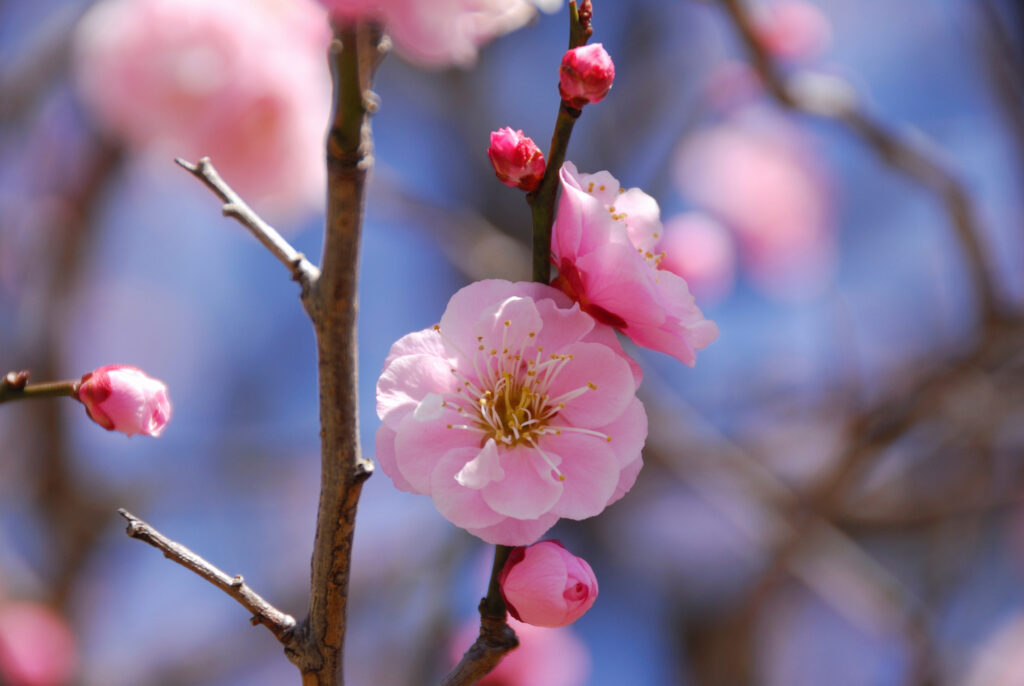
Soft pink plum blossoms with layered petals.
Yet beyond their colors and forms, plum blossoms share something deeper.
⭐Plum Beyond the Blossom
In my mother’s garden, the plum trees are grown simply for their blossoms — admired each year for their quiet beauty.
They are not cultivated for fruit, but for the way they soften the still-cool air of early spring.
Yet not all plum trees are only for viewing.
Some varieties are carefully grown for their fruit.
After the petals fall, small green plums begin to form — firm and bright against the leaves of late spring.
By early summer, they are harvested and transformed into pickled plums, syrups, and seasonal preserves.
Long after the blossoms have faded, the presence of plum continues in kitchens and on family tables.
In this way, plum bridges seasons.
From delicate petals in the cold air
to tart fruit preserved for warmer days,
it remains quietly woven into everyday life.
🌼 Fragrance and Memory
Plum blossoms are often remembered not only for their petals, but for their scent.
A well-known poem by Sugawara no Michizane, a Heian-period scholar and poet, reads:
When the east wind blows,
send your fragrance, plum blossom.
Even if your master is gone,
do not forget the spring.
In this verse, it is the fragrance that carries longing and memory.
The blossom is asked to send its scent on the spring wind — as if the perfume itself could travel across distance and time.
Sugawara no Michizane is enshrined at Tenmangū shrines throughout Japan, where plum trees are often planted in his honor.
(I wrote more about him in Japan:Life & Spirit #12│A Day in Kitano: Kobe’s Cultural Crossroads. )
Even today, the scent of plum is associated with early spring.
Traditional incense inspired by plum — known as baika — evokes that same refined and gentle presence.
Unlike flowers that fill an entire field with fragrance, plum invites you closer.
Its scent lingers softly near the branches, noticeable only when you pause.
Perhaps that is part of its quiet charm.
🎍Meaning in Tradition
Plum blossoms have long carried meanings beyond their delicate appearance.
Long before cherry blossoms became the symbol of spring, plum was celebrated in poetry and art.
It was admired not only for its beauty, but for the courage it seemed to embody — blooming while winter still lingered.
In traditional symbolism, plum forms part of shō-chiku-bai — pine, bamboo, and plum.
Pine endures the harshness of winter.
Bamboo bends without breaking.
And plum blooms in the cold.
Together, they represent resilience, flexibility, and renewal —
different expressions of quiet strength.
Perhaps this is why plum blossoms feel so familiar.
They do not wait for perfect warmth.
They open when it is their time.
🕊️Kaha’s Note
Soon after plum blossoms fade, peach flowers will open.
Cherry blossoms will follow.
Fields and hills will grow brighter with color.
Spring will arrive in fullness.
But plum is the beginning.
It blooms before certainty.
It opens before warmth has fully settled.
It carries fragrance even in the cold.
Perhaps that is why it feels so close to us.
We rarely begin when conditions are perfect.
We begin when something inside tells us it is time.
Soft, fragrant, and quietly resilient,
plum blossoms remind us that renewal does not need applause.
It begins gently.
It begins early.
It begins with a whisper.
🌈 Explore More
If you’d like to explore more quiet seasonal stories and visuals, you’re always welcome back at our home.

コメント