
🌿Lead-in
When people hear the word charcoal, many imagine outdoor barbecues or campfires. In Japan, however, charcoal has long been part of everyday life, valued not only as a source of heat but also for its many practical uses around the home.
From purifying drinking water and caring for plants to the refined world of the Japanese tea ceremony, charcoal continues to play a quiet yet meaningful role in Japanese culture. Today, while modern lifestyles have changed, many of these traditions are still appreciated for their natural beauty, sustainability, and craftsmanship.
Let’s take a closer look at three of Japan’s most well-known traditional charcoals—and discover how they continue to enrich everyday life today.
💧 Charcoal in Everyday Japanese Life
For centuries, charcoal has been part of everyday life in Japan. While it was once an essential source of fuel, it continues to be appreciated today for its many practical uses around the home.
Among its many uses, water purification and natural deodorizing are two of the easiest to incorporate into daily life. Charcoal specifically prepared for water purification can be placed in a jug or bottle to help improve the taste of drinking water.

Charcoal used for water purification
Charcoal is also widely used as a natural deodorizer. Small pieces are often placed inside paper tea filters—the same disposable filters used for brewing loose-leaf tea—or in small fabric sachets before being placed in closets, shoe cabinets, or refrigerators. Larger pieces may also be displayed in a bowl, basket, or tray, allowing them to become part of a simple and natural interior.
One of the advantages of charcoal is that it can be used repeatedly. After use, it can simply be rinsed with water and dried in the sun before being used again.
One thing I learned from the shop owner was that charcoal doesn’t have to be thrown away when it is no longer used indoors. Instead, it can be added to flower pots or garden soil, where it helps improve soil structure, drainage, and air circulation around the roots.
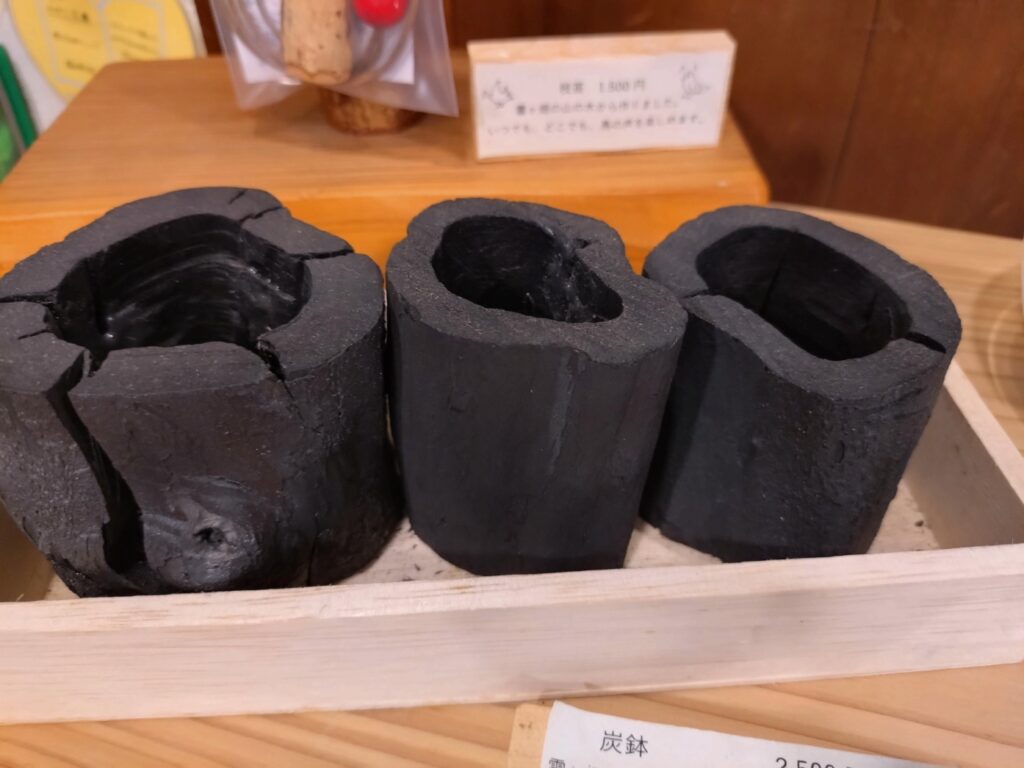
Some charcoal products are even crafted as planters, showing how natural materials can be both practical and beautiful in everyday life.
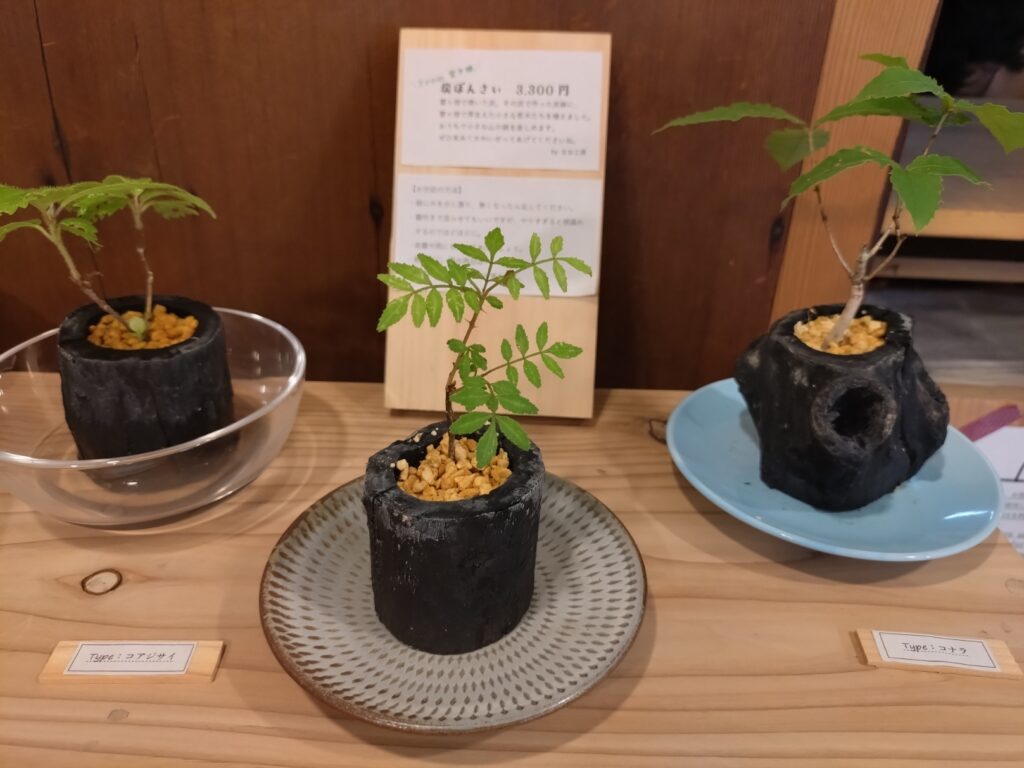
Plants sold in handcrafted charcoal pots, combining natural materials with simple Japanese design.
🌳Different Types of Japanese Charcoal
Over the centuries, Japanese artisans have developed different types of charcoal to suit different needs. Some are traditionally used in the tea ceremony, while others are commonly used for cooking, water purification, deodorizing, or gardening.
🏵️Kiku-zumi (Chrysanthemum Charcoal)
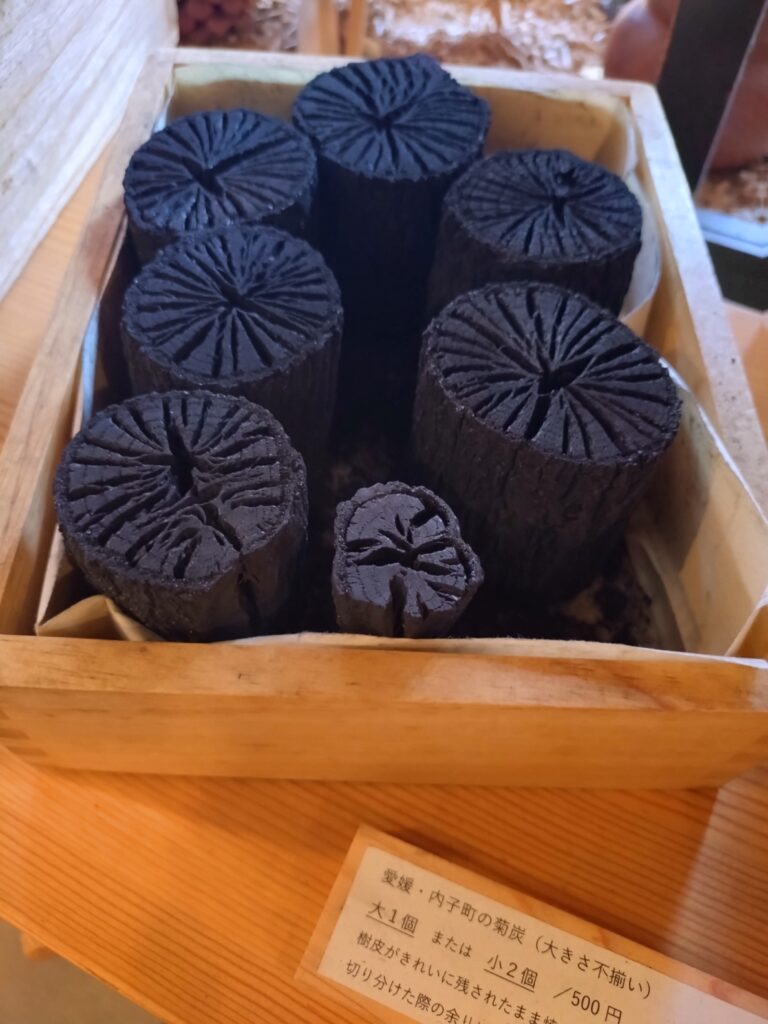
Kiku-zumi (Chrysanthemum Charcoal) displayed in a small shop in Kyoto, showcasing both craftsmanship and beauty.
Kiku-zumi is a premium black charcoal made from kunugi oak. It is named after the beautiful chrysanthemum-like pattern that appears on its cut surface.
For centuries, it has been treasured in the Japanese tea ceremony, where its clean burn, minimal smoke, and elegant white ash have been highly valued. Beyond its practical use, its chrysanthemum-like pattern has also made it a beautiful decorative piece for modern interiors.
🔥 Binchōtan (White Charcoal)
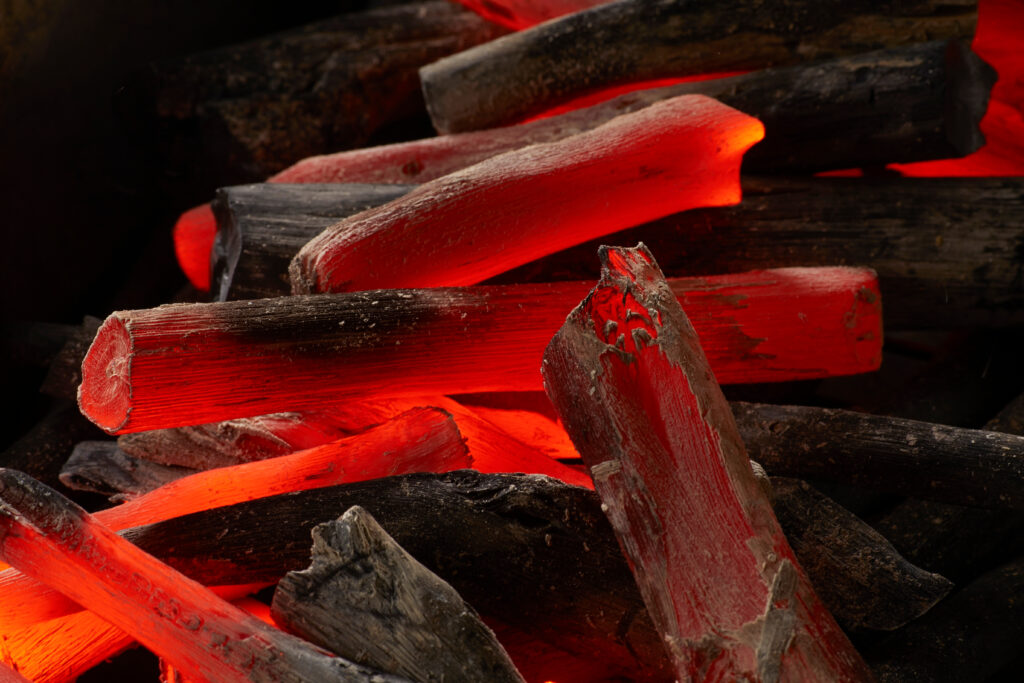
Glowing Kishu Binchōtan, one of Japan’s most famous traditional white charcoals.
Binchōtan is a premium white charcoal traditionally made from hard woods such as ubame oak. It is fired at temperatures exceeding 1,000°C (1,832°F), creating an exceptionally hard charcoal known for its long-lasting heat and clean burn.
Its steady heat and far-infrared properties make it especially valued for Japanese grilling, helping food cook evenly while preserving its natural flavor. Specially prepared Binchōtan products are also available for water purification, natural deodorizing, humidity control, and other everyday household uses.
Its outstanding quality, durability, and versatility have made Binchōtan one of Japan’s most highly regarded traditional charcoals.
🎋 Bamboo Charcoal
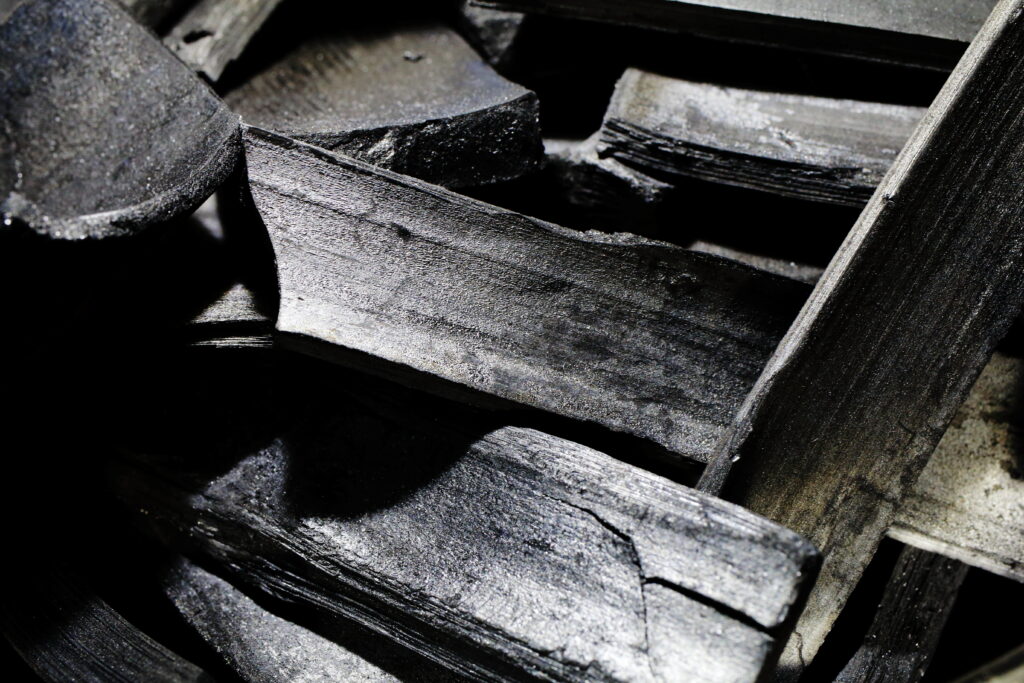
Close-up of bamboo charcoal, commonly sold in stick-shaped pieces.
Made from bamboo rather than wood, bamboo charcoal has countless tiny pores, giving it exceptional odor- and impurity-absorbing properties. This highly porous structure is what makes bamboo charcoal especially useful in everyday life.
It is commonly used for natural deodorizing, humidity control, water purification, and improving garden soil. Because of its excellent absorbent properties, bamboo charcoal is also used as an ingredient in a variety of personal care products, including soaps, facial masks, toothpaste, and even some toothbrushes.
Practical, sustainable, and remarkably versatile, bamboo charcoal has become a popular natural material in many aspects of everyday life in Japan.
💙 Kaha’s Note
Before writing this article, I had already been using charcoal at home to purify drinking water and as a natural deodorizer in my shoe cabinet. However, kiku-zumi was a completely new discovery for me.
Today, I use kiku-zumi as part of my home décor. I love that it is not only beautiful to look at but also serves as a natural deodorizer. During Japan’s hot and humid summers, fresh flowers don’t always last very long, so I now display kiku-zumi in the space where I would normally place a small flower arrangement.
I also noticed beautifully displayed charcoal while traveling in Ise City. In one traditional inn, charcoal was placed in the restroom almost like a decorative object, quietly adding both beauty and a practical purpose to the space. It reminded me once again how naturally Japanese craftsmanship blends function with aesthetics.
If you’re looking for a simple, natural way to freshen your home, perhaps charcoal is something worth discovering.
🌈 Explore More
If you are interested in Japanese culture, sacred places, nature, and spirituality, discover more stories from Rainbow Awakening.

コメント