
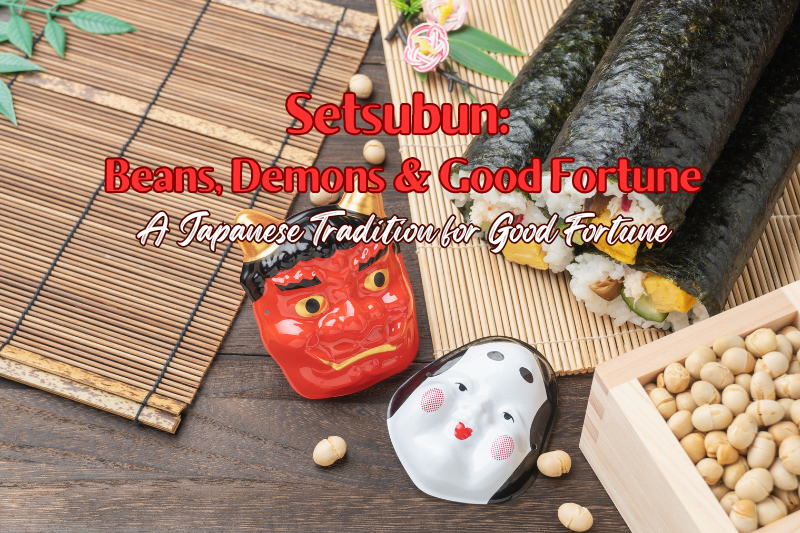
- 📝 Lead-in
- 🧧What Is Setsubun? A Seasonal Shift in Japan
- 🏺The Origins of Setsubun: History and Belief
- 👹The Mamemaki Ritual: A Tradition Passed Down Through Play
- 🧭Ehōmaki and the Lucky Direction — A Delicious Modern Tradition
- 🌿Driving Away Evil with Sardines and Holly — Other Setsubun Customs
- 🏮Where to Experience Setsubun in Japan (2026)
- 🌟Kaha’s Note
- 🌈 Explore More
📝 Lead-in
As winter lingers and icy winds sweep through Japanese towns, a quiet yet powerful tradition marks the subtle shift toward spring. Setsubun, held in early February, may still fall within the chill of winter, but spiritually, it signals a new beginning.
This centuries-old Japanese ritual is more than just throwing beans at imaginary demons — it’s a symbolic cleansing of misfortune and a warm invitation to good fortune. With ancient chants, costumed figures, and lucky foods, Setsubun offers a fascinating glimpse into how Japan honors seasonal change with intention and spirit.
Let’s explore how this tradition prepares the nation, not just for a new season, but for a renewed sense of balance and hope.
🧧What Is Setsubun? A Seasonal Shift in Japan
As the calendar turns from January to February, Japan prepares for one of its most quietly meaningful traditions: Setsubun, the “seasonal division” that signals the end of winter and the spiritual arrival of spring. While the air is still cold and the days short, Setsubun — observed around February 3rd, just before Risshun (the traditional first day of spring) — reminds people that change is near.
At its core, Setsubun is not about celebrating spring itself, but about preparing to welcome it. It serves as a moment of spiritual reset, when families symbolically cleanse their homes of bad luck and make room for good fortune in the new season. The idea is deeply tied to Japan’s traditional lunar calendar, where seasonal changes were not just physical but spiritual thresholds.
Although today’s Japan is modern and fast-paced, many households still pause for this annual tradition. From scattering roasted soybeans to displaying seasonal decorations, Setsubun blends age-old beliefs with the rhythm of contemporary life. It’s not a national holiday, yet its presence is felt in homes, temples, supermarkets — even in shop window displays featuring oni masks, sushi rolls, and wooden boxes of beans.
In a culture that values harmony with nature and cyclical time, Setsubun remains a gentle yet powerful way to say: “Out with the old, in with the new.”
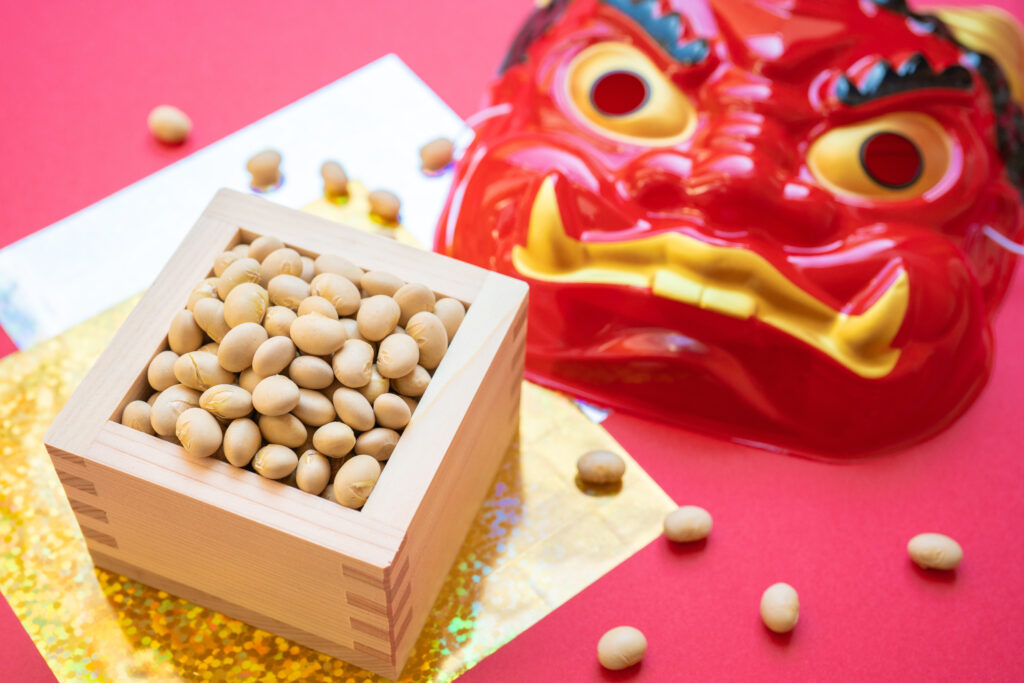
A traditional set used for Setsubun: roasted soybeans in a wooden masu box and an oni mask — symbols of cleansing and protection.
🏺The Origins of Setsubun: History and Belief
Though Setsubun is a familiar event in modern Japanese life, its origins stretch back over a thousand years. The practice was first introduced from ancient China during the Nara and Heian periods (8th–12th centuries), as part of a set of seasonal rites designed to purify and protect the imperial court. These rituals, known as tsuina (追儺), were held at the end of each season to drive out evil spirits believed to cause misfortune, illness, or natural disaster.
Originally a courtly practice, tsuina was a formal, ceremonial exorcism that involved chanting, costumes, and driving out invisible demons using bows, arrows, and symbolic gestures. Over time, these elaborate state rituals gradually filtered down to the common people, evolving into more accessible household customs. The name Setsubun, meaning “seasonal division,” referred to the last day before each of the four traditional seasons: spring (Risshun), summer (Rikka), autumn (Risshū), and winter (Rittō). However, it was the transition to spring — when the new agricultural year began — that became the most spiritually significant.
By the Edo period (1603–1868), the custom of throwing roasted soybeans (mame-maki) had become widespread, especially among common households. It was believed that beans had the power to purify and protect, both through their physical form (tough, nourishing, round) and through a linguistic pun: the Japanese word mame (豆) sounds like mame (魔滅) meaning “demon destruction.”
This spiritual symbolism lives on today, even if modern Setsubun celebrations are often more lighthearted. The red-faced oni — sometimes scary, sometimes cartoonish — represents more than just an imaginary monster. In ancient belief systems, it symbolized the invisible forces of chaos, illness, and imbalance that people sought to drive away at seasonal turning points.
What makes Setsubun fascinating is how these ancient ideas remain embedded in the culture. Even without understanding all the historical details, families continue to chant “Oni wa soto! Fuku wa uchi!” (Demons out! Fortune in!) as they toss beans toward the door — participating in a ritual that has endured, adapted, and remained meaningful for generations.
👹The Mamemaki Ritual: A Tradition Passed Down Through Play
In today’s Japan, the tradition of mamemaki, or bean-throwing, continues as both a cultural practice and a joyful seasonal ritual — especially among families with children. While its roots lie in spiritual purification, the way it’s carried out in homes and schools today blends meaning with lighthearted fun.
In many households, it’s common for a parent to wear a red or blue oni mask — a character often depicted with horns and a fearsome expression — and playfully act the part of the “demon.” Children, armed with handfuls of roasted soybeans, shout the familiar chant and gleefully toss beans at the intruder.
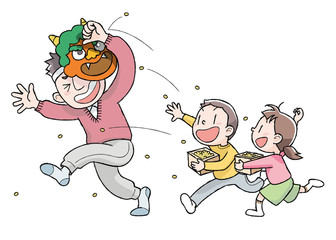
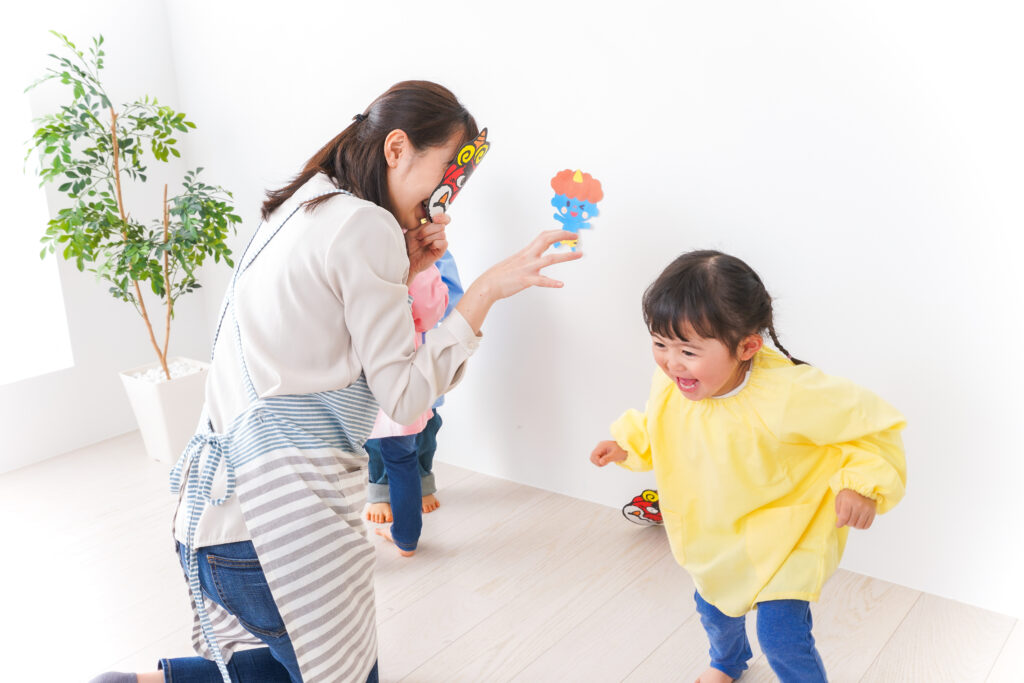
At home, a parent often plays the role of the ‘oni’ while children gleefully throw beans — a playful twist on an ancient tradition.
Preschools and kindergartens across the country hold annual Setsubun events where teachers become the oni. These scenes, full of laughter (and sometimes a few scared tears), help children connect with tradition in a hands-on way. More than a simple game, it’s a way of passing down cultural knowledge through embodied experience.
After the beans have been thrown — whether at a costumed oni or simply out the front door — there’s one final step in the ritual: eating them. Traditionally, each person in the household eats one roasted soybean for every year of their age, plus one extra for good luck in the coming year.
In many homes, especially when the beans are scattered indoors, they are picked up and shared among family members. It’s a simple, quiet act that brings the ritual full circle — from cleansing to nourishment, from casting out to welcoming in.
Each bean thrown represents a small act of cleansing. While children may not grasp the deeper symbolism, they intuitively learn the rhythm of Japan’s seasonal life — the idea that the year must begin with a symbolic fresh start.
🌄A Rare Welcome: Tenkawa’s “Oni no Yado” Tradition
What’s especially interesting is how the role of the oni varies across Japan. In most places, they are chased away as a form of symbolic exorcism. But in Tenkawa village, located in Nara’s sacred mountains, a very different custom unfolds. There, during Setsubun, the community welcomes the oni into their homes with the chant: “Oni wa uchi, fuku mo uchi” — meaning “Demons in, good fortune in.”
In a rare ceremony known as Oni no Yado (“The Demons’ Lodging”), villagers prepare a place for the oni to rest and offer them hospitality for the night. Rather than seeing these beings as evil, they are treated as spiritual protectors or ancestral figures. This practice reflects a broader Japanese belief that even seemingly negative forces have a role to play in balance and renewal.
Whether through playful bean battles or quiet spiritual gestures, mamemaki remains a vivid expression of seasonal transition — alive in homes, classrooms, and mountain shrines alike.
🧭Ehōmaki and the Lucky Direction — A Delicious Modern Tradition
In addition to bean‑throwing, another custom that has become widely associated with Setsubun in modern Japan is eating a special sushi roll called ehōmaki. Unlike typical sushi enjoyed year-round, ehōmaki is eaten specifically on Setsubun as part of a symbolic gesture to invite good fortune.
These uncut, thick sushi rolls are filled with a variety of ingredients — such as sweet egg omelet, cucumber, shiitake mushrooms, kanpyō (dried gourd), and seafood — and are eaten whole, in silence, while facing a specific direction known as the ehō.
So what exactly is this “lucky direction”?
Each year, the ehō is determined by ancient fortune-telling traditions and marks the direction where Toshitokujin (歳徳神) — the deity of prosperity and good fortune — is believed to reside for the year.
📍 In 2026, the lucky direction is south-southeast (南南東)➡️.
Facing this direction while eating the roll, without speaking, is thought to bring success and happiness in the coming year.
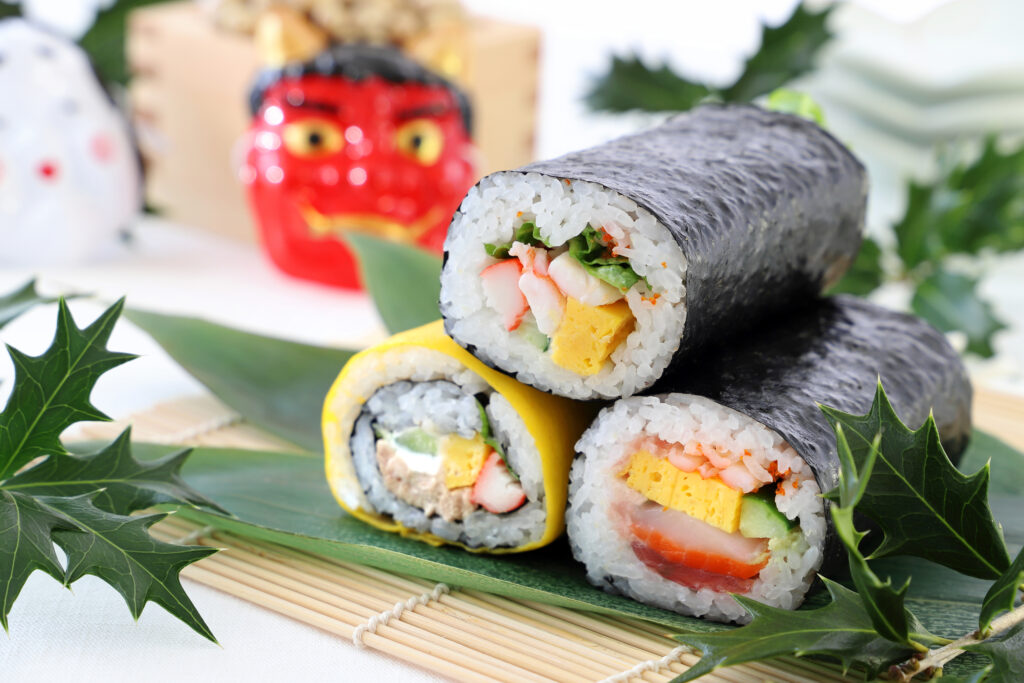
Ehōmaki — eaten in silence while facing the year’s lucky direction — a modern but meaningful ritual.
Although this practice may sound ancient, it is in fact a relatively modern tradition. It began in the Kansai region and spread nationally in recent decades, thanks in part to marketing campaigns by sushi shops and convenience stores. Even so, it has become a beloved part of Setsubun across Japan.
Many families now buy ehōmaki from local supermarkets or make them at home, customizing the fillings based on taste or tradition. Some rolls are extravagant, filled with premium ingredients, while others keep to classic recipes. What’s important isn’t the exact contents, but the quiet moment of reflection and intention while eating.
The combination of lively mamemaki and quiet ehōmaki in the evening offers a beautiful rhythm — a day of driving out bad energy and carefully inviting in the good.
🌿Driving Away Evil with Sardines and Holly — Other Setsubun Customs
While bean‑throwing and sushi rolls are the most well‑known parts of Setsubun, other traditional customs offer a deeper glimpse into Japan’s seasonal spirituality.
One such tradition is the display of grilled sardine heads (iwashi) on branches of holly (hiiragi) — a practice known as hiiragi iwashi (柊鰯). This talisman is typically placed at the entrance of homes around February 3rd to serve as a powerful ward against evil.
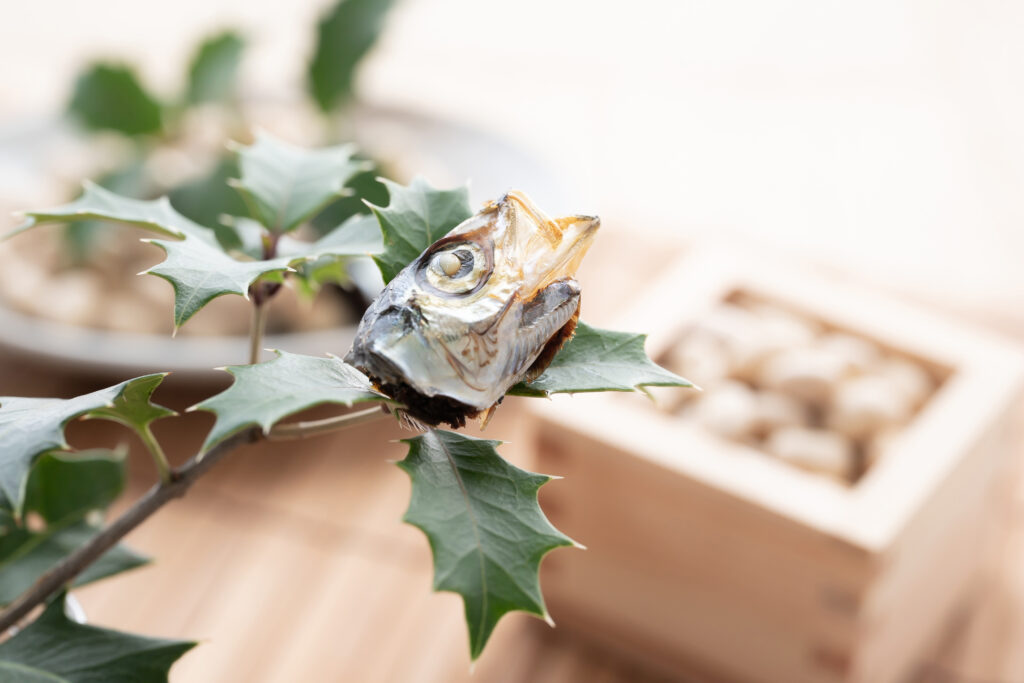
Hiiragi iwashi — grilled sardine heads on holly branches — placed by the entrance to ward off evil and bring good health.
The reason is that Demons (oni) are said to hate two things: sharp holly leaves and the strong, smoky smell of grilled sardines. By combining the two, people believed they could keep malevolent spirits from entering the home.
The sardine heads are grilled, then pierced onto a fresh holly branch and displayed by the front door. This act is both symbolic and sensory: the smell, the visual, and even the prickly texture are meant to repel bad energy and invite health and safety for the year ahead.
This practice is also known as yaikagashi — literally “grilled smell guard” — and has long been associated with wishes for good health and protection from misfortune. It is more commonly observed in western Japan, particularly in rural or tradition-conscious areas, though it is still practiced in modern adaptations elsewhere.
Some people now use symbolic versions — paper sardines or pre-made talismans sold at supermarkets — but the core meaning remains: protecting the household as the seasons shift.
Together with bean‑throwing and ehōmaki, hiiragi iwashi adds another layer to Setsubun’s purpose — not just to cast out misfortune, but to actively guard and bless the space we live in.
🏮Where to Experience Setsubun in Japan (2026)
Setsubun is not just a cozy family tradition — it is also celebrated with festive public rituals at many shrines and temples across Japan. On February 3, 2026, visitors can witness bean-throwing (mamemaki), prayers for good fortune, and even traditional dances or lantern festivals.
Here are some authentic and popular locations where you can experience Setsubun firsthand:
⭐ Sensō-ji Temple — Tokyo
One of the oldest and most visited temples in Tokyo, Sensō-ji hosts large-scale mamemaki ceremonies. Performers dressed as the “Seven Lucky Gods” throw roasted soybeans from the temple stage, chanting blessings for health and fortune.
📍 Date: February 3, 2026 (check closer to the date for exact schedule)
📷 Tip: Arrive early — it gets very crowded!
🔗 Sensō-ji event info
🏯 Tōdai-ji Temple — Nara
In this ancient temple, monks hold Setsubun ceremonies in the Nigatsu-dō Hall. The hoshiyu star prayer ritual at night is especially moving, as lanterns are lit to drive away misfortune and invite good spirits.
📍 Date: February 3, 2026
🌌 Highlight: Quiet, spiritual atmosphere
🔗 Tōdai-ji event info
⛩️ Kasuga Taisha — Nara
At Kasuga Grand Shrine, over 3,000 stone and hanging lanterns are lit during the Mantōrō Festival in the evening. This rare event only happens twice a year and is deeply symbolic.
📍 Date: February 3, 2026
✨ Atmosphere: Peaceful and sacred
🔗 Mantōrō event
🗼 Tokyo Tower — Setsubun with a View
A modern twist: Tokyo Tower hosts an annual Setsubun event, where visitors can join a mamemaki at the observation deck. You’ll get both tradition and city views!
📍 Date: February 3, 2026
🎫 Note: Check event times in advance
🔗 Tokyo Tower event
🛕 Other Notable Events
These locations are known for lively Setsubun celebrations every year:
- Ikegami Honmon-ji (Tokyo): Classic temple festival with bean-throwing
- Zojo-ji Temple (Tokyo): Located near Tokyo Tower, offers a traditional blessing event
- Naritasan Shinshoji Temple (Chiba): Features sumo wrestlers and celebrities throwing beans
- Kushida Shrine (Fukuoka): Known for local participation and lucky bean packets
- Heian Shrine & Yasaka Shrine (Kyoto): Elegant festivals with geisha dances and mamemaki
- Chichibu’s “Bean-Throwing Train”: A fun regional variation on a moving train! 🚃
✅ Visiting Tips
- 🗓️ Date: Most events take place on February 3, but check for local variations (some start Feb 2)
- 🕙 Timing: Mamemaki usually happens between 10 AM and 3 PM
- 🆓 Admission: Free or low-cost; some temples offer lucky beans (fukumame) or charms
- 🧭 Plan ahead: Visit temple websites or tourism boards for up-to-date details
This is a wonderful chance to see Japan’s seasonal culture in action — whether you’re at a grand temple like Sensō-ji or enjoying lantern light at Kasuga Taisha, Setsubun offers a memorable blend of ritual, fun, and reflection.
🌟Kaha’s Note
As the Setsubun season approaches each year, I begin to notice subtle changes around town — storefronts decorated with small oni masks, colorful signs advertising fukumame (lucky beans), and flyers promoting early reservations for ehōmaki. These quiet signals always make me pause and think,
“Ah, Setsubun is almost here.”
During a recent trip to Nara, I came across a small display outside a local shop: a red demon mask, a small box of roasted beans, and a simple hand‑written sign welcoming the season. It was such an ordinary moment — but it brought back so many memories of the rituals I grew up with, and reminded me how seasonal traditions still live on in everyday life.
As I walked away, I thought:
“Maybe this year, I’ll share a little bit of Setsubun’s story with others — and quietly enjoy my own ehōmaki, facing the lucky direction.”
I hope this article has brought you a step closer to understanding the spirit of Setsubun.
May it bring you joy, luck, and maybe even a new way to celebrate the seasons — wherever you are in the world.
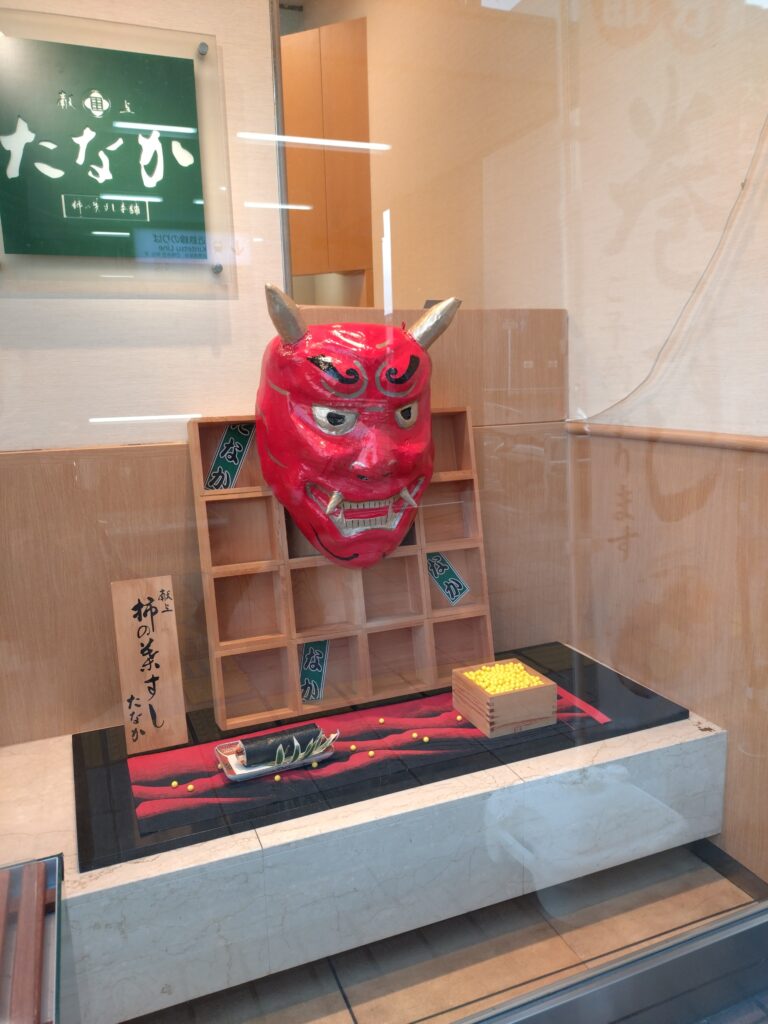
A quiet moment in Nara — this storefront display, with its bold oni mask and lucky beans, brought back the feeling that Setsubun is just around the corner.
🌈 Explore More
Would you like to explore more gentle stories of Japan’s spiritual traditions, seasonal reflections, and everyday moments of beauty?
🔗 Return HOME to Rainbow Awakening
Discover quiet stories from Japan — reflections on nature, healing, cultural traditions, and soulful living.


コメント